Trump’s Midterm Rout Didn’t End the Threat From J. D. Vance
President Trump’s midterm debacle has weakened the entire MAGA camp. But J. D. Vance, a more disciplined and more ideological far-right figure, is already positioning himself to inherit the movement in 2028.
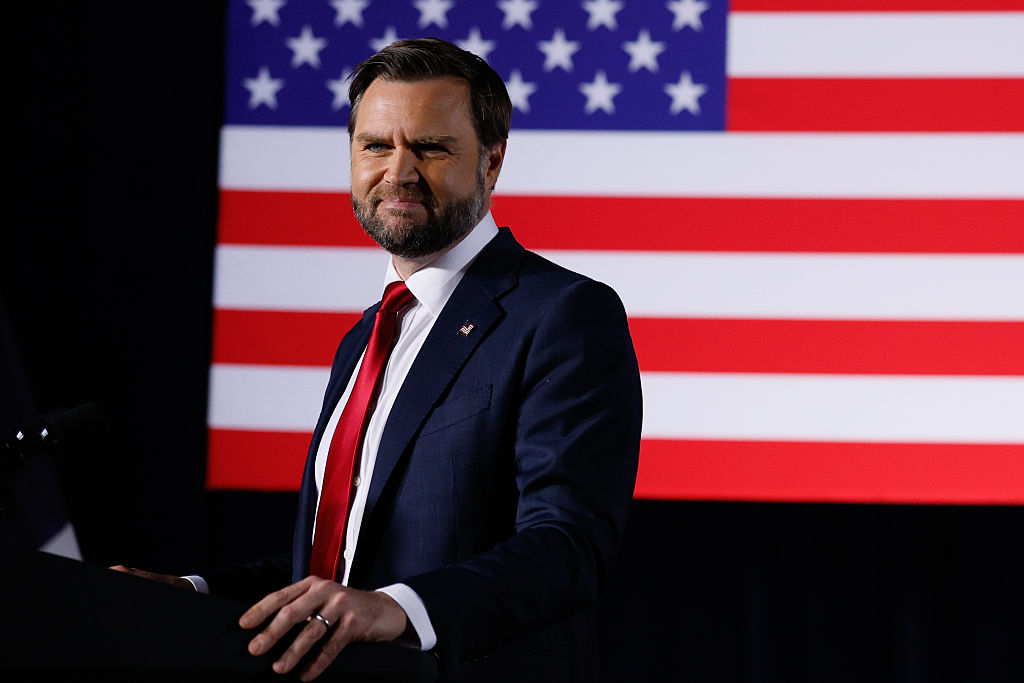
Unlike Donald Trump, J. D. Vance has intellectual pretensions and his own wing of the MAGA movement. After the midterms, Vance is plotting how to put both of them to use. (Evan Vucci / Pool / Getty Images)
Donald Trump may have foreseen another reversal of his political fortunes when he chose J. D. Vance as his running mate. For who would want to remove Trump if the result were Vance at the helm of US executive? After all, Trump is the ultimate opportunist, a man who can smile and shake hands with Zohran Mamdani while hurling outrageous anti-socialist and Islamophobic slanders at him; a man who can pose as a dove while acting as a hawk, and who is so obsessed with his own ego that he is ultimately his own most effective enemy — as he proved brilliantly in bringing about the Republicans’ midterms debacle. Vance, on the other hand, is a consummate far-right ideologist. True, he does not lack opportunism either. As Compact magazine’s editor Matthew Schmitz recently reminded readers in a New York Times op-ed: “He made his way from the Rust Belt to Yale Law, and from saying Mr. Trump might be ‘America’s Hitler’ to serving as his vice president.”
Yet this is closer to the cold-blooded careerism so common on the far right than to Trump’s crude, crowd-pleasing demagogy. Moreover, as The Washington Post’s George F. Will, a traditional conservative and longtime Trump critic, put it: “Trump’s deepening weirdness (e.g., repeatedly proclaiming his admiration for various men’s and women’s body parts) suggests he is residing in the suburbs of dotage. Vance has no such excuse.” Unlike Trump, Vance harbors intellectual pretensions and has been cultivating his own wing of the MAGA movement with close, personal ties to other far-right ideologues such as Steve Bannon and Tucker Carlson. In that sense, he would be an even more dangerous president than Trump. However, the resounding rebuke Trump suffered in the recent elections has also damaged his entire camp, including the ideological far right that Vance represents. Schmitz concludes: “Perhaps he can complete another unlikely journey, to the presidency. But he now seems farther from that office than he did just one week ago.” That is fair enough, but no one should assume that the vice president too has become a lame duck.
Vance’s Post-Mortem
Vance was visibly stunned by the scale of the electorate’s repudiation of Trump — which is also a repudiation of the MAGA craze by a clear majority of voters. Like a rat fleeing a sinking ship, the vice president hurried to disclaim responsibility for the debacle and distance himself from the president. His reaction is revealing, for it indicates what his ideological campaign will center on in the next two years, as he plainly seeks to become the next MAGA presidential candidate. On the afternoon of November 4, once the Republican rout was largely confirmed, he posted his break with Trump on X. Citing an unnamed pollster, “one of the smartest people I know in politics,” he listed what he described as the four main issues behind the rout — and, by implication, his four priorities for the next two years: “1) End the war; 2) Focus on cost of living/inflation; 3) Put America First; 4) Change our relationship to Israel.”
Let us consider these four points and what they leave unsaid. Trump’s war on Iran has obviously not gone down well with the US public. Not only did it flatly contradict the pacifist-sounding promises of Trump during his presidential campaigns — promises that, to be sure, reflected no real love of peace, only an appeal to the old far-right isolationist legacy long embodied by Pat Buchanan. More importantly, while Trump assumed that the US public would barely feel the consequences of the war, it came home to roost in the form of an inflationary surge fueled by gas prices. Yet the war accounts for only part of this surge, which — under the name of “affordability” — loomed far larger than war itself in the campaign. Hence, Vance’s second point on the cost of living. But he keeps mum about the squeeze’s root causes, above all Trump’s outrageously pro-rich budget and his ultranationalistic, wildly erratic tariffs. Vance would not say a word about these for the very good reason that he fully endorsed them, unlike the war on Iran, from which he tried, albeit timidly, to distance himself.
The Same Old Scapegoats
Then comes the old far-right refrain of “America First,” dear to Trump and the MAGA crowd. This hollow slogan serves only to stoke the basest ultranationalist sentiments among mostly poor white social layers that tend to interpret their economic hardship in a highly skewed, xenophobic, often racist way. It is a slogan whose clearest translation is Immigration and Customs Enforcement (ICE). And one that obscures all the real problems that the US working class is facing, offering tariff fetishism as a universal panacea instead. For the section of the far right to which Vance belongs, and which he hopes to lead, this jingoism has typically gone hand in hand with antisemitism. It is their way of perverting the massive — and entirely legitimate — rise in popular antipathy toward Israel caused by the appalling genocidal war it has waged in Gaza with full US support, from Joe Biden to Trump: diverting it into a “blame it on Israel” stratagem. The aim is, of course, to deflect attention from the reality of US imperialism, including, in this case, the deeply corrupt interests of the Trump syndicate and its cronies, by resorting to the oldest of far-right scapegoating tricks.
As for Vance’s fourth point, his phrasing — “Change our relationship to Israel” — is deliberately vague, a far cry from the increasingly popular and unambiguous calls to end all US military support for Israel. The key issue is certainly not the $3.8 billion that Washington grants Israel every year under a memorandum of understanding concluded by the Obama administration. In a classic case of US taxpayers’ money being funneled to the US military-industrial complex, these funds were earmarked for Israeli purchases of US weaponry. The mercenary logic governing Trump’s foreign policy — which, by gutting the United States Agency for International Development, has inflicted severe damage on several countries of the Global South — had already led him to cut off the much larger US funding of Ukraine’s purchases of US military hardware, forcing Kyiv’s European backers to foot the bill themselves. Now Israel will have to pay for its deadly US imports on its own — hardly a big deal for the Zionist state. Trump presented the move as agreed upon with Israeli Prime Minister Benjamin Netanyahu, who confirmed it, even boasting of what he portrayed as a shift in Israel’s relationship with its US godfather from dependence into equal partnership.
Peter Thiel’s Godson
That said, the most glaring blind spot in Vance’s account of the rout is his total silence on one of the issues that decided the elections: Big Tech, AI, and data centers. “There’s no question about how voters feel about data centers after Election Day, with restrictive measures across 10 states going 43–1 at the ballot box. The margins weren’t close, with an average of 75% of people favoring restrictions,” wrote Maria Curi of Axios. “America turns on Donald Trump’s tech cheerleaders,” declared a Financial Times headline in the elections’ wake. Polls indicate that public resentment of what is perceived as a Big Tech mafia has become one of the main channels through which Americans register the immense social inequality of their society, far greater than in any other economically advanced country. On this, of course, Vance — the political godson of Peter Thiel, who, along with Elon Musk, is the farthest right of the Big Tech tycoons — would not utter a single word, even though some of his most populist MAGA allies, such as Steve Bannon, have joined the anti–Big Tech chorus, which fits neatly with the anti-elitist rhetoric characteristic of their brand of far-right ideology.
Vance is being built up as the standard-bearer of MAGA continuity. While many expected a reshuffle that would oust the ultramasculinist, hyperarrogant “Secretary of War” Pete Hegseth, one of the administration’s most unpopular liabilities, Trump instead promoted his éminence grise, Stephen Miller — a sinister far-right ideologue, rabidly antimigrant (Mr ICE par excellence) and Islamophobic — to the key post of White House chief of staff. Vance immediately hailed the promotion on X: “Stephen Miller is an amazing patriot and will do great things.” Backed by Thiel, Donald Trump Jr, and others of their ilk, Vance is already poising himself to lead the MAGA current into the 2028 presidential election. It is vital not to underestimate the threat he represents, and to make the fight against this chief embodiment of the US far right as one of the priorities of the coming period.
Vance might have once been thought of as “Trump lite.” But it’s abundantly clear now that, if he somehow made it to the White House, he could possibly be even worse that the godfather of MAGA himself.