Providence Built a Winning Movement to Divest From Israel
Providence, Rhode Island, is now the largest US city to divest from Israel and the first to enact a divestment law through popular vote. An organizer on the campaign explains how they did it alongside campaigning for socialist elected officials.
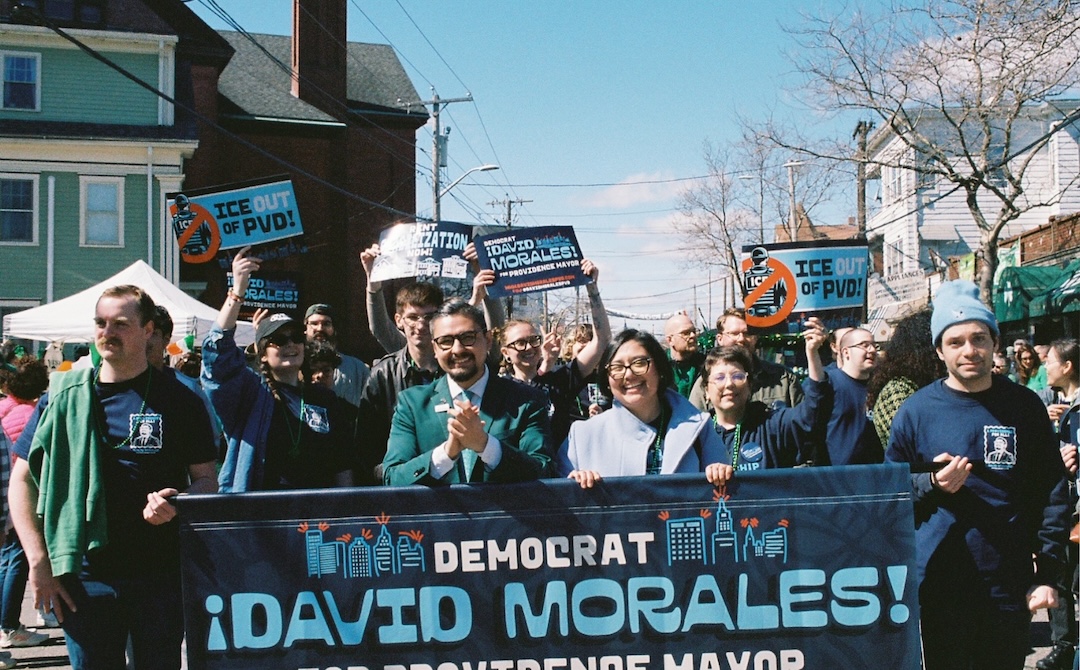
Providence for Palestine absorbed many of the volunteers who turned out for socialist candidates, like Providence Mayor-elect David Morales, and held over thirty canvasses between the primary and the general election. (David Morales for Mayor)
The midterm elections saw progressive, pro-Palestine candidates sweep into office across the country on the back of public outrage at Israel’s ongoing genocide in Gaza. These victories should help reshape the conversation around Israel in Washington, reflecting the shifts in American public opinion against Israel that have acutely developed over the past three years. But that shift can be seen in other ways beyond electoral victories — like the passage of a binding ordinance last Tuesday in Providence, Rhode Island, divesting from Israel and other entities complicit in “ethnic cleansing, apartheid, illegal military occupation, or genocide.” The measure, which was listed on the ballot as Question 7, makes Providence the largest US city to divest from Israel and the first to enact a divestment law through popular vote.
The first two years of Israel’s genocide in Gaza saw unsuccessful divestment campaigns both inside Providence City Hall and at Brown University. In 2024, Jewish Voice for Peace–Rhode Island (JVP-RI) launched a campaign to pass Israel bonds divestment legislation through city council. While the campaign had a long list of endorsers, a base of popular support, and the backing of three city councilors, Providence Mayor Brett Smiley (a darling of the Israel lobby) threatened to veto the measure and leaned on councilors to oppose it, ultimately succeeding in stymieing the effort. That same year saw massive student uprisings for divestment across the country, including a hunger strike and the Gaza Solidarity Encampment at Brown University. The university threatened disciplinary action against student protesters and charged them with criminal trespassing.
In late 2025, as the “ceasefire” took effect in Gaza and energy for street protests and civil disobedience waned, the local anti-genocide movement in Providence was in a position to reassess our strategy. We had tried lobbying our leaders, and we knew our power lay in the overwhelming popular opposition to the US-backed genocide in Gaza. At the same time, broader political opportunities in Providence had opened up. In addition to standing in the way of divestment, Mayor Smiley also killed a rent stabilization bill after a hard-fought battle led by housing justice group Reclaim Rhode Island (Reclaim RI). Rhode Island has one of the worst homelessness crises in the country, and Providence consistently ranks among the least affordable cities for renters.
In September, democratic socialist State Rep. David Morales announced a run for mayor, centering his campaign around housing and affordability. Morales was also joined by a growing slate of progressive city council candidates backed by Reclaim RI, including core JVP-RI organizer Jackie Goldman. Watching as this citywide socialist wave took shape, we knew we needed a vehicle to keep Palestine and the demand for divestment alive in this potentially transformative electoral cycle.
Soon enough, organizers in nearby Somerville, Massachusetts, gave us our vehicle. In November 2025, Somerville for Palestine passed a nonbinding citywide Boycott, Divestment, and Sanctions (BDS) referendum, winning with 56 percent of the vote. This new and almost entirely untested tactic seemed to offer the answer to our problem. By bringing a similar citywide referendum, we could take the question of divestment directly to the people while building a positive feedback loop with candidates campaigning on affordability and immigration justice.
A largely unused clause in Providence’s city charter allowed us to bring a binding ordinance to popular vote through a two-step petition process. After working with national movement leaders and legal experts and seeking advice from Somerville for Palestine as well as organizers in Pittsburgh who had attempted a similar referendum but failed to overcome legal challenges to their initial petition, we finalized an ordinance to be printed on thousands of petition sheets that would circulate into the spring and summer. During this process, JVP-RI pulled together a coalition of organizations to back the campaign under the banner of Providence for Palestine: Rhode Island Democratic Socialists of America, Reclaim RI, American Muslims for Palestine MA/RI, and American Federation of Teachers (AFT) Local 6516, which houses Brown University graduate workers, many of whom were involved in the previous divestment struggle at the university.
A Ubiquitous Presence in Providence
The campaign launched in February with about forty volunteers who slogged their way through two blizzards to collect the first thousand signatures required by the city charter to bring the ordinance to city council. In April, the council declined to pass the ordinance into law. Prepared for the council’s unwillingness to act and determined to bypass its authority by bringing the ordinance to popular vote, a rapidly growing base of volunteer petitioners set out to collect signatures from an additional 5 percent of the city’s registered voters. We soon became, according to one local reporter, “a ubiquitous presence at parks, farmers markets, and events” all summer long.
The requirements of the petition were a blessing in disguise: they forced volunteers to get good at standing on street corners and talking to voters across the city about the relevance of the genocide in Gaza to local politics, the ethical virtues of divestment, and the power of local citizens to bypass elected officials on matters of grave moral importance. By the end of July, Providence for Palestine announced a tally of an additional 9,500 signatures gathered by almost 150 volunteers since the initial petition had been brought to city council in April.
Morales and several of the other progressive candidates — including Goldman and Brittany Kubicek, who RI DSA was running as an independent socialist candidate for state representative — had already endorsed the petition effort before it got on the ballot, with some carrying petition sheets door to door as they canvassed their districts. By the time the city officially placed Question 7 on the ballot on July 30, divestment was already becoming a core plank of their collective platform.
On September 9, the socialist wave crashed in Providence. Not only did Morales win the mayoral primary in a landslide — making Smiley the first incumbent mayor ever to lose a primary in Providence — but every single Reclaim-endorsed candidate won their primary, securing a progressive majority bloc on city council.
In deep blue Rhode Island, almost all races are decided in the primary. That meant that between September 9 and November 3, divestment became the core electoral priority for the local left. Providence for Palestine absorbed many of the volunteers who turned out for socialist candidates and held over thirty canvasses between the primary and the general election. By November, we had reached out to almost thirty thousand voters to talk about divesting city funds. On election night, Question 7 won majorities in every one of the city’s fifteen wards, including in the most heavily Jewish neighborhoods.
Where’s Next?
Our victory in Providence was shaped by local conditions, but we believe it has potential to be a watershed moment for the BDS movement across the United States. The gap between the American public’s opposition to Israeli apartheid and our elected leaders’ continued support has never been wider. In both Somerville and Providence, ballot initiatives have proved a fruitful tactic to tap into popular outrage at the political establishment, build a mass base, and win concrete policy victories.
This campaign also represented an evolution of the pro-Palestine movement’s relationship to the socialist electoral wave sweeping the country. Not only did the movement in Providence jump into the ring to support a candidate who aligned with our values, as we’ve seen occur in New York City and in Democratic primaries across the country; we forwarded our own policy priority and pulled socialist candidates into the campaign on the strength of its momentum. This is an expansion of the Palestine solidarity playbook and could make divestment an achievable demand in major US cities at the same time as pro-Palestine politicians work to end US military backing of Israel in Washington — a huge leap forward for the BDS movement.
If Providence — a heavily Jewish city not previously viewed as a stronghold of left politics — can win divestment with 75 percent of the vote, we believe this is a winnable campaign in any city in the country. Where is next?