Let Andreas Malm Speak
Britain has banned climate scholar and left-wing activist Andreas Malm from visiting the country. Following the ban on Hasan Piker, it points to an alarming repression of pro-Palestine speech in Britain.
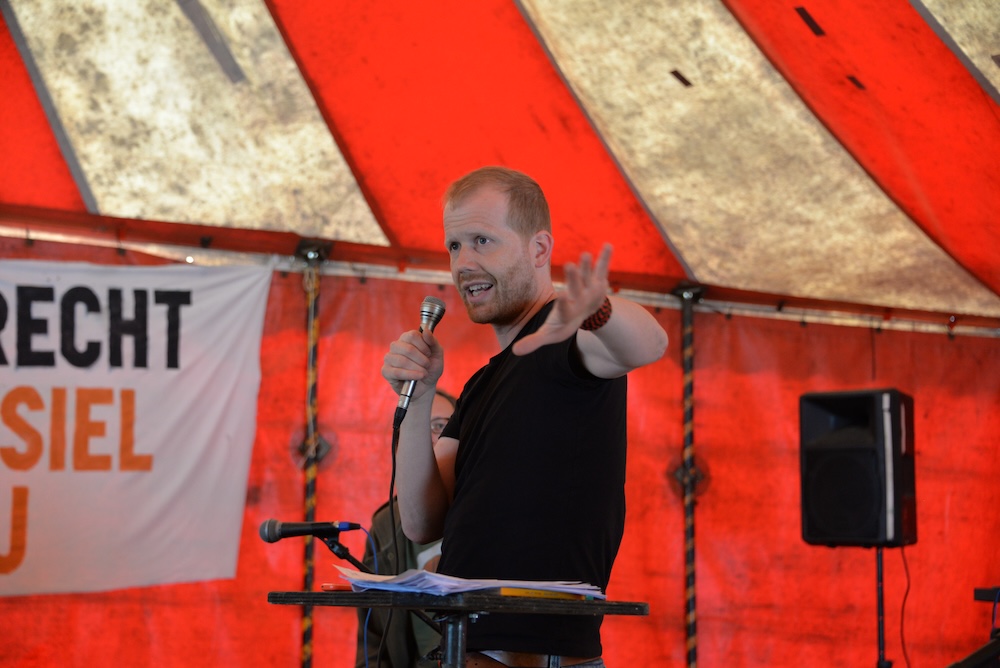
Andreas Malm is a leading critic of climate devastation and the genocide in Palestine. Now Britain’s Labour government has banned him from entering the country, silencing a scholar who dares to address the key moral issues of our time. (Code Rood / CC BY-SA 2.0)
Andreas Malm’s work has been among the most important of any scholar in any academic field over the past decade. His theoretical and strategic contributions have led developments in our understanding of the climate crisis’s basis in capitalism and fed debates about how to respond.
Yet last week, Britain’s Home Office banned Malm from entering the country, on the grounds that his “presence in the UK is not considered to be conducive to the public good.”
Malm had been due to visit London to speak alongside Palestine Action cofounder Huda Ammori at a Tribune magazine event, attend the academic conference Historical Materialism, and be interviewed by BBC Radio 4.
No specific reason was given for the ban. But it seems that the government’s decision is due to Malm’s principled opposition to the proscription of the direct-action network Palestine Action, officially labeled a “terrorist organization.” The move came a fortnight after publisher Faber & Faber announced that it would withdraw Sally Rooney’s novels from the UK market due to her support for Palestine Action, which means she is unable to collect revenue in the country. She too had fallen victim to the government’s silencing of free speech on Palestine, and to measures widely condemned by leading authors, artists, and public figures.
In June, American left-wingers Hasan Piker and Cenk Uygur had already been banned from entering the UK.
The decision by Andy Burnham’s government to ban Malm represents a further attack on the Marxist left. It denies ordinary citizens the opportunity to hear from someone who speaks and writes so clearly about the imminence of climate catastrophe, the horrors of Israel’s genocide in Gaza, and their entanglement.
It is surely no coincidence that these are the two areas in which Burnham’s government is failing resoundingly.
The ban on Malm comes in the same month that Energy Secretary Miatta Fahnbulleh approved the Jackdaw gas field in the North Sea despite the Labour Party’s 2024 manifesto commitment to issue no new licenses for oil and gas.
It also comes just a few weeks after Burnham insisted that Labour could not work with Green councilors who failed to renounce their party’s policy holding that “Zionism is racism.” Foreign Secretary Ed Miliband’s recent emotive denunciation of Israel’s ethnic cleansing and settler violence does not do enough to stop the material support that the British state continues to provide to the genocide.
Malm is not an extremist from whom the British public needs protecting. His work is resolutely in the Marxist tradition but is cited widely by scholars across disciplines and spanning the political spectrum.
The Destruction of the Earth
Malm’s contributions are many. His seminal 2016 work, Fossil Capital, is perhaps the most important theoretical account of the historical entanglement of fossil fuel production in capitalism. The Progress of This Storm stakes out a clear position in ecological Marxist debates, asserting the need for human agency in confronting the crises we face. In the early 2020s, Corona, Climate, Chronic Emergency and How to Blow Up a Pipeline elaborated on this with essential contributions to debates on climate strategy following the insurgency of Extinction Rebellion and school climate strikes. Coauthored with Wim Carton, Overshoot and The Long Heat then offered masterful accounts of the ideological and technological bases of the march toward climate catastrophe.
More recently, Malm’s impassioned 2025 work, The Destruction of Palestine Is the Destruction of the Earth, places Israel’s genocide in Palestine in its proper historical setting, locating it in the context of British empire and enduring expansion of the fossil economy.
Malm, like Rooney, is no terrorist. In fact, it is the power of his ideas and the clarity of his expression that make him particularly dangerous for the British government. It clearly fears that Malm — like Rooney, Palestine Action, and Just Stop Oil (JSO) — will expose their inexcusable negligence on the most consequential questions of our time.
This episode raises a sobering question not just for the Marxist left, but for anyone in Britain committed to freedom of speech and political expression, and anyone who might expect to publicly criticize any government failing to act on genocide and climate collapse in the coming years: If Burnham’s government is prepared to ban Malm from entering the country, how many of its own citizens would it gladly deprive of their political freedoms if it had the opportunity?
This is an instructive moment. The only real difference between Burnham’s Labour and his predecessor Keir Starmer’s rule lies in the world of vibes and affect. Burnham says he identifies with ordinary people’s problems, names neoliberalism as an enemy, and shares your cultural tastes, perhaps evoking some combination of hope, nostalgia, and northern English pride.
But his government shares with Starmer’s an inability to confront the precipitous decline in living standards, an enthusiasm for growing the destructive defense and AI industries, and ongoing material support for Israel’s genocide in Gaza.
It leaves untouched the massive intensification of state repression of peaceful protest introduced under the last Tory government (in response to Extinction Rebellion and JSO), which was extended to Palestine Action by Starmer’s government.
Even worse than Starmer’s, Burnham’s government has abandoned Labour’s hard-won commitment to stop new fossil fuel production in the North Sea.
Each of these positions undermines the medium- to long-term viability of human civilization as we know it. The banning of Malm is an insight into how ostensibly center-left governments will deal with political dissent as they fail to address the crises in the years to come.
The Marxist left, within and outside the UK, is not only a legitimate political tradition that must be protected from repression on principle. It is the political tradition offering the strongest insights and most vibrant debate on the nature of the crises we face and how to overcome them. Its repression is an assault on everyone.
We should express our solidarity with Andreas Malm and Sally Rooney. But this situation also raises wider demands: for the de-proscription of Palestine Action and the repealing of anti-protest legislation. And, more materially, for an end to the UK’s practical support for Israel’s genocide in Palestine and to fossil fuel production in the North Sea.
Each of these claims are basic expressions of humanity and should be uncontroversial to state out loud in Britain today. It is the moral responsibility of anybody in the public sphere to express them. Burnham’s government rejects them all, and for this deserves our unrelenting opposition.