In Britain, Counterterror Laws Trample on Protest
This month, four Palestine Action activists were jailed as “terrorists,” even though the jury didn’t convict them on such charges. The case shows how counterterrorism powers are used to impose extreme penalties on unwanted protests.
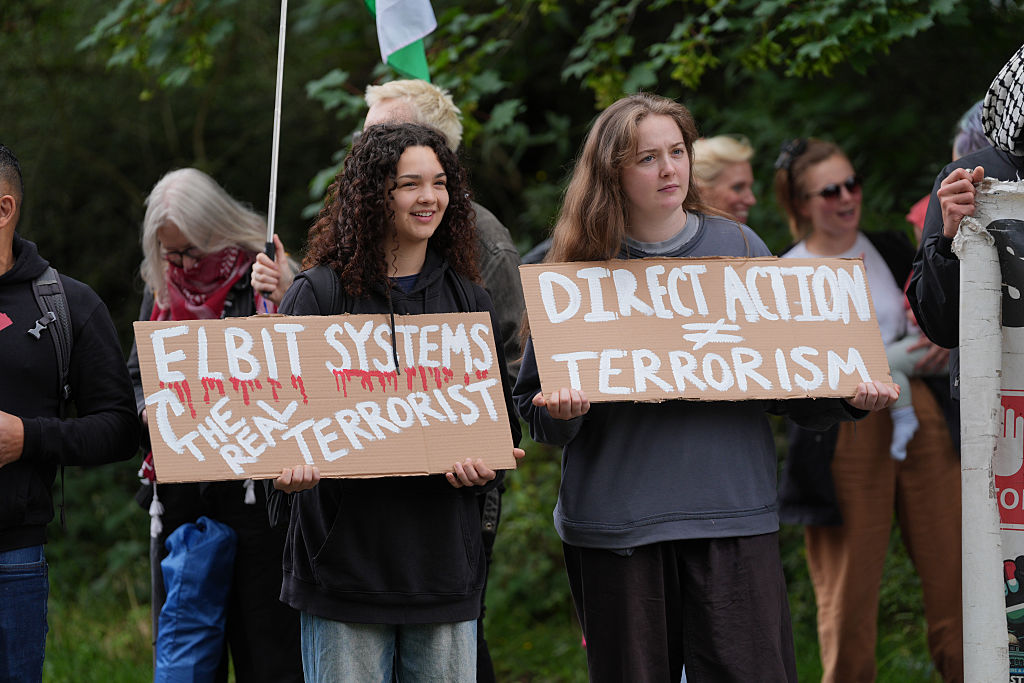
The British state has long used counterterror powers to crush national liberation movements. A string of recent legal cases shows how the British courts are today widening these powers in order to criminalize controversial opinions. (Yui Mok / PA Images via Getty Images)
In 1999, Britain’s then-Home Secretary Jack Straw defended proposed counterterror legislation by telling Parliament its use would be curtailed by existing human rights laws. Responding to questions posed by MPs, he assured them that the tabled legislation would not threaten freedom of expression or the right to protest.
This proposed legislation became the Terrorism Act, a cornerstone of the UK’s counterterror powers. A quarter of a century into its existence, Straw’s words ring hollow, as several recent legal cases show how Britain’s counterterror powers disproportionately and unjustly target those resisting genocide and opposing authoritarian and racist governments.
While many communities in Britain have long been familiar with the violent measures promoted under the guise of counterterrorism — Irish Republicans, Muslims, Kurds, and Tamils among them — these powers are currently undergoing a rapid and unprecedented transformation in the courts.
Palestinian and Kurdish Protest Under Attack
This has been especially clear over the last year, after Keir Starmer’s government proscribed Palestine Action, a direct-action group carrying out nonviolent protest against Israeli weapons manufacturing in Britain. The ban has already led to some of the most visible and outrageous uses of counterterror powers in recent history, as seen in a sentence handed down this June 12. Four defendants in the high-profile Filton case — arrested for destroying drones at arms firm Elbit — were not convicted under counterterror powers, but were then sentenced as terrorists and given a total of twenty-five years’ imprisonment. Crucially, the judge prohibited the jurors in the case from knowing about the “terrorism connection” that could be applied in sentencing.
Meanwhile, thousands of people have been arrested for showing their support for Palestine Action in the face of the proscription. Last Monday, June 15, the Court of Appeal overturned the High Court’s previous decision, which had found the proscription to be unlawful — and thus upheld the government’s original ban on Palestine Action. This means that over three thousand people could be tried for the offense of supporting a proscribed organization, facing potentially up to fourteen years in prison. Most of them were arrested for holding signs simply saying, “I oppose genocide. I support Palestine Action.”
While Palestine Action has commanded headlines, another case has also been quietly working its way through the justice system. In November 2024, six members of London’s Kurdish community were arrested in dawn raids. The police operation involved more than eight hundred officers who closed a Kurdish community center in North London for almost two weeks. The six arrestees were held in isolation for days and eventually charged with a range of offenses, including membership of a proscribed organization — likewise risking them up to fourteen years’ imprisonment.
The charges were based on a supposed link to the Kurdistan Workers’ Party (PKK), a proscribed organization in the UK. The PKK, which recently disarmed itself in order to begin peace negotiations with Turkey, has been a central element in the decades-long struggle for Kurdish rights and self-determination. Its proscription has been repeatedly challenged and debated.
The four-month-long trial ended in May with a jury returning not guilty verdicts on four counts, including three of membership, and failing to reach verdicts otherwise. The lack of convictions did not deter the Crown Prosecution Service, which has brought a retrial against the remaining three defendants. Much of the trial centered on the definition of membership of the PKK. Unlike in the case of the Palestine Action defendants, this offense is not based on active participation in direct-action protest: the prosecution argued that actions such as speaking at community events or holding the PKK flag could constitute de facto membership. This opens the door for interpreting even simple participation in community life as proof of a terrorism offense.
Counterterror Law and State Repression
Sabotage against arms manufacturers is a long-standing tactic of the British antiwar movement: it was once defended in court by Starmer himself, in his days as a barrister. Yet while such actions had until recently resulted in charges such as criminal damage, they have now entered the shadowy realm of counterterrorism. With judges willing to constrict a jury’s right to access full information regarding the motivations behind defendants’ actions — and jury trials themselves under threat — the British justice system is entering a new era of authoritarian uses of counterterror law. This props up states like Israel and Turkey, both condemned by international legal scholars and human rights organizations for continued violence against Palestinians and Kurds, respectively.
Some of this, however, is not new. Counterterror legislation is simultaneously highly permissive of state surveillance and repression, and extremely broad in its definition of who can be targeted. It has long resulted in harsh measures such as intrusive surveillance and disruptions to everyday life for many racialized and politicized communities — not to mention the extralegal practices normalized during the war on terror, including secretive renditions and unfounded detentions, most commonly targeted at Muslims but also aimed at struggles for liberation and self-determination.
But when faced with the reality of these current legal cases, alarm bells should be ringing. Proscription, which Straw in his day called a “heavy power” — one that, he claimed, would be curtailed by respect for human rights — is now being extended to a category of organization it has previously not touched: UK-based direct-action groups. Palestine Action, as many legal professionals have warned, should be seen as a test case — indicating a desire for the Home Office to expand the use of counterterror legislation more broadly.
As seen in the Kurdish case, proscription carries exceptional capacity for state intrusion into the life of a community and of individuals. The six defendants were not only subjected to the singularly long period of detainment permitted by the Terrorism Act: they also endured exceptionally restrictive bail conditions and had to disclose traumatic experiences of state discrimination and violence during the trial. While some have been acquitted, three defendants yet again face an excruciating wait for another trial. Their lives have been irreversibly ruptured despite none of them having been accused of violent, dangerous, or disruptive acts.
Indeed, the potentially vague interpretations of “membership.” together with the power to proscribe organizations (at the discretion of the home secretary), together form a potent combination of state overreach. With the proscription of Palestine Action deemed lawful, and with an explicitly political use of counterterror legislation increasingly normalized, people living in Britain face a reality in which seemingly any protest group can be proscribed as a terrorist organization — and in which the charge of membership of such an organization can be based on everyday community participation and a supportive view of its activities. To spell it out: extremely powerful laws, created with the justification that they would only target the most seriously violent actors, could be used to imprison anyone with an opinion inconvenient to the British government. Crucially, these powers extend far beyond the justice system: they enable widespread surveillance, disruptions to finances and travel, and the monitoring of personal relationships of those deemed “suspect” by the state — whether or not they are accused of committing a crime.
It is not surprising that these powers are being trialed against communities facing an onslaught of propaganda in political discourse: Palestinians and Kurds share a long history of being profoundly marginalized and brutally repressed, and their attempts to defy colonial violence have long been criminalized. The central mechanisms of twenty-first-century counterterrorism grew from the subsoil of European colonialism, created to uphold the forces of imperialism and capitalism. With this history in mind, those mobilizing against Britain’s diplomatic and economic investment in ongoing colonial violence are naturally first in line to be targeted. But it would be naive to think that it is only these movements that will face the brunt of counterterror powers.
The 2024 Walney report on political violence, which supported the restriction of Palestine Action’s activities, crucially urged more police attention toward “extreme left-wing” protesters. This direction of travel shows that political groups taking action on questions of racism, the climate crisis, and economic inequality should expect to increasingly be caught in the crosshairs of counterterrorism and subjected to exceptionally opaque and coercive forms of state power.
It should be harrowing enough to see such powers applied against people resisting the injustices of genocide, colonialism, and political repression. But if that fails to move the British public, this realization ought to: Anyone seen by the government as a threat or nuisance could be next.