Sweden’s Left Faces a Political Deadlock
In September, Swedish voters defeated a governing coalition that the far right had propped up. But the Center Party is now blocking a new government because it wants to keep Left Party ministers out of the cabinet.
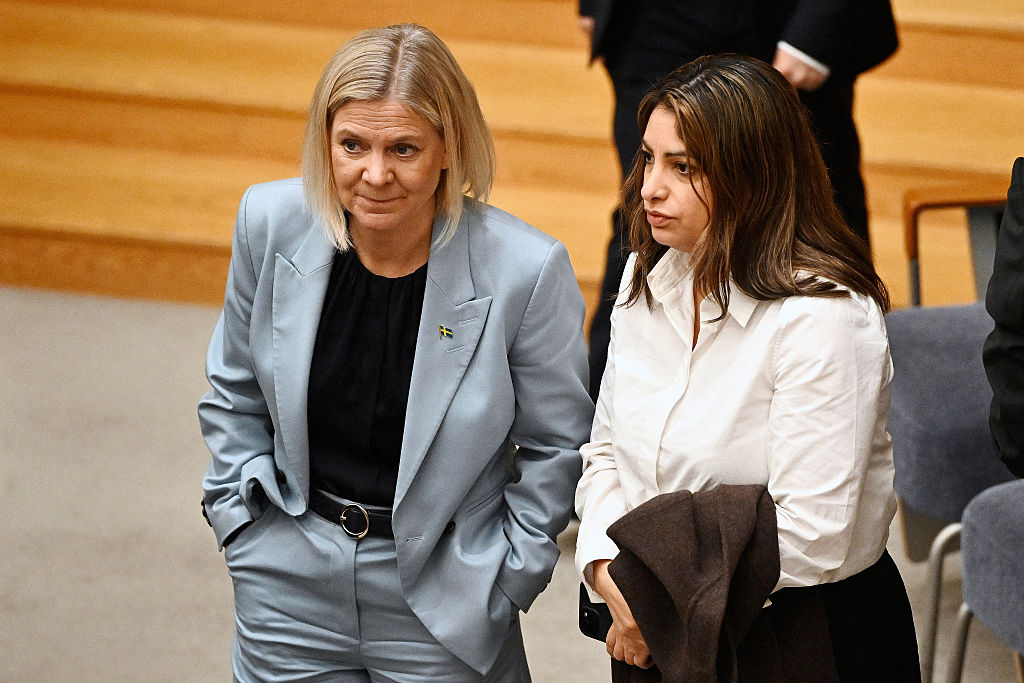
Social Democratic Party leader Magdalena Andersson speaks with Left Party leader Nooshi Dadgostar during a session of the Swedish parliament on October 15, 2026. (Fredrik Sandberg / AFP via Getty Images)
After four years of a right-wing government that the far-right Sweden Democrats (SD) heavily influenced, the parties that refuse to cooperate with the SD secured a narrow victory in the general election on September 13. However, the winning side consists of four parties that are politically very far apart and have so far been unable to agree on a new government.
While the Left Party refuses to support a government in which it does not hold cabinet posts, the neoliberal Center Party refuses to support a government that includes Left Party ministers. Nobody wants a snap election or a repeat of the extremely slow, 134-day process of forming a government that followed the 2018 election. But there is still no solution in sight to this stalemate.
Ultimately, Sweden’s dilemma is bigger than the question of which parties receive which portfolios. It is whether the parties that claim to defend democracy against the inroads of right-wing populism can win a positive majority for a different economic policy agenda rather than a negative majority against the SD’s influence.
Swedish Lessons?
For much of the postwar period, Sweden seemed to offer a reassuring lesson for the rest of Europe: a strong labor movement could turn social conflict into universal security, while the far right remained at the margins. That settlement rested not only on strong social ties but on a universalist welfare state whose erosion has not been a single event. It has been a piecemeal dismantling.
The SD emerged from the neo-Nazi milieu around Keep Sweden Swedish (Bevara Sverige Svenskt) and rebranded itself to take far-right, xenophobic ideas into the mainstream. The other parties of the Right progressively abandoned the cordon sanitaire around it as the SD’s voter support grew.
In the 2018 election, the Right still held firm, and a weak centrist government took office. But in the run-up to the 2022 election, the temptation to capitalize on the right-wing majority to form a government proved too strong. Three out of four center-right parties formed an alliance with SD and took over the reins of government.
This was a three-party coalition that the Moderate Party led, in which the SD formally did not participate. However, as the largest party within the alliance, the SD exerted a very strong influence over government policy through the Tidö Agreement, named after the palace where the parties negotiated it.
Before the 2026 election, Prime Minister Ulf Kristersson went further, promising SD ministerial posts if his bloc won a majority. In exchange, the post of prime minister would remain with the Moderates, even though they were still polling below the SD.
We should measure the far right’s advance in Sweden and elsewhere not only in terms of who holds a particular office but also in terms of who shapes the broad political agenda. By that measure, the SD has been remarkably successful: politicians across the Right now voice views that would have been beyond the pale a decade ago.
The SD’s growth and the prospect of its formal entry into government have polarized Swedish politics. The Swedish Social Democratic Party (SAP) and Center Party — the only traditional right-wing party that still refuses to govern with the SD — presented themselves above all as guarantors against the SD entering any government. Yet they offered voters few clear political distinctions from the governing bloc beyond that pledge.
The four-party opposition grouping of SAP, the Left Party, the Center Party, and the Green Party won 176 seats against 173 for the parties of the Tidö Agreement. Swedes often call this grouping red-green, despite the Center Party’s liberal and economically right-leaning profile. But the arithmetic has not produced a government.
The Center Party campaigned on keeping both the Left and SD out of government, while the Left Party’s congress had committed the party to refusing to support a government in which it did not participate. Neither party has yet moved. The result is a political deadlock: there is a parliamentary majority opposed to SD’s entry into government but no agreement on what should replace the current administration.
The January Agreement’s Afterlife
There is a history behind this impasse. After the prolonged stalemate in 2018–19, the Social Democrats and the Green Party eventually formed a government with the active support of the Center Party and the Liberals. The January Agreement promised to keep both the far right and the Left away from political influence.
However, this agreement depended on the passive support of the Left in parliament. To secure the support of the Center Party and the Liberals, SAP and the Greens accepted a program of liberal economic reforms, such as the weakening of employment protections and tax cuts for high-income earners.
One clause in the agreement — coined the “humiliation clause” by politicians and analysts alike — stated explicitly that the Left Party was to have no influence over government policy. The Left Party nevertheless allowed the government to form on this basis, because its leaders believed that the Liberals would otherwise switch sides and form a government with the support of the SD.
The supporters of the January Agreement presented it as a firewall against the far right. But a firewall built by moving the house to the right is a curious defense. The Left Party declared that its support had limits: if the government moved to implement the agreement’s provisions toward the elimination of rent controls or weakening of labor law, the Left would bring it down. In the summer of 2021, it did just that.
Although the SAP soon formed a new government, the episode left a legacy of deep mistrust between the two parties of the labor movement. An SAP-led government, with passive support from the Left, nevertheless presided over tax cuts for high earners and the weakening of the right to strike. Critics warned that, while this arrangement may have temporarily prevented an SD government, in the long term it would be more likely to strengthen the far right.
In the end, the January Agreement collapsed, but its governing logic survived. This is a case of technocratic centrism at its worst, where there are few substantial differences between the proposed governing alternatives, and the parties largely ask voters to choose the more popular prime minister.
It is also the logic of triangulation. According to this logic, erstwhile left-wing forces should concede the economic terms that the center demands, borrow the language of the Right, and hope that competence can compensate for the absence of a distinctive social project. SD remained outside the cabinet, but the party system increasingly organized itself around its priorities: migration, crime, national identity, and the supposed impossibility of a more generous welfare settlement.
The Left Party has spent more than a century outside the national government since its origins as the Communist Party of Sweden in 1921. In that time, it has often supported SAP administrations, because the alternative appeared worse — though in recent times, it has increasingly felt as if the lesser of two evils was only slightly lesser.
After the humiliation of the January Agreement, which did not stop SD from heavily influencing the next government, the Left Party’s congress this time decided that the party would not hand its seats to a government it did not join. By making that a congress decision, the party leadership sought to bind itself against the predictable pressure to back down in the name of preventing a right-wing government.
The party leadership and its supporters argue that this is a necessary break with a pattern in which the Left supplies votes while the Center Party shapes economic policy. They also argue that ministerial posts are the best way to guarantee influence over the government’s day-to-day decisions. Others in the party suggest that the substance of policy is more important than ministerial posts, and that it may even be an advantage for a fringe party to exert influence without having to take responsibility for all government decisions. Overall, support for the prevailing line remains strong within the party.
SAP’s wider political ecosystem is pressing the Left to accept a policy agreement without insisting on entry to government. The left wing of SAP, for example Daniel Suhonen of the think tank Katalys, argues that since the SD grew under a similar arrangement, the Left could do the same. But the comparison misses a crucial difference: the SD benefited from a continental tide of right-wing populism, and parties across the Right were normalizing its political project. Repeating the argument that the Left must always accept less to keep SD out of power will not solve its dilemma.
It might also turn out that the SD’s tactics delivered a Pyrrhic victory, at least in terms of voter support. The party saw its support decline for the first time in a general election, finishing at 17.5 percent — significantly lower than the Moderates, who thus regained their position as the largest right-wing party.
The Sweden Democrats appear to have suffered a loss of support from both ends. Some voters returned to the center-right parties, presumably satisfied with the SD-inspired tightening of migration policy that the Tidö government implemented. At the same time, the most radical supporters felt that the SD had become far too willing to compromise and opted for smaller parties even further to the right.
A Left Under Pressure
Despite achieving a respectable 8.4 percent of the vote this time, the Left Party has its own unresolved crisis. The current leadership comes from a close circle of colleagues whose ties go back to the party’s youth organization. For more than a decade, their project has been to show that the party has put its unruly radical past behind it, and that the Left is ready to govern alongside SAP as a junior partner only slightly to its left. Internal critics argue that this drive to make the party both easier for its leadership to control and fit for government has repeatedly undermined its support for traditional left-wing positions.
Long-standing members have left amid disputes over the Left Party’s support for arms to Ukraine, its acceptance of the arms race and an expanded military budget, its softened opposition to the North Atlantic Treaty Organization, and its retreat from a more assertive form of internationalist solidarity. The party’s relationship with the Palestine solidarity movement has become an especially visible flash point. Members have criticized its failure to take a stronger stance on Palestine as well as the absence of the party leadership from weekly demonstrations. These disputes have also sharpened tensions over how the party handles questions of internal dissent, discipline, and public protest.
As the election approached, media scrutiny focused on Left candidates — often low on the lists in smaller municipalities — over statements they had made about Israel and Palestine. The cases ranged from explicitly antisemitic remarks to statements supporting armed resistance by Palestinians. The party responded with repeated expulsions. In the heat of the campaign, many activists felt that the party was distancing itself from the Palestine solidarity movement rather than standing with it.
Similar conflicts have arisen around other issues. At times they have led well-known members, and some members of parliament, to break away and form new parties or organizations. These breakaways explicitly claim that their new ventures will be more attuned to the demands of social movements. These are recent examples of an age-old tension within the socialist movement: Can a parliamentary party remain rooted in social movements without trying to domesticate them?
Despite these incidents, which often involved members with an immigrant background, the party achieved remarkable success precisely in those stigmatized suburbs where first- and second-generation immigrants are most concentrated. Voter turnout is usually low in these districts, and the people who do vote most often support the SAP. But turnout rose this year, and the Left made significant inroads.
In many such places, the Left became the largest party. If we put its supporters together with the still substantial number of votes for the Social Democratic Party, the two “red” parties often accounted for over 90 percent of the vote.
Statistics from exit polls show that the difference in voting behavior has widened even further. If only “ethnic Swedes” had voted, the Tidö parties would have won, and the same would have been true if only men had voted. Rural areas are now right-wing, while the major cities have a red-green majority.
Those who self-identify as workers voted in equal measure for the red-green parties and the Tidö parties. The SAP remains the largest workers’ party with 31 percent, but the SD is the second largest with 25 percent, while the Left has 10 percent.
The fact that so many people from migrant backgrounds voted for the Left fueled menacing postelection debates in which both Sweden Democrats and some Moderates claimed that migrants in general and Muslims in particular had decided the election. They often combined this with insinuations of electoral fraud. But it should come as no surprise that this section of the population now votes for the opposition. For the past four years, the government parties have constantly singled it out as problematic and made successive attempts at weakening or even revoking residence permits for recent migrants and their families.
The Arithmetic of Exclusion
The parliamentary deadlock reflects the existence of two different majorities. There are enough seats to keep SD out of a government, yet on economic questions, a cross-party majority often leans to the right. The Center Party’s red lines on taxation, welfare profits, and public investment would pull any government dependent on it in that direction. The anti-SD majority is therefore a negative one: it can block one outcome without agreeing on a positive program.
The Left’s choice is not simply whether to demand ministerial posts. It is whether to accept a policy agreement that leaves it outside government, with the Center Party setting much of the economic direction, or to insist that the party’s voters should also have a share in executive responsibility.
The stakes are material as well as symbolic. Without ministers and a role in setting priorities, the Left could again find itself endorsing compromises whose costs fall on its own program and electorate. But holding firm also carries risks: critics may blame the party if the parties cannot form a government, resulting in an early election and possibly the return of the Right.
There are two familiar ways to describe this dispute. One is that the Left Party must be responsible and accept a lesser role to keep the SD out. The other is that the Center Party must be responsible and accept the Left Party in government, because the parliamentary numbers require it. Both framings moralize what is fundamentally a political conflict over who gets to govern and whose program counts as reasonable.
The conflict has already produced an extraordinary opening scene. The Left Party voted with the Moderates to reelect the Moderate Andreas Norlén as speaker of the parliament. SAP leader Magdalena Andersson then returned her first exploratory mandate, saying she could not form a government under the new parliamentary conditions.
On October 2, the speaker gave her a fresh mandate which expired yesterday, October 15, when the SAP proposed a vote on a prime minister and a government consisting only of their own party. It did not pass, since no agreement between the four parties was reached. (Both the Greens and the Left had already stated that they would vote no in this round.)
The speaker will now likely pass the exploratory mandate on to the leader of the Moderates, Ulf Kristersson — the recently resigned prime minister — who will have one or two weeks to attempt to form a government. That too will likely end in a vote in which the candidate does not secure a majority, and the ball will once again be in the court of SAP, the Left, the Greens, and the Center Party. After four unsuccessful attempts to elect a prime minister, the law requires that a general election be held. That prospect gives every party a reason to hold its line — and a reason to blame someone else if negotiations collapse.
The Center Party’s refusal to govern with the Left also leaves open a dangerous escape route. If talks fail, the Center Party could face pressure to tolerate a center-right government dependent on SD’s support, or even to join a right-wing majority, while SD remains outside the cabinet. The party leaders have explicitly said they will not support a government that relies on SD votes, even if SD receives no ministerial posts. But there may be a clear incentive, in a crisis, for the party to redefine what it means by “reliance.”
The Center Cannot Hold by Imitation
For SAP, the deeper problem is older. For years it has tried to neutralize the challenge from the Moderate Party by imitating its approach to government. This has meant favoring fiscal caution over public investment and market discipline over democratic control, combined with punitive responses to social insecurity and increasingly restrictive language on migration.
That strategy has not defeated the Right. It has merely helped legitimize the discourse of the Right while leaving the Left with fewer convincing answers of its own. It has also led to the worst electoral result for the SAP since the advent of universal suffrage.
The same dilemma faces social democracy across Europe. Centrist parties can win office by promising stability and borrowing the Right’s language, but the strategy gives voters little reason to expect a different future. When the mainstream says no alternative is possible, the far right offers the most dramatic alternative of all.
There is no denying that the situation is bleak. Nor are there clear-cut answers about what the Left’s strategy should be, either in the broad sense of a political program or, more narrowly, in terms of parliamentary tactics for the Left. The recent election gave a majority to right-leaning economic policies, although the Center Party opposition to SD cuts across this majority.
The parliamentary strategy of the Left Party has resulted in serious internal conflicts. Although its vote share of 8.4 percent is slightly better than usual, it does not represent a major success. At the same time, this has been the general trend for parties of the radical left in Western Europe: even when they have not been losing support, they have not been making major breakthroughs. In the absence of a surge of civil unrest or the emergence of a charismatic figure to lead the Left, it’s not clear how things could have been different.
Under prevailing conditions, we face the prospect that governments will continue dismantling Sweden’s welfare institutions — either quickly and aggressively with the Right in charge or at a somewhat slower pace under the Social Democrats and their centrist allies.