Sweden’s Far Right: Faltering but Not Defeated
Sunday’s Swedish election saw the center-left bloc narrowly defeat the outgoing right-wing government. While the Social Democrats are set to lead a new coalition, the once-mighty party has continued to lose its historic base.
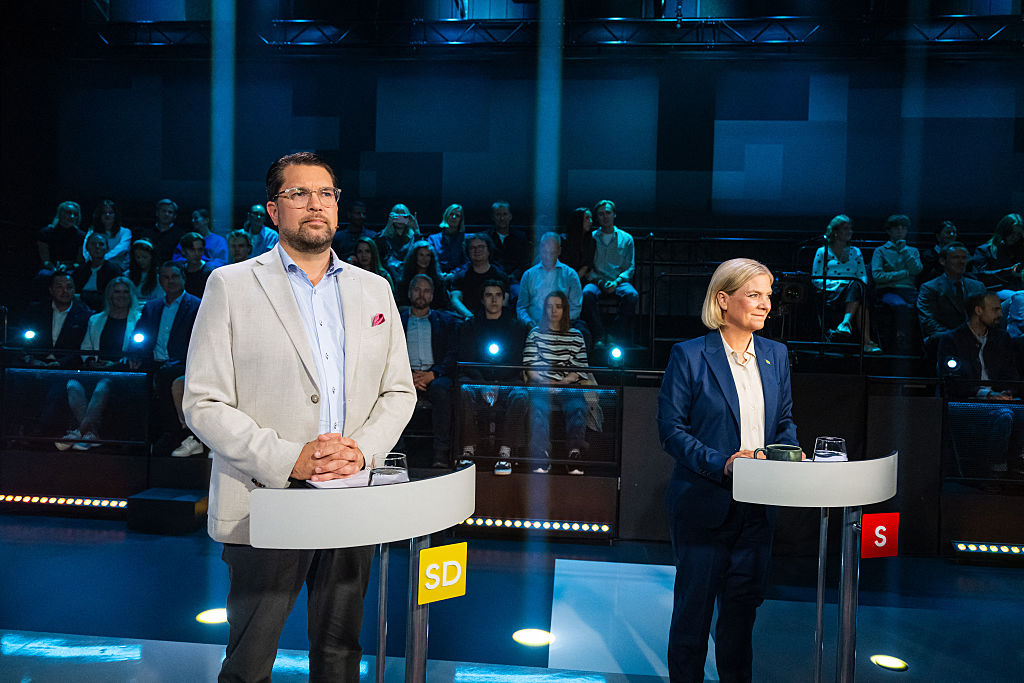
While Sweden is often considered a heartland of social democracy, its model of work and welfare has been hollowed out over decades. It’s helped feed a split in the working class, between left-wing voters and a powerful far-right bloc. (Jonathan Nackstrand / AFP)
For the far-right Sweden Democrats, Sunday’s parliamentary elections may have looked like the final step toward full “detoxification.” Success in the election for the Riksdag promised to crown the party’s integration into the Swedish political system — a formality by this point, but a significant step nonetheless.
That integration had substantially taken place already four years ago, when a government coalition deal was agreed on at the Tidö Castle. The Sweden Democrats had previously been subject to a cordon sanitaire excluding them from office: the Moderate Party leader, Ulf Kristersson, even solemnly promised a Holocaust survivor that he would never cooperate with the far right. But after the 2022 elections, this pledge was ditched. Kristersson soon formed a coalition of traditional center-right parties (Moderates, Christian Democrats, and Liberals), which relied on the outside support of the Sweden Democrats, who had placed second in that vote.
The establishment was betting on moderating the far-right party. In reality, the opposite happened: the Sweden Democrats reaped the benefits of normalization, and the traditional right shifted to a harder line on immigration and criminal justice policy while also dismantling climate policies. This is no national peculiarity. Through European Commission President Ursula von der Leyen’s second term, we have seen a similar process in the EU institutions themselves, with a slew of deregulation, the shelving of the Green Deal, and a migration policy coordinated between Christian democracy and the various forces of the far-right front.
The Sweden Democrats’ leader, Jimmie Åkesson, had his sights on breaking the last taboo: a full and direct entry of his party into government, taking over key ministries. The traditional right-wing parties had accepted this, albeit with some internal unease in the Liberals’ case. Already, over the past four years, the boundaries of what is possible in Sweden have been pushed far beyond previous limits. Take the cases of the young adults with an immigrant background being deported to their parents’ countries of origin (including to such unsafe countries as Egypt or even Iran), while their families remain in Sweden. From this perspective, the alarms raised by Human Rights Watch come as no surprise; Greta Thunberg denounced her own country’s government.
The Sweden Democrats’ election campaign raised the stakes. One Riksdag member, Richard Jomshof, openly described himself as Islamophobic. To those who pointed out that not all Muslims fit his racist stereotype, he replied contemptuously: “Then they can stop being Muslims.” In western Sweden, the party went so far as to plaster public transit buses with advertisements reading: “Do you miss Mogadishu? Remigration will help you go home,” sparking protests from some drivers of Somali origin.
Ultimately, the election saw Åkesson’s bid for ministerial power repelled — albeit by a narrow margin, and with a smaller gap than indicated by recent opinion polling and even Sunday night’s initial exit polls. In a narrow outcome, the broad right-wing bloc secured 173 seats, while the four opposition parties spanning the centrist-to-left-wing space won 176.
Hardly Emphatic Win
Social Democratic leader Magdalena Andersson, already briefly prime minister in 2021–22, will now again be tasked with forming a government. In fact, her party’s 28.1 percent score on Sunday was its worst result in decades (slightly less even than a past bad result in 2018), and with a loss of seven seats compared to 2022. The Sweden Democrats lost ground (17.6 percent, down 3 percent and eleven seats from the previous election), overtaken by the Moderates (19.9 percent, with two more seats than last time).
Researcher Tobias Hübinette suggests that the Sweden Democrats lost some of their voters to the Moderates but others — particularly young men — turned to smaller parties further to their right. These groups did not make it into parliament, but they represent a phenomenon worth monitoring given their violence and aggressive racism, as noted by Duroyan Fertl regarding one such force, the Örebro Party. There was slight growth for the other two parties in the center-right bloc: the Christian Democrats (6.2 percent, three more seats than in 2022) and the Liberals (5.4 percent, three more seats). Many polls had predicted the Liberals would fall below the 4 percent threshold, as part of their electorate was uncomfortable with their collaboration with the far right.
On the opposition side, the Social Democrats’ losses are offset by gains from their potential allies. The Left Party increased its number of Riksdag seats from 24 to 29 (on 8.2 percent of the vote), while the Center gained one seat, on 7.1 percent. The Greens also performed well, gaining four seats and securing 6.1 percent.
So, Kristersson’s right-wing bloc has lost its majority, and the far right has been stopped. These are two pieces of excellent news, but the hard part comes now. The opposition’s election campaign — especially that of the Social Democrats — was very timid, with significant concessions to right-wing rhetoric on immigration and criminal justice policy. Even on social issues (revitalizing the welfare state), Sweden’s biggest party did not seem to show the necessary combativeness or consistency, and this also explains why some of its voters turned to the radical left. Not by chance, Leonidas Aretakis, editor of socialist magazine Flamman, expressed some skepticism about whether defeat for the right-wing coalition would actually lead to the abandonment of right-wing policies.
This skepticism is also driven by the balance of power among the opposition parties and, in particular, by the conflicting agendas of the radical left and the Center. The latter have made no secret of their preference for grand coalitions over cabinet cooperation with the Left Party. This latter has, however, made clear that it intends to join the government, believing that this offers it greater influence than providing external support to the Social Democrats (tactical approaches already used in the past and common in some Nordic countries).
The opposition has major contradictions. The Center Party, champions of pro-market policies, had in fact long been partners of the traditional center right, only to distance themselves when these other forces moved closer to the Sweden Democrats. Conversely, the Left Party is calling for higher taxes on the wealthy, public investment, and the strengthening and decommodification of the welfare state. In particular, it is calling for universal dental care, as achieved by the Left’s Danish counterparts, and the removal of the profit motive from the education system — a highly sensitive issue in Sweden.
Labor Relations
This conflict is not limited to the world of party politics, for it also tells us something about what has become of Sweden and its model of work and welfare in recent decades. If in the 1970s economist Rudolf Meidner proposed moving beyond the welfare state and intervening directly in property relations via employee-owned funds, such proposals are now long in the past.
Indeed, neoliberalism has taken its toll even on what was once the flagship of European social democracy. Today’s Stockholm is teeming with tech oligarchs: we need only think of the emblematic example of Spotify. During the lead-up to this election, industrialists, also given a platform in the Financial Times, publicly spoke out against the broad-left opposition’s proposals to increase taxation. Here as around Scandinavia, direct political pressure from the dominant economic actors is on the rise, as also recently seen in Denmark with businesses such as Maersk intervening in a similar debate on tax justice. This is a striking sign of renewed inequalities and a conflict between democracy and oligarchy that will also weigh on talks about Sweden’s next government.
To properly analyze the outcome of Sunday’s election, we also ought to grasp the link between what happens in the corridors of power and what is going on in wider Swedish society. If Sweden was long the country that best embodied the social democratic compromise, this was based on a strong institutionalization of industrial relations. To understand whether a left-wing policy can be revived, this is perhaps where we need to start from.
Recently, Tesla struck a blow to such an idea as it defeated a long strike by the engineering union demanding collective bargaining. Such a defeat demands further contemplation. For today, Sweden is increasingly marked by a deregulated and informal sector in the service industries, reliant on migrant workers, those with a migrant background, and workers from ethnic minorities.
Some industrial disputes are taking place in the catering sector, with grassroots trade unionism uniting the struggle for better working conditions with the challenge to restrictive immigration policies and racism. This offers an important lesson in terms of rebuilding the prospects of an egalitarian society.
Nor should we forget that, in this vote, new Swedish citizens of non-European origin were decisive in keeping the Sweden Democrats from power. This time, they abstained less and voted slightly more for the radical left and slightly less for the Social Democrats than they had previously. Palestine may, too, have played a role in their choice. In any case, Sunday’s election was another sign of how a better future will also depend on the active role of these parts of the working class.