Bernie Sanders’s 2016 Campaign Lit a Spark Beyond Elections
Electoral campaigns can feed workplace struggle by politicizing people, raising their expectations, bringing activists together, and giving them experience organizing others. Bernie Sanders’s presidential campaigns did all four.
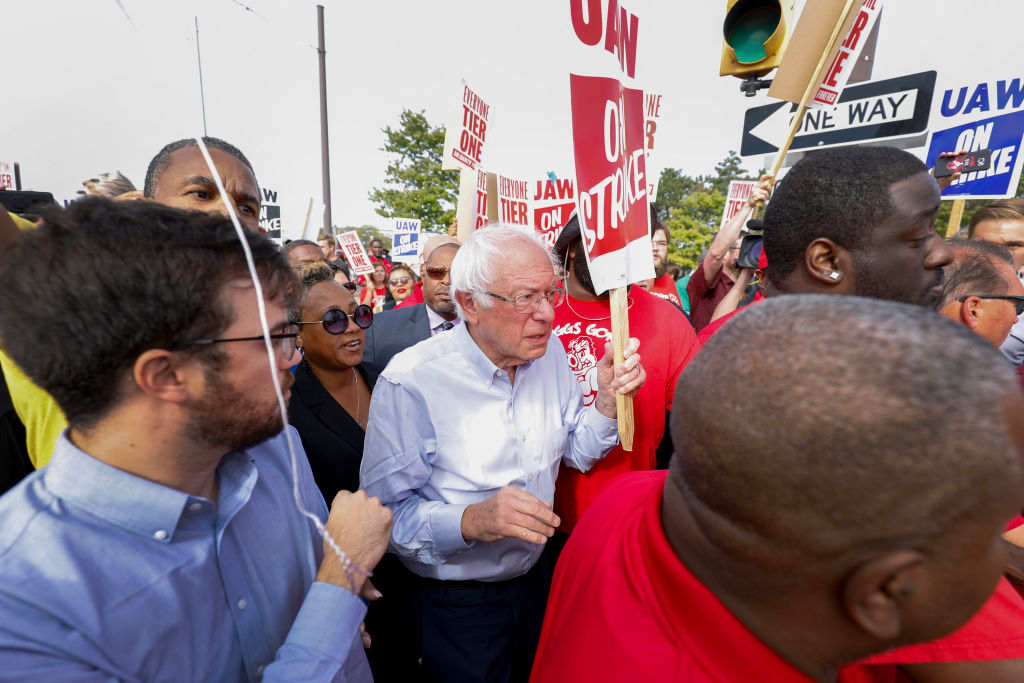
Bernie Sanders’s 2016 presidential campaign didn’t just launch the current wave of socialist electoral challenges. It also inspired and cohered a new generation of labor activists. (Bill Pugliano / Getty Images)
Bernie Sanders’s impact on the American left is not typically measured in social movement terms. The story normally goes that democratic socialism returned to national politics after 2015, tens of thousands of people joined the Democratic Socialists of America (DSA), a new generation of socialist candidates ran for office, and a much larger left media ecosystem emerged.
That’s all true. But another part of the story has received relatively less attention: the role Bernie’s campaigns played in inspiring and cohering a new generation of labor activists.
I first started making this argument while writing about the red-state teachers’ revolt of 2018. Obviously, Bernie did not cause these massive statewide strikes; years of austerity and attacks on public education created the conditions. But while reporting on those strikes on the ground in West Virginia, Oklahoma, and Arizona, I kept finding that many of the rank-and-file leaders who took the initiative to get them started had been politicized by Bernie’s 2016 campaign.
“The role of the Bernie campaign of 2016 on organizing in West Virginia really cannot be overstated,” Charleston teacher and strike leader Emily Comer told me. Bernie’s campaign, she explained, “got people, especially young people, plugged in who before had been feeling hopeless and who would not have made their way into organizing before.”
This was not just retrospective speculation. Morgantown teacher Anna Simmons described the night West Virginia teachers decided to defy their unions’ proposed settlement and continue their strike. It was the moment, she told me, when she realized that the fight “was about more than just insurance premiums and salaries. It was the continuation of a movement that started with Bernie Sanders and is going to result in a power shift from the elite wealthy to the working people.”
When I first made this case about the 2018 strikes, some critics dismissed it as a Bernie Bro exaggeration. But what happened after 2020 made the larger pattern much harder to dismiss.
The post-pandemic labor upsurge has been driven to an unusual degree by young workers organizing from below, many of whom were radicalized and made class conscious by Bernie. For my book We Are the Union, I surveyed over two thousand worker leaders who unionized their workplaces in 2022; the median respondent was twenty-seven years old and almost half identified politically as radicals.
When I asked what broader movements had influenced them, recent labor struggles were, unsurprisingly, the biggest factor. Yet more than 80 percent of respondents cited at least one outside struggle as a major influence on their decision to unionize. Among non-labor movements, Black Lives Matter and Bernie stood out: BLM had the widest reach, followed right behind by Bernie, whose campaigns also had the most intense reported impact.
My interviews with worker leaders put faces on those numbers. Max Yusen, who helped turn his St Louis Starbucks into a union stronghold, had not grown up around organized labor. “Labor was a big part of Bernie’s message,” he told me, “and being around union members while canvassing and inside DSA really made me see how important they are.” When he moved back to St Louis, he deliberately got a job at Starbucks “with the goal of unionizing it.”
Bernie’s influence also produced institutions that outlasted his campaigns. The Emergency Workplace Organizing Committee (EWOC) grew directly out of Bernie 2020 and the DSA for Bernie campaign. When Covid hit in March 2020, workers began contacting the Sanders campaign asking for help winning protective equipment and sick pay. A handful of labor organizers from the campaign, along with organizers from DSA and the United Electrical Workers, set up a Google form and began connecting those workers with volunteer organizers. It was, from the start, animated by both the class-struggle politics and the distributed organizing model of the Sanders campaign.
The same political generation appeared elsewhere in the post-2020 upsurge. Most of the salts, the rank-and-file workers who got jobs in order to organize and who played an important role in the successful Amazon Labor Union campaign at JFK8 on Staten Island had been politicized by Bernie’s presidential runs. At Starbucks, Amazon, CVS, Trader Joe’s, and elsewhere, young workers entered organizing with an anti-billionaire politics that had become far more widespread since 2016.
None of this means that Bernie produced the labor upsurge. Covid was a huge catalyst. So was the tight labor market, a more favorable National Labor Relations Board under President Joe Biden, digital tools, and, above all, the contagious example of workers themselves winning. The 2018 teachers’ strikes themselves helped inspire later strikes; Starbucks and Amazon victories then convinced thousands of other workers that organizing was possible.
But recent evidence does make the connection I saw in 2018 look less incidental. Electoral campaigns can feed workplace struggle by politicizing people, raising their expectations, bringing activists together, and giving them experience organizing others. Bernie’s campaigns did all four.
And that story is still unfolding. Amazon organizing has expanded far beyond the original JFK8 victory: the Teamsters reported this year that roughly ten thousand Amazon workers had organized at thirteen facilities around the country. In New York, Amazon workers and Teamsters are simultaneously organizing on the job and campaigning for the Delivery Protection Act, which would regulate last-mile facilities and impose new employment and safety requirements; as of September 2026, the bill remains pending in the city council with thirty-five council sponsors.
Once MAGA is ejected from the White House, there is every reason to expect that the Bernie generation of labor organizers will go back on the offensive nationwide to unionize the megacorporations that have reaped the benefits of America’s New Gilded Age and that, virtually without exception, have bent the knee to Donald Trump.
Bernie’s contribution to the revival of the American left, then, did not stop with DSA or socialist electoral politics. As Vince Quiles, a young Home Depot worker in Philadelphia, put it to me: “Bernie showed me and a lot of people my age that it’s not a bad thing to fight corporations or demand more from your government. We’re workers, you know, we produce everything, and we deserve more.”