How Bernie’s Campaigns Reorganized the Organized Left
A decade after Bernie Sanders’s first presidential run, intraleft debates about whether to engage with the Democrats are largely settled. That campaign taught US socialists much about how — and how not — to build a powerful socialist movement.
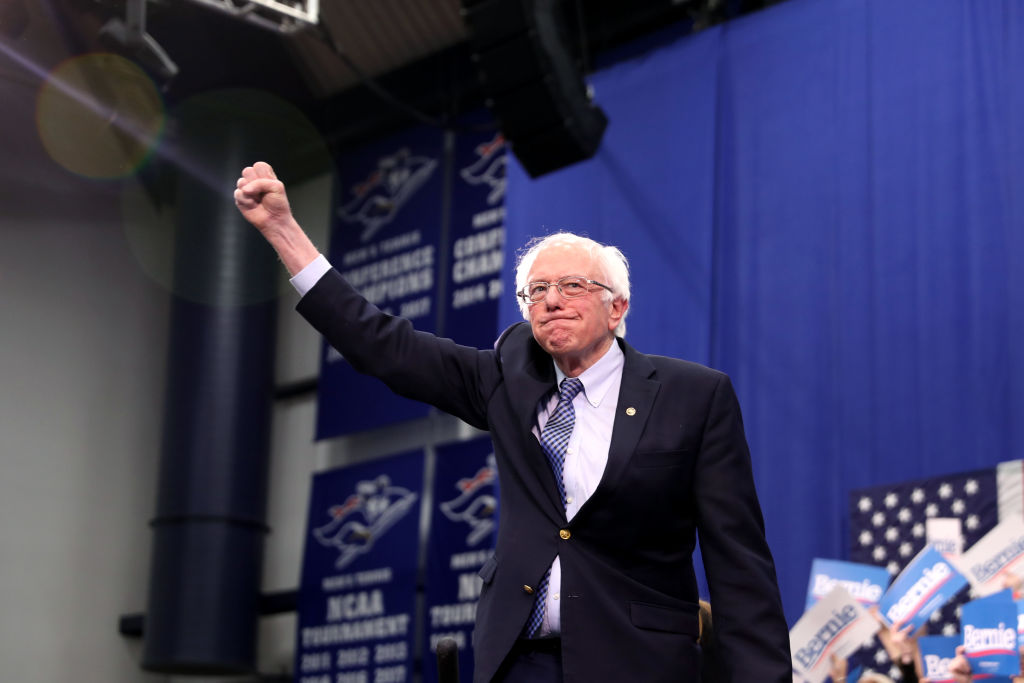
If it wasn’t for Bernie Sanders’s 2016 campaign, many on the Left would still be spinning their wheels rehashing the same debates about whether it is possible to engage with the Democratic Party as socialists. (Joe Raedle / Getty Images)
Ten years ago, while socialist Bernie Sanders was making his historic run for the Democratic presidential nomination that drew millions of supporters and promised a “political revolution” to live long past his campaign, I was part of a small revolutionary organization that pooh-poohed him as a faux renegade.
The socialist left at the time had been largely marginal to the American political landscape. This was not only because so few socialists sat in political offices. Organized socialists were unable to insert our ideas, strategies, or demands beyond small meetings and study groups, only occasionally influencing national discourse by being part of movements that showed themselves on the street in mass numbers. But movements naturally ebb and flow, and in their absence, much of the Left would retreat back into itself time and again.
In 2016, Bernie Sanders showed that socialists could be relevant to mainstream discourse, could move the needle on major policy issues, and could do so on the basis of a class politics that resonates widely and deeply around the country. Though he didn’t win that primary nor the following one in 2020, Bernie’s runs transformed the mainstream political landscape and, along with it, the organized left.
The section of the Left that threw itself in with Bernie’s campaigns — most significantly, the Democratic Socialists of America (DSA) — grew exponentially in both numbers and influence and developed a deep well of experience and savvy. The section of the Left that scorned his campaigns in favor of independence from the Democratic Party and time-honored revolutionary principles stagnated or fell apart, leaving DSA and electoral projects at the forefront of an ascendant movement.
The Left was thus reorganized to take the lead from Bernie’s “political revolution,” where electoralism was one important piece of a broad strategy to contend for power and build a mass politics. Ten years on, that political revolution continues to grow, while the approach of smaller socialist sects that had characterized so much of the pre-2016 left has receded into the background. We need not return to the path of permanent outsiders ever again.
With DSA a powerful political force in the country and democratic socialist elected officials making concrete strides forward for working people, the intraleft debates that surfaced in 2016 are largely settled. They offer important lessons about the pitfalls of a sectarian approach that places organizational identity above building the biggest and most powerful left and holds rigidly onto traditional principles above shifting political realities.
2016 Was a Turning Point
2016 was an odd time for the radical left. For those of us standing outside of the most transformational development within the American political landscape to have taken place in many years, having to explain that Bernie wasn’t a true socialist to scores of newly energized and activated young people made us feel like killjoys, no matter how we tried to spin it.
The group that I was a member of, the International Socialist Organization (ISO), insisted that we could relate to the movement around Bernie without supporting its candidate, by showing up to rallies with our newspaper and by engaging in organizing work around demands like Medicare for All. The main thrust of our argument served as a wet blanket.
The radical left quibbled with some of Bernie’s positions, but his cardinal sin was collaboration with the Democratic Party and the fact that, despite decades of holding political office as an independent, he was running for president within the Democratic primary. The reasoning behind the argument isn’t entirely wrong: the Democratic Party is a party controlled by big business. Ruling elites have traded political power among themselves through the Democratic and Republican parties for over 150 years.
The entrenchment of the two-party system in the United States is unique in comparison to other capitalist democracies. Because of antidemocratic and restrictive barriers to entry into the electoral arena, independent parties of the working class, poor farmers, and the oppressed have struggled heroically — and largely failed — to assert themselves or break the stranglehold of the two parties. In that context, Bernie Sanders and others who have followed in his footsteps since have opted to run for political office utilizing the Democratic Party and its open primary elections.
Despite the conservative leadership of the party, Sanders wagered, socialist politics could appeal to the base of the party and create a movement from within. Sanders understood it was a serious problem that workers didn’t have their own party and were largely stuck with the Democrats, but also that the structural limitations of American politics made a break with them impossible in the short term. So he developed a strategy of running for president within the Democratic Party and engaging mass numbers of Americans while remaining independent of and often explicitly hostile to the party’s elites.
Many on the already existing radical left weren’t buying it. Bernie was just another “sheepdog,” according to Bruce Dixon of Black Agenda Report, “charged with herding activists and voters back into the Democratic fold who might otherwise drift leftward and outside of the Democratic Party.” Howie Hawkins, a Green Party leader who himself had run for various offices on the Green Party line, argued at the time: “Sanders is violating the first principle of socialist politics: class independence.” Bernie’s positions on the issues, he explained, are “secondary to the question of whether his politics are helping the working class act for itself or subsume itself under the big business interests in charge of the Democratic Party.”
According to this line of argument, the party leadership actually benefits from such campaigns, because the campaigns reengage otherwise disaffected voters.
The “well-trodden path” worn by Dennis Kucinich was the prime example. Running in the Democratic primaries for president twice, in 2004 and 2008, on a platform opposing war in Iraq and in support of single-payer health care, he garnered less than 4 percent of votes, eventually throwing his support behind John Kerry and then Barack Obama.
The radical left assumed the same fate for Bernie Sanders in 2016. “The Democratic establishment can breathe a collective sigh of relief,” argued one Socialist Worker article. “It doesn’t, in fact, fear liberal Democrats like Kucinich or Sanders, but third-party challenges like [Ralph] Nader’s that have the prospect of breaking their stranglehold on votes from workers and the oppressed, as several local and statewide campaigns have shown over the last few years.”
From there flowed a familiar refrain of arguments: No sustained movement would come of it. The Democrats have always functioned as the “graveyard of social movements.” Radicals attempting to change the Democratic Party would only end up changed themselves, ostensibly into toothless reformists. And the old favorite, quoting historian Howard Zinn: “What matters most is not who is sitting in the White House, but ‘who is sitting in’ — and who is marching outside the White House, pushing for change.”
The only revolutionary socialist organization to endorse Sanders was Socialist Alternative. It took the awkward tack of endorsing Bernie while urging him to run as an independent in the general election, in the likely event that he lost the primary (although he had made it clear, in no uncertain terms, that he would not do so). It tried to distinguish its politics from the larger DSA, which was much more integrated into Bernie’s campaign. Meanwhile, the American Stalinist organization the Party for Socialism and Liberation (PSL) ran its own candidate for president but more enthusiastically greeted the Bernie movement as a positive step for the socialist left, frowning upon the strategy of other socialists for calling out Bernie as “not a real socialist.” By 2020, it would argue for critical support of Sanders’s campaign.
Of course, what actually happened in 2016 didn’t follow the expected script. Entering the campaign with no name recognition and polling just 3 percent at the start, Sanders went on to win twenty-three primaries and caucuses and about 46 percent of pledged delegates at the Democratic National Convention. Leaked emails among Democratic National Committee members (who, as it turned out, were much more afraid of Sanders than they ever were of third-party challengers like Nader) exposed behind-the-scenes work in the committee to help Hillary Clinton secure the nomination.
Bernie did endorse and campaign for Clinton in the general election, as promised. But that didn’t stop millions of his supporters from learning a bitter lesson about the party’s establishment. The word “socialist” went from a slur to a point of pride. The “political revolution” that Sanders promised came to be through a growing number of democratic socialist campaigns, from Alexandria Ocasio-Cortez’s upset victory over ten-term incumbent Joe Crowley in 2018 through to Zohran Mamdani’s New York City mayoralty today.
But while the Left as a whole was buoyed by Bernie’s 2016 run, some radical socialist organizations floundered. DSA grew exponentially by the tens of thousands, and groups like the ISO shrank. Three years later, when it came time to decide how to relate to the 2020 election, most of the revolutionary left opted to just run it back. What could arguably have been considered an understandable mistake in 2016 was by 2019 a different ballgame.
Sanders had proven that it was possible to make a serious run; that millions would be radicalized rather than sheepdogged; that tens of thousands would become politically activated in a more long-term way, whether through joining an organization like DSA or by taking inspiration to organize their own workplace.
But despite the fact that reality did not play out in the way that the theory had said that it would, the revolutionary left doubled down. Unwilling to adapt the theory to fit new realities or even to acknowledge obvious truths standing right in front of it, the revolutionary left made clear that opposition to the Democratic Party was its core political identity. That identity was hard to part with, and it precluded a serious political and strategic discussion of how to go about rebuilding the Left in a country where the undemocratic two-party system has a stranglehold over electoral politics. So much so that a remotely viable third-party challenge, on a national level, has not happened in a very long time.
Lessons for Today
As the Left reorganized, three critical lessons emerged. First, theory, even that which has been elevated to first principles, is good only insofar as it explains the world around us. If we can’t question our a priori assumptions when they no longer fit reality, then we have become pure propagandists. Second, if those principles become your identity and the organization holding that identity becomes more important than the health of a broad, effective left, then you have become a sect rather than a serious political project.
In the ISO, which I was still a member of in 2019, a small group of us attempted to shift the organization’s electoral strategy to allow for endorsing Bernie Sanders and other socialist candidates running on the Democratic Party ballot line and were met with dismay from the majority of the organization. One document written against our proposal understandably argued that willingness to work within Democratic Party campaigns “logically spells the end of the ISO as a distinct organization on the left.” Pointing out that without a hard abstention from the Democratic Party, the ISO’s politics would be “virtually indistinguishable from the left-wing socialist currents inside DSA,” the document asked: “Why would someone eschew joining a vibrant and growing organization of 40,000 socialists — which includes a growing faction that accords with their politics completely — in favor of joining a political facsimile which is not only outside of DSA but boasts a membership that is a mere 3% of the size of DSA?”
The assumption that carried the argument was that the ISO’s brand, identity, and survival as an organization were paramount. This was not because members of the ISO, or any other radical socialist organization, were particularly inclined toward sectarianism. But the many years and decades of operating in isolation, which were imposed by a historically weak Left and labor movement, had left their mark. Detached from working-class movements, the Left developed deeply harmful habits and a mindset that assumes that your organization’s preservation is critical above all else.
Lastly, while revolutionary socialists weren’t wrong in their assessment that it’s a huge problem that the Left doesn’t have its own party, they were wrong in their prescription for how we get there and wrong in their assumption that a third party is on the agenda at this moment. Some pointed to polls showing widespread support for a third party. In fact, at least 40 percent of Americans have told Gallup a third party is needed every time it has asked the question since 2003, and majorities have said so in every poll since 2013. But the idea of a third party is very different from actually voting for a third party that has no chance of winning in a system stacked against it.
Thus in 2016, while millions donated to, and over 13 million voted for, Bernie Sanders, Green Party candidate Jill Stein received 1.5 million votes, just over 1 percent of the total. The high points of third-party electoralism included Ralph Nader’s 2000 run, which garnered less than 3 percent of the vote and in which Nader was excluded from ever appearing at a presidential debate. As a socialist, I helped lead a Nader 2000 committee at the time, and the experience showed a huge potential for organizing vibrant electoral campaigns. But Nader’s relegation to “spoiler” status by our undemocratic electoral system made it impossible to make substantive headway on Election Day.
Worse, the backlash against Nader’s campaign once George W. Bush won (arguably stole) the election by a slim margin only further set back the left electoral project. Even Eugene Debs, the American socialist movement’s greatest popularizer, won 6 percent of the vote in 1912. The Populist Party made its most impressive national gain in the 1892 presidential election with just over 8 percent of the popular vote.
Today, with democratic socialist Zohran Mamdani the mayor in New York City, making good on promises to freeze rent and provide universal childcare, the popularity of socialist ideals is soaring, with a majority of young people, women, and people of color favoring socialism over capitalism. Meanwhile, a recent CNN poll showed the Democratic Party’s favorability ratings at a low of 30 percent, while Mamdani, Ocasio-Cortez, and Bernie Sanders top most lists of politicians by popularity. It seems that their campaigns, rather than rehabilitating the Democratic Party, have accentuated the fissures within it. Democratic socialist politicians, no matter their popularity, haven’t been immune to criticism either — a point brought home when Sanders’s slowness to call out Israeli genocide in Gaza earned him scorn from his own supporters.
Ten years after Bernie’s first presidential run, his political revolution is still in its early stages. Organizing an independent left pole within the Democratic Party has already scored significant victories, strengthened insurgent left organizing, and popularized the ideals of socialism to millions of people.
The Left has grown quickly over the past decade. Despite largely settling the question of whether we can work within the Democratic Party, which was so anathema to many radicals before 2016, we must still grapple with questions of how to do so effectively while avoiding the pitfalls that so many previous American leftists have fallen into in engaging with the party. Winning mass-based electoral campaigns against the Democratic establishment is the first hurdle. But navigating the complexities and contradictions of socialist governance in a capitalist state is a harder hurdle to clear.
If we can absorb the lessons that Bernie first started teaching us a decade ago — shedding permanent outsider status and purity politics in favor of broad-based organizing, avoiding the pitfalls of sectarianism in favor of building a powerful left, and discarding rigid theoretical commitments in favor of tactical flexibility rooted in firmly held political principles — who knows where the Left will be another decade from now?