A Decade After His First Presidential Run, Bernie Isn’t Alone
It’s a mark of the influence of Bernie Sanders’s first presidential campaign that the American political landscape before he ran looks unrecognizable now. Most of the hundreds of socialists who now hold power across the country were directly inspired by it.
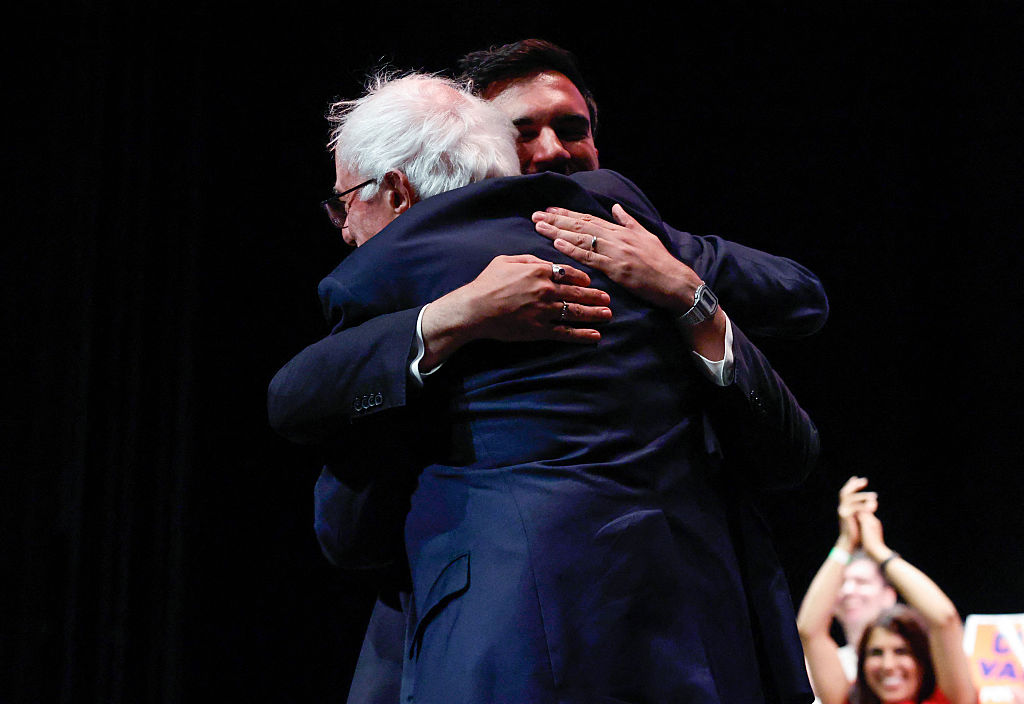
The American left would not be in the newly relevant, growing, and increasingly powerful state it is now in without Bernie Sanders’s first presidential run ten years ago. (Kena Betancur / AFP via Getty Images)
If you’re anyone who veers remotely to the left politically, there are two eras: a time before Bernie Sanders ran for president, and a time after. The US political landscape before Sanders’s first presidential campaign looks today like an alien planet. There were virtually no socialists who held elected office, or at least those who admitted to it. The Democratic Socialists of America (DSA) was an obscure organization with a little over six thousand members across twenty-six chapters. Arguably the most prominent leftist figure was a curmudgeonly linguist who almost never appeared in mainstream media, Noam Chomsky. Only 59 percent of Democrats and less than half of independents were willing to vote for a socialist candidate. And the great progressive hope was a politician who flatly opposed single-payer health care and ran on a platform of stronger regulation and more public investment in key industries.
Within five years of Sanders’s run, dozens of open socialists served in elected office at every level of government, including the US Congress. DSA’s membership had exploded to more than 55,000 with more than 150 chapters in every corner of the country. Socialists like Sanders and Alexandria Ocasio-Cortez were among the most popular political figures in the country. The share of Democrats willing to vote for a socialist candidate had jumped to 74 percent. And that progressive politician, Elizabeth Warren, launched a presidential campaign on a platform of single-payer health care, universal childcare, free public college, and debt cancellation.
Neither Sanders nor his campaign were single-handedly responsible for all this. But it’s not a coincidence that the political landscape transformed this drastically, in this particular way, within less than a decade of his first campaign, nor that 97 percent of DSA’s now 120,000-strong membership joined after 2016 (the majority of its current members joined after 2019, when Sanders launched his second run and a year after Ocasio-Cortez first won election). Before Sanders made his first official announcement — to a small crowd of Capitol Hill reporters, muttering that there wasn’t an “endless amount of time” because he’d have to get back to work — most people, even on the Left, would have told you the world we currently inhabit, with all its horrors but also its sudden possibility, was decades away at best.