The Problem With Homeownership
A new history traces the American idealization of homeownership. It lays bare the high social costs of organizing democracy around property values.
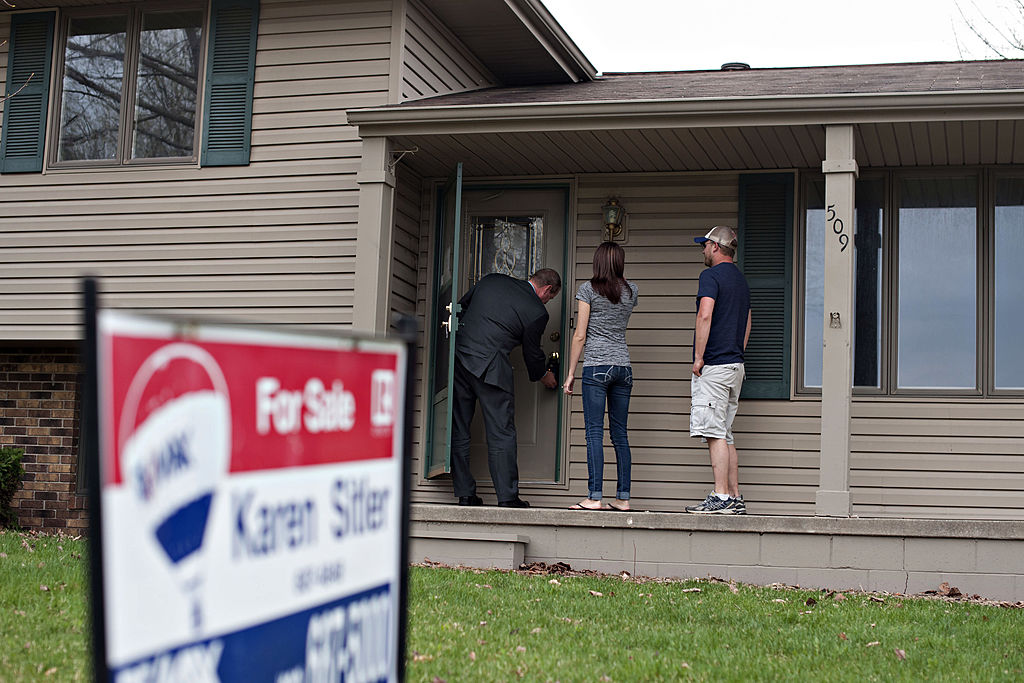
Joshua Specht’s new book argues that the American story is the story of land, with the cult of homeownership its most striking subplot. It vividly illustrates the moral and political dangers of allowing property values to dictate public values. (Daniel Acker / Bloomberg via Getty Images)
A few days from now, my adopted hometown of Vancouver in British Columbia is going to elect a new mayor and council. The low turnout in municipal elections here skews toward affluent owners of detached houses who pay the most property tax and grumble about it. Mayor Ken Sim and his ABC (“A Better City”) party, who won the 2022 election, understand their base: they froze property taxes this year after abolishing the living wage for city employees. The ABC administration also implemented a wave of layoffs and promises to repeat the trick next year if reelected. Meanwhile, underfunding has left two-thirds of the city’s community centers to crumble away.
Although ABC has given property developers a free hand to put up towers in the city’s core, they have not touched the zoning regulations that prevent the construction of apartments across most of Vancouver, which interwar planners intended to be a suburban city of detached homes. Sim’s party has also stoked the dread of the transient poor that has always thrived in its more chichi neighborhoods by imposing a ban on new supportive housing and hiking the police department’s inflated budget. Although ABC’s progressive opponents have condemned these actions as cruel, many of them are no keener to challenge homeowners by permitting greater density.
Vancouver is but one example of the property-value politics now widespread across Canada, in which the desires of existing homeowners take precedence over economic development or the common good. The historian Joshua Specht suggests that such politics are even more pronounced in the United States. Property Values: The Rise and Fall of the American Homeowner asks how and why municipal officials, planners, and politicians decided to take the side of homeowners against real and imagined threats to the value of their investment. It emphasizes the accidental triumph as well as the social costs of a narrow cult of private ownership that took off because it promised to maintain moral and political principles dear to Americans.
Property and Ownership
Specht comes to this project as a discerning analyst of market failure. Red Meat Republic, his first book, explained the rise of nationwide cattle markets that turned later nineteenth century Americans into insatiable consumers of beef. It also showed how poorly efforts to manipulate those markets often worked out: cattle ranchers lost their shirts to meatpackers, while country towns that remade themselves to handle livestock traffic failed when it migrated to better-connected locations. The foundations of the American home, Specht argues, turn out to be no less shaky.
It takes Specht half of his book to get to houses. “The American story is the story of land,” he argues at some length, before presenting the cult of homeownership as the most striking of its subplots. The founding fathers dreamed of a Roman republic of independent farmers whose sturdy labor would make a patch of the new world their own and confer on them the independence that theorists insisted was crucial for participation in politics.
This dream was a nightmare for indigenous peoples. Although historians now celebrate their intermittently effective resistance to settler aggression, they were displaced from their lands and eventually confined to reservations. Nevertheless, the yearning for land of one’s own certainly popularized democratic ideals among settlers. Specht tells the story of the rebel tenant farmers of New York State, who rose up in the 1840s against the old stock landowners who had tightened the screws on them. Disguised as the Native Americans they had replaced, in a loaded allusion to the Boston Tea Party, they hazed their rent collectors and disputed their leases. The moral economy of the crowd — some said mob — emboldened them to demand the right to own the land that their toils had improved. Although their ringleader, “Big Thunder,” was jailed, they prevailed, not least because New York State’s political parties sensed electoral advantage in courting them.
Slavery is often regarded as the original sin that poisoned and then nearly broke up the United States, but Specht argues that these controversies came second to the primal question of who should own the soil. John Brown and his godly terrorists killed farmers at Pottawatomie Creek in Kansas because they had arrived there from slaveholder states. “Free soilers” like Brown wanted to ensure that this newly created territory belonged to independent proprietors rather than being snapped up by the South’s satanic aristocracy.
After the Civil War began, the North tried to end the Southern plantocracy for good. The Emancipation Proclamation would rob it of its workforce, while the rollout of the 1862 Homestead Act in the West would establish America as an egalitarian democracy of small farmers. That vision still required wiping indigenous people off the map. Brown’s bloodstained creek bore the name of the Potawatomi people who had been marched there from Indiana before settlers pushed them still further west. General William Tecumseh Sherman of the Union Army pivoted from burning plantations to starving indigenous societies into submission by killing their buffalo and destroying their crops.
A landowning democracy never took off in the defeated Confederacy. Sherman wanted to carve smallholdings out of plantations for the “respectable Negroes” who had flocked to his army. But President Andrew Johnson was a white supremacist with no desire to create a black yeomanry. Northern elites accepted the planter argument that only their large-scale estates — now worked by dependent, though nominally free, laborers — could produce enough cotton to feed northern mills. The Southern Homestead Act (1866) was the best Washington could do for black Southerners: it allocated them plots on federal lands, but these were too poor to make viable farms. In 1900, three-quarters of black farmers in the South were still tenants. Hopes of colorblind landownership nonetheless took a good while to fade. Specht points to the black homesteaders who trekked to Kansas to found Nicodemus, a boomtown that soon supported two newspapers.
Landowning Democracy in a World of Finite Land
Nicodemus shrank once it became clear that no railway would run near it. Western homesteaders soon learned that their towns could only survive if the farmers they hosted could get their produce to market. Yet the only way to build railways was to offer enormous land grants to railway companies. Because railways could redraw their routes at almost any time, they had an edge speculating in property, enriching themselves and stranding others. Land became a commodity rather than a firm basis for a continental polity.
An agrarian republic also had to reckon with an unstable climate. The rush to homestead the West after the Civil War coincided with a wet period that encouraged the tilling and grazing of its soils. This changed when droughts and locust plagues set in. The steam-powered integration of farmers into far-flung markets also proved to be a curse after distressed Argentinians dumped their wheat in the United States and crashed prices.
A landowning democracy presupposed a limitless supplies of western land. But as the historian Frederick Jackson Turner first observed, the consolidation of California and the completion of railways to the Pacific had closed the frontier. The fear grew that a grasping minority could now monopolize a finite resource at the expense of small producers. This explained social reformer Henry George’s abstruse but popular proposals to tax the value of land. It also motivated the populism of William Jennings Bryan, who urged the adoption of bimetallism to loosen up the currency and so to inflate away the debts of mortgaged farmers. Although Bryan won the Democratic presidential nomination in 1896, his populism turned out not to be that popular outside the rural South and Midwest, because it had little to say to the growing number of Americans who worked in cities.
Where did America’s future lie, if not with farmers? Before Specht turns to the rise of the homeowner, he points to an important false start: the vision of Jane Addams, a wealthy woman who pursued the gospel of social reform in Chicago. She experimented with running a farm and went to Russia to commune with the novelist and ascetic Count Leo Tolstoy. Back in her adopted home of Chicago, she decided that she did not want to be an urban peasant who baked her own bread and instead helped cofound Hull House, a social hub that promoted the mixing of classes and ethnicities. Chicago was America’s future: a place that reflected the country’s heterogeneity and compensated for it by encouraging the “Americanization” of its residents.
The second half of Property Values explains why this urban “social democracy” never materialized. The main cause was the state’s resolute defense and then eager promotion of private homeownership. It began as a panicked response to the mounting problems of agriculture, which became a crisis after the Great Depression. Farmers had borrowed heavily during the 1920s in order to industrialize their operations. They were then hit hard when American banks and foreign lenders sought to contract their lending and interest rates rose. The return of drought and the erosion of topsoil in the West compounded the crisis. The banks foreclosed on people and sold off farms, bringing about the first nationwide drop in home prices with the onset of the Great Depression.
America’s “Resettlement”
This essentially rural crisis evoked an emotional defense of homeownership from successive presidents. In 1931, Herbert Hoover observed that it “makes for happier married life” and so for “better citizenship.” He felt that “homeowners no matter how humble they may be” were the mainstays of “liberty and freedom.”
Franklin Delano Roosevelt spent heavily on such phrases, passing the Emergency Farm Mortgage Act to bring relief to troubled farmers and creating the Home Owners’ Loan Corporation. In its first three years, it refinanced one million home loans on the kind of terms that are still familiar: amortization over the course of the term at fixed rates of interest. By 1936, 10 percent of all non-farm mortgages were managed by the corporation. Congress also created the Federal Housing Administration (FHA), which insured mortgages, and the Federal Savings and Loan Insurance Corporation, which insured deposits in savings and loan associations.
Roosevelt’s New Dealers spoke of a “resettlement of America” that moved the site of ownership to the suburbs. Farmers would be subsidized to end overproduction of crops and the rural population would shrink. The future lay with wage earners toiling in factories and offices to pay off mortgages. Men would make the payments and women would make homes with the aid of new labor-saving gadgets. They would live outside the “skyscrapers and tenements of New York and Chicago”: homemaking required grassy yards in which adults could relax and children play.
These priorities tied housing to the automobile and so to the burning of gasoline, with huge consequences for the built environment and the climate. Specht, however, is more interested in what they did to sharpen social and racial inequalities.
The FHA’s decision to refuse loans to homebuyers in black or racially mixed areas ruled out a genuinely egalitarian democracy. Redlined districts subsided into slums because black homeowners could not borrow against their homes to renovate them; houses in these neighborhoods perversely became more expensive as builders had no incentive to increase supply.
To the indignation of black organizations, William Levitt and other postwar suburban developers used racially restrictive covenants to obstruct non-white buyers. Residents who bought into their developments accepted the premise that black neighbors would harm their investment. When Bill and Daisy Myers bought a house in the Philadelphia suburb of Levittown in 1957, they endured a violent campaign of harassment before finally moving away after five years.
Homeowner Representation Without Taxation
For Specht, this ugly episode was more than an explosion of atavistic bigotry. It was a response to how markets operated: residents were likely correct to fear that racial mixing would depress prices in Levittown. Of course, this was not a result of a natural economic law — it was the result of the real estate market structurally organized by developers and financial institutions to set a higher price on ethnically homogenous neighborhoods.
Even Quaker activists who supported the Myers urged the need to temper the “flow of negroes” into Levittown. Many protesters were consistent in their own minds in claiming to approve of the “nice” Myers while vitriolically opposing them as neighbors. Specht’s materialist reading of racism perhaps underplays the visceral character of the reaction to the Myerses: the people who waved Confederate flags and burned crosses on lawns worried about miscegenation as well as mortgages.
A few stood against this immoral economy of the crowd. The Wechslers, who lived next door to the Myers, braved antisemitic threats for standing by them. Yet in 2000 over 90 percent of Levittown was still white. American homeowners today — even in fiercely liberal districts — continue to mobilize against renters, immigrants, or other undesirables who threaten the value of their homes.
In addition to their fellow citizens, many homeowners came to view the state as a threat, forgetting that federal backing made the mortgage market viable to begin with. Specht illustrates this with a brisk telling of the rebellion against property taxes that shook late 1970s California. Investors seeking a hedge against inflation had poured money into homes. Prices rose across the nation but rocketed in Los Angeles County, where the impossibility of everyone living in a roomy detached house by the beach, or even near centers of employment, engineered an artificial scarcity of housing.
Because tax assessments were computed as a fraction of the market value of homes and revised to take account of the sales price of comparable properties, bills soared accordingly. Homeowners remained more or less quiescent only because pliable and sometimes corrupt assessors were willing to keep assessments artificially low. When this element of discretion vanished, the result was a rabble-rousing campaign to pass Proposition 13, which capped the property tax rate at 1 percent of assessed value and restricted annual increases in assessed value to 2 percent.
The Californian rebels resembled the Levittown racists in securing their own market position to the exclusion of other moral or social considerations. They were not wrong to resent the fact that property taxes in California were 50 percent higher than the national average. Yet the passage of Proposition 13 in 1978 did enormous damage to the funding of public goods — and of schools in particular — for decades to come. By limiting the annual increases in the assessed value of existing owners’ homes, it privileged incumbents over newcomers, shielding the former from the impact of subsequent increases in house prices.
New entrants to the Californian market were stung by taxes assessed on the high prices they had just paid. An effort by one purchaser, Stephanie Nordlinger, to challenge this unfairness in the courts failed in 1992. Specht wryly notes that she still owns that home and so has long since benefited from the injustice she once contested.
The revolt had big ideological ramifications nationwide, putting Americans on guard against “wasteful government.” Ronald Reagan, governor of California while the revolt gathered steam, took this resentment of taxation with him to the White House. The spread of homeowner associations as a vehicle for property development in recent decades has further entrenched selfishness as a governing principle: homeowners who pay high fees to have their associations fix their private roads and collect their trash now wonder why they must also pay property taxes to the city.
The BANANA Republic
The last chapter and epilogue of Property Values show how the 2008 crash pushed the treatment of homes as tradable assets to its disastrous finale. Its origins lay in the rise of mortgage-backed securities, which expanded the amount of capital available to lenders. They issued more and more loans with small down payments, high loan-to-value ratios, and teaser rates that initially kept monthly payments low before resetting. Yet bundling mortgages into securities and dividing them into different “tranches” — ostensibly safe claims were sold to investors while toxic residual risk spread throughout the financial system — disguised how risky such practices were. Foreign banks eager for a share of America’s growth were happy to purchase these securities.
The sums poured into housing doubled the price of the average home, encouraging speculative buyers to flip homes for profit. Existing homeowners refinanced, extracting trillions of dollars of equity from their properties to finance renovations or just to buy consumer durables. The inability of “subprime” borrowers to keep up with their repayments finally caused the banks to initiate a wave of foreclosures. This tanked values in boomtowns like Las Vegas: buyers who now owed much more than their waning assets were worth often abandoned or vandalized their homes, perpetuating the downturn.
The federal government proved keener to rescue the financial institutions that had made this market than homeowners. President Barack Obama shrank from “cramdown” legislation that would have shrunk the liabilities of individual borrowers. He also had to reckon with a fierce revival of prejudice over which Americans deserved to own homes. Many on the Right blamed the crisis on ill-considered loans to ethnic minority homeowners. The Tea Party movement arose amid ferocious opposition to government mortgage relief for struggling borrowers.
Prices have rallied since the crash, not least because homeowners in the most sought-after and dynamic parts of the United States have blocked further development near them. NIMBYs (Not in My Backyard) of coastal California have hardened into BANANAs (Build Absolutely Nothing Anywhere Near Anyone), protecting home values not through naked class or racial prejudice but by posing as guardians of the environment.
A tenuous but malign stability has therefore settled over the American housing market. Around two-thirds of Americans still own homes, but with the average price roughly double its 2010 level, new owners are often carrying grotesquely higher levels of debt. It is not just price pressures but a deranged climate that is hollowing out this lopsided homeowner democracy. Global warming is supercharging Californian wildfires and tropical storms in Florida, forcing states to prop up housing markets as insurers of last resort.
Urban Abundance or the End of Ownership?
Property Values is a model of the academic trade book. It is as fluent as it is gloomy. Each of its chapters reads like a superior kind of New Yorker essay, starting with a person or a community whose heroism or sufferings illustrate a circuitous but inexorable drift toward disaster. These horrible histories of the present often suggest that life in North America could have turned out differently — fairer, nicer, less polluting — if only we had listened to this or that visionary. But can Specht offer us a way out of the housing trap whose jaws so slowly closed around us? Not really.
He respects the continued popularity of homeownership and so won’t give up on it. He shares the conviction that owners maintain their homes and so take pride in their communities more than renters do. With the frontier long closed, where to find a new “abundance” of places for Americans to own? Instead of sprawl, Specht urges “density”: filling in the costlier metropoles with higher complexes (and perhaps smaller homes) as well as expanding cheaper cities so that almost everyone can own a row house or a condo. He also offers some diffuse suggestions for cultivating “egalitarianism without exclusion” that Jane Addams would have approved, such as going for neighborhood walks or putting on potluck suppers.
These are reasonable proposals but do not explain how we might overcome the entrenched suspicion of the property developers that would be required to construct enough urban condos for sale in some version of a free market. Here in Vancouver, for instance, such sentiment is just as common among renters who fear “demoviction” and professional planners who prioritize “deep urbanism” over speedy construction as it is among boomers ensconced in multimillion-dollar heritage houses.
Specht’s emphasis on cities also comes as a plot twist, given how abruptly his story of ownership jumps from farms to suburbs. It is hard to see how federal or state agencies could be pushed to give up subsidizing the lives of suburban car drivers. The same holds true here in Canada, where provincial governments spend on highways but too often won’t fund the urban and intercity transit infrastructure that cities need to grow.
Specht never considers whether we should abandon or heavily qualify the dream of ownership that has bent North American life out of shape — and has never been feasible for many people with low or irregular incomes. Ownership could sustain community rather than encourage selfish fear of outsiders, but it usually hasn’t; housing markets could offer dignity and security to the majority, but in the end they haven’t.
There is a reason why social democrats across Europe and North America once focused on building urban nonmarket housing for rent. Access to health-giving and dignified housing without regard to income was meant to be the material foundation for the kind of ethical community dear to Jane Addams. Specht vividly illustrates the moral and political dangers of confusing property values with public values. Might it not be time to separate them once again?