Trump’s Politicized Deportations Are Becoming the Global Norm
The politically driven attempt to deport war critic Leonid Ragozin from Latvia shows that liberal democracies are starting to employ the very Trumpist and Putinist measures they claim to despise.
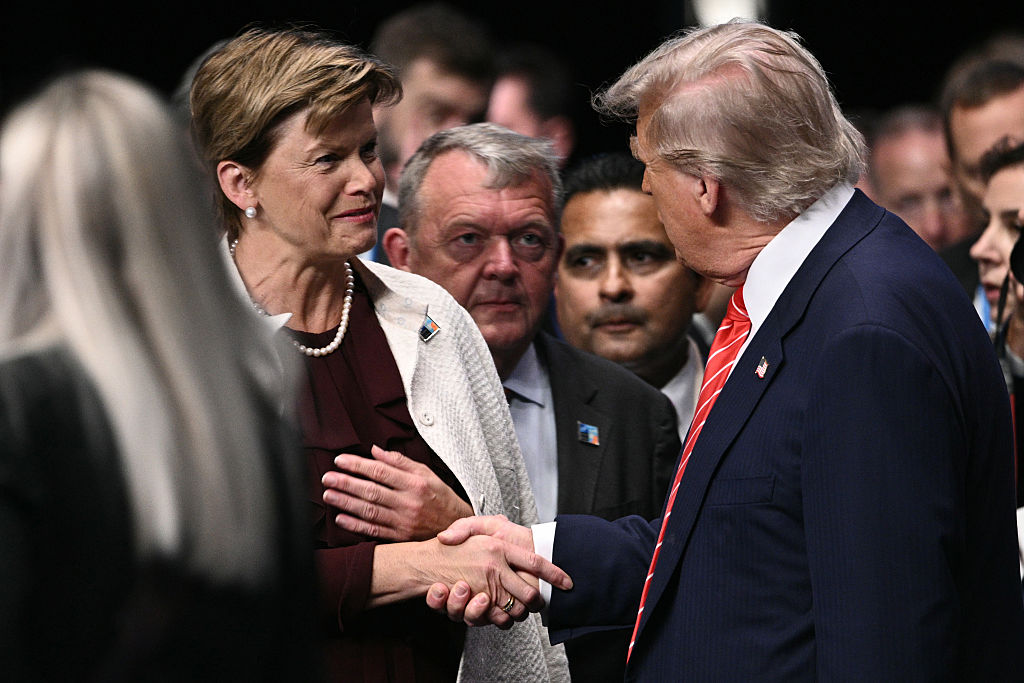
More and more, particularly in liberal democracies, we are seeing immigration policies leveraged as a way to punish and censor speech. (Brendan Smialowski — Pool / Getty Images)
Given all the headlines about the US government trying to deport one or another migrant over their foreign policy views, you’d be forgiven for thinking this is a uniquely Trumpian innovation. Sadly, as the recent developments out of Latvia show, it’s far from it.
Yesterday news broke that Leonid Ragozin, an exiled Russian journalist who has lived in the Baltic country for over a decade (and is also a Jacobin contributor who I interviewed for a forthcoming piece) has been declared persona non grata by the Latvian government, which intends to swiftly deport him. The Latvian foreign minister cited unspecified “information” received from “the competent authorities” to justify this extraordinary measure, but you barely have to even read between the lines to see that Ragozin’s offense was simply having opinions and doing reporting that the Latvian elite don’t like.
For one, there’s the fact that Latvia’s own interior minister, Jānis Dombrava, came right out and said this, complaining last week that Ragozin had “over a prolonged period of time, publicly expressed opinions that are in blatant contradiction to the interests of the Latvian state.” You’ll note that this rationale is eerily similar to the words that Donald Trump’s State Department has used to claim the power to strip permanent residency from and deport pro-Palestinian activists Mahmoud Khalil and Mohsen Mahdawi: that they hold views that might have “serious adverse foreign policy consequences” for the United States.
That Ragozin is being targeted for his journalism and opinions is made even less in doubt by the fact that several news reports based on information fed by European officials all mention a recent interview Ragozin did with Aaron Maté for the podcast Useful Idiots, clips of which have then been circulated online and cited by anti-Russia accounts that exist to harass anyone not toeing a sufficiently pro-war line on Ukraine. Ragozin’s critics have charged variously that he’s an “apologist of Moscow’s war against Ukraine,” that he “push[es] aggressively pro-Russian lies,” or, in the words of the Latvian politician who suggested he be deported in the first place, says things that reflect Russian propaganda about the war in Ukraine and so was actually playing a role in Russian “hybrid warfare” activities. (Yes, a politician really said this).
You may not be shocked to find out that this is all complete and utter nonsense. Ragozin has done a lot of writing, so it is not remotely difficult to quickly bring up a long paper trail of all the times he has criticized Vladimir Putin and his horrendous war.
The day Russia invaded Ukraine, Ragozin called it “a crime against Ukraine” and a “brazen violation of international law” that “will mark a dark chapter in Russia’s history.” He also called it “insanely criminal” and “all-out aggression” and accused Putin, who he has called “horrible,” of having “unleashed evil.” In a piece for The Washington Post early in the war, he dismantled he war propaganda fed by the Kremlin to the Russian public, telling readers that “Russians are not facing an existential threat now, of course” but rather “it is their own country that’s posing an existential threat to a neighbor.”
In other posts, he’s charged “the vote was blatantly unfree” in Russian elections, mocked the nonsense math involved in Putin’s rigged elections, pointed out the gulf between the Russian leader’s sanctimonious appeal to “traditional values” and his own private behavior, and frequently lauded and defended the liberal Russian opposition leader Alexei Navalny, who was tortured and likely killed by the Putin regime. You could go on and on with this, but you get the idea.
Look at what Ragozin actually said in the interview, and it’s obvious his critics are doing what the war lobby always does, including throughout the nearly five years the Ukraine war has raged: twisting his words to make his analysis seem like partisan cheerleading. Far from justifying Moscow’s actions — or lobbing a threat against Latvia, as some have claimed particularly dishonestly — Ragozin was doing what analysts and journalists do and explaining the mindset that is driving the current Russian “hybrid warfare” campaign in Europe.
No, if you want to understand what Ragozin has done wrong, Latvia’s interior minister helpfully laid it out: Ragozin has, among other things, “blamed the West” for the war, “criticized the West and Ukraine,” “discredited” Ukraine’s politicians and armed forces, called the anti-Russian sanctions ineffective, and questioned if simple imperialism was really the only motivating factor behind Putin’s invasion, as Western politicians tend to insist.
In other words, he has done reporting, voiced opinions, and highlighted information that are politically inconvenient for a hawkish Latvian elite — no different from how those who said September 11 was blowback for US foreign policy have been labeled pro-terrorist, or how those pointing out that the seeds for October 7 were sown in previous decades of Israeli brutalization of Gaza were labeled antisemitic pogromists.
Or, as an editor at the Berlin-based Zentrum Liberale Moderne — a think tank that styles itself as “stand[ing] for the defense and renewal of liberal democracy” — helpfully summed it up: “Since 2022 he gradually transformed into a rancorous peacenik.”
Weaponizing Immigration
On the one hand, this is all the culmination and natural outgrowth of a toxic political discourse that’s developed around the Ukraine war and Russia. Ragozin, like all critics of this war, has for years been on the receiving end of these kinds of spurious and ugly smears, meant to cast basic foreign policy analysis as treasonous and even criminal, a trend hardly limited to the Baltics but sadly one we’ve seen across Europe and the Western world. The difference is, until this current Latvian government, no government was thuggish and shameless enough to treat these kinds of internet smears as the legal basis for something as serious as deporting someone.
But there’s something else going on here. As Ragozin himself wrote yesterday, Latvian authorities are resorting to declaring him persona non grata out of “the desire to deny me justice in the court system where the case — as senior politicians involved in attacking openly admit — won’t hold water.” In other words, weaponizing the immigration system against a dissident and war critic means a much easier threshold to punish someone for doing journalism.
This, too, is part of an alarming and accelerating trend, a different one. More and more, particularly in countries that are meant to be liberal democracies, we are seeing immigration policies leveraged not for their actual purpose — for managing the millennia-old, natural movement of human beings across borders in a secure and orderly fashion — but as an extralegal way to punish and censor speech. The Trump administration’s use and abuse of this move is probably most famous, targeting activists and journalists as the verbal threat of denaturalization and deportation for political views becomes a shockingly regular part of right-wing political rhetoric.
But we’re seeing it pop up elsewhere. Recently, the journalists behind NAZA, the recent documentary featuring Israeli soldiers recounting the war crimes they carried out in Gaza for the past three years, were threatened by both the Israeli prime minister and culture minister with being stripped of their citizenship over their work, despite the fact that both filmmakers were born in Israel. Before that, Israeli authorities denied entry to and deported a French journalist explicitly because her work criticized Israel’s war in Gaza and used the word “apartheid” to describe its treatment of Palestinians.
This past June, the French government placed under house arrest and deported Xenia Fedorova, the former head of Russian state television network RT France, who had become a critic of the Ukraine war for a conservative billionaire’s media empire, on the basis that she was a potential risk to “national security” and that she was acting as a “conduit for disinformation campaigns orchestrated by the Russian authorities,” even as media outlets readily admitted there was no evidence she was paid by or had any links to the Kremlin.
Unlike Ragozin, Fedorova really did hew close to Moscow’s talking points — calling the war a “special military operation” for instance, the Kremlin’s preferred term for its invasion. But the rhetoric and reporting on Fedorova folded this kind of thing into legitimate points she’s raised about how NATO expansion helped spark the conflict and the Western role in prolonging the war, as if they’re all one and the same — points that are far from unique to her and have been made by many voices not friendly to the Kremlin. Her deportation opens the door to the French government deeming anyone making those inconvenient criticisms a national security threat subject to expulsion.
In the UK, British conservatives demanded that recently released British-Egyptian democracy activist Alaa Abd El Fattah be stripped of his British citizenship for decade-old intemperate tweets praising the murder of Zionists — even as Israeli officials who have called for and actually carried out much worse violence are welcomed to the country. Last year, a German climate activist who already served a stiff prison sentence over a peaceful protest was facing the “double punishment” of being deported for it, too, and being separated from his British partner and stepfamily in the process, a case he ultimately successfully appealed.
Whatever you think of each of these cases or the politics of the people involved, they reflect a rapid degradation in the Western world when it comes to the right to speak freely that’s meant to be core to liberal democracy. And they suggest Ragozin’s case, rather than being unique, is a preview of something that will become increasingly common.
The Bell Will Toll for Thee
Anyone cheering this should, first of all, be embarrassed. But they should also not be so naive to think that, in systems where power regularly changes hands and swings constantly between Left and Right, the targets of a policy of vindictive, politically motivated expulsion are going to stay limited to the viewpoints they personally disagree with.
As I’ve written before, stripping citizenship from or expelling government critics and other dissidents used to be the behavior of the authoritarian states that Western politicians hold up as examples of what we must stop our societies from becoming, including Nazi Germany and, ironically, Putin’s Russia. But because the immigration system typically lacks the due process, evidentiary standards, and checks and balances of the criminal justice system, those same Western politicians are now increasingly turning to it as a way to punish critics while sidestepping legal protections or even having to mount a case that stands the test of a proper criminal trial.
It is also one of the sad and predictable ironies of war fever, warned about at the start of the Ukraine invasion, as Western governments embarked on a program of Putin-like censorship to fight the so-called “information war” over the actual war. On that topic, maybe it’s best to give Ragozin himself the last word.
“Putin’s greatest — and perhaps unintended — success in this conflict has been a profound Putinization of the Western discourse when it comes to Ukraine and Russia,” he wrote earlier this year, complaining about how it had been taken over by black and white thinking, loss of nuance, and an atmosphere where people in democracies denounced each other like they were living in occupied East Germany.
“I can’t see how one can defeat the rising authoritarianism embodied by Putin with the help of Kremlin-styled intimidation, threats, online mob attacks and vile propaganda,” he concluded. “I don’t want to live in a world that’s made of different versions of Putin.”