In Italy, Giorgia Meloni Is Hardening Her Calls for Order
Recent protests in northern Italy draw inspiration from France but also reflect grievances over poverty wages and an out-of-touch government. Prime Minister Giorgia Meloni’s only answer is to demonize the protests, ignoring the discontent behind them.
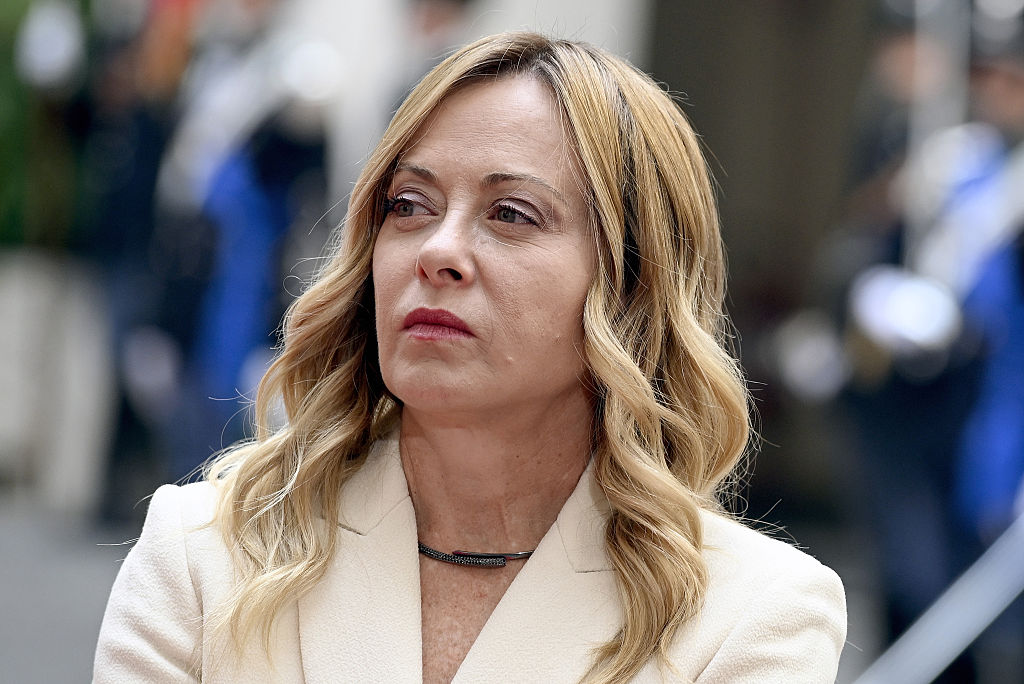
Giorgia Meloni’s rule has long relied on using EU funds to fund job creation. But now the jobs are drying up, it’s clear it hasn’t actually worked, and ordinary citizens are getting more angry at her waning government. (Simona Granati / Corbis via Getty Images)
There’s a story doing the rounds. A woman is sitting in a bar in tourist-filled Turin; you can imagine the glass panes looking out onto the square, the little tables for spritzes and olives. Kids and chitchat. Then, out of nowhere, everyone starts coughing and wheezing; she feels a burning sensation in her eyes. The air is filled with white fumes, tear gas engulfing the little tables. Everyone rushes inside, they lock themselves in. Only afterward do they spy, through the fumes, a few hooded protesters running towards the piazza. Only afterward — when they can breathe more easily and slip into the side streets to make their way home — are the squares and streets fully taken over by skirmishes and barricades.
The great Italian critical theorist Furio Jesi, thinking of his native Turin, wrote in 1969 that “you can love a city, and recognize its houses and its street in your deepest and dearest memories: but it’s only in the moment of revolt that you feel like the city is truly yours.” Revolts, Jesi argued, offer up strangely telling moments of symbolism. In the story above, the tear gas arrives before the protests. It smothers the emblematic scene of Italy’s commercial place in the world — its food and monuments, the great Italian hope. The image is engulfed by clouds of authoritarianism. The protesters arrive afterward, few and scattered, but the damage precedes them.
The protests that have rocked northern Italy over the past two weeks represent the outcome of years of repression and criminalization by the political and media classes. On the one hand, they take inspiration from a remarkably international moment. R., an activist from Cantiere — one of Milan’s historic social centers — tells me that young people of North African descent in Milan’s suburbs look to their French equivalents like their big brothers, with their expansive culture of hip-hop, film, and militancy. And similarly, she notes, throughout the street protests you could see not only the ubiquitous Palestinian flags, but also Moroccan and Albanian ones, symbols of other cousins in other streets but in the same struggle. On the other hand, interviews with kids involved in the clashes and protests in Milan and elsewhere underscore the desperation of Italy’s economic conditions: families that simply cannot get by on poverty wages. It is entirely normal in Italy for a month’s salary to be less than €1,000, barely covering rent and bills. Add to this the rising costs of food and gas, and it is surprising that the protests didn’t break out sooner.