Against the Politics of Communal Fear
We can take antisemitism seriously without making communal identity the organizing principle of public life.
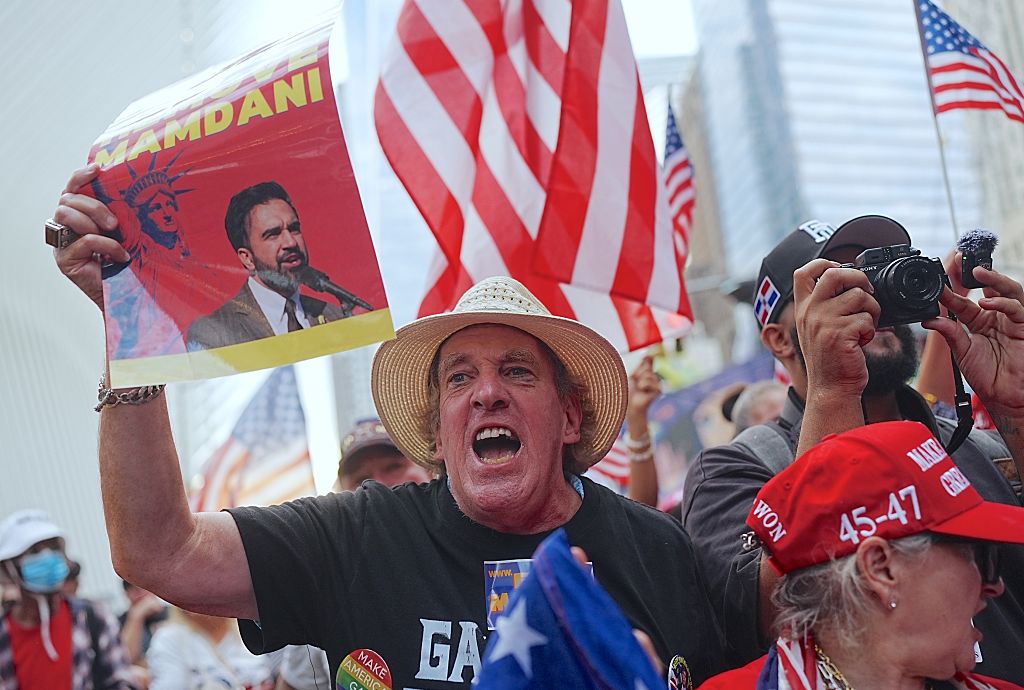
Zohran Mamdani’s strongest answer to his critics is the universalism that helped elect him. (Selcuk Acar / Anadolu via Getty Images)
New York City’s new municipal strategy to combat antisemitism comes just days after the war criminal Benjamin Netanyahu used his platform at the United Nations to call Zohran Mamdani “the antisemitic mayor of New York” and claim that since his election “many Jews no longer feel safe” in the city. The initiative seeks to expand education, support victims of hate crimes, and fund security at Jewish institutions and other houses of worship throughout the five boroughs.
Laudable as any attempt to reduce animus is, the Left should view the plan skeptically.
Antisemitism, it goes without saying, is an evil. And it’s an evil that socialists have particular reason to be concerned with. For centuries, the idea that powerful Jewish interests were at the heart of social injustice was widespread. Socialists of August Bebel’s generation called antisemitism “the socialism of fools” for how it steered resentment of capitalist instability and speculation into ethnic hatred.
Today Mamdani is right to condemn it. And it is understandable that he wants to give that condemnation a practical policy expression. This makes sense on the level of both principle and tactics for a political leader who has been the subject of a deliberate and baseless attempt to equate his support for Palestinian freedom with antisemitism.
Any socialist mayor should oppose prejudice, enforce equal rights, and respond to specific acts of discrimination or violence. The question is whether the administration’s response is proportionate to the problem, and whether its rhetoric helps people assess their circumstances accurately or encourages them to understand their lives through a sense of communal siege.
Assessing the Threat
The strategy, produced by the Mayor’s Office to Combat Antisemitism, coordinates work across schools, the police, civil rights authorities, and other agencies through an interagency task force. It doubles funding for the broader Partners Against the Hate grants program to $6.4 million and allocates $1 million for security at nonprofits, including synagogues and other houses of worship.
Notably, the report explicitly defends New Yorkers’ right to protest and doesn’t adopt the flawed International Holocaust Remembrance Alliance (IHRA) definition of antisemitism, which has been used to conflate criticism of Israel with antisemitism. Its commitment to enforcing civil rights and teaching Jewish American history also deserves support. But its account of Jewish insecurity and its outsourcing of much of its work through third-sector organization deserves scrutiny.
Since October 7, 2023, political discourse in New York has been disproportionately concerned with the supposed threats to Jewish New Yorkers, particularly from supporters of Palestinian liberation and Muslim New Yorkers. The campaign against Mamdani intensified that tendency. A secular socialist was portrayed as a Jew-hating Islamist because of his Muslim background and support for Palestinian self-determination. The Israeli government and its supporters, who identify the Jewish people with a violent state, have deliberately blurred the line between being challenged for controversial views (say, defending a genocidal state on a college campus) and being hounded for one’s religious identity.
In reality, NORC research found that people on the hard right held significantly more antisemitic attitudes than other Americans, while those on the hard left held more anti-Israel views.
Still, it’s reasonable to say that amid rising authoritarianism, a right-wing administration, and anger at Israel’s actions, certain forms of antisemitism have grown. These range from naked bigotry to the subtler reification of identity involved in asking Jewish New Yorkers born in the American republic, six thousand miles away, to repent for Israel’s murderous actions.
A real social problem, however, can also acquire the dimensions of a moral panic, and that panic can be weaponized against the Left. Consider a recent example: like other Americans, Asian Americans were victims of violence, some of it racially motivated. Yet the rise of the “Stop Asian Hate” movement brought sweeping claims about what it meant to be Asian in America, rooted in collective vulnerability and identitarian remedies.
Reported hate crimes against Asians did rise during the pandemic amid Donald Trump’s anti-China rhetoric. But the mobilization against those real acts also encouraged a salience bias, in which seemingly every street altercation involving an Asian victim was viewed as a targeted hate crime.
Yet one widely cited tally, from Stop AAPI Hate, consisted mostly of verbal harassment; physical assaults made up about 16 percent of the nearly eleven thousand incidents reported to the organization from March 2020 through December 2021.
Hate crimes against Asians recorded by the NYPD rose sharply, from twenty-eight in 2020 to well over a hundred in 2021. But the movement went further, presenting those attacks as a wave of racist hostility directed at a single community. “Asian American and Pacific Islander” is an umbrella label that groups together people with origins across a vast region, divided by class, language, and national background.
The “Stop Asian Hate” remedies were tautological. The movement insisted there was a mass problem that demanded marches and won corporate declarations against hate, new federal hate crime legislation, and pork for community nonprofits. It didn’t matter that some of the most high-profile incidents fit the story poorly.
In January 2022, Michelle Go was murdered while waiting for a train at Times Square. The man charged with pushing her in front of the train was homeless and had been diagnosed with schizophrenia two decades earlier. A better-staffed public transit system, track barriers, more state funding for psychiatric care, and supportive housing might all have helped prevent Go’s murder. Public education about the contributions of an imagined “AAPI community” would not have.
But organizing around identity made those universal solutions harder, not easier, to imagine. And it taught many Asian Americans to feel irrationally unsafe in the cities and towns where they grew up and to understand their safety in racial terms.
The same dynamics are at play in discussions of antisemitism today. When something happens to a Jewish New Yorker, the first response is seemingly to present the incident as evidence of an all-encompassing danger, making other Jews feel less secure. That fear itself then becomes politically noteworthy: “I don’t feel safe in the city of my birth anymore.” Communal identity becomes even more central to how people understand their lives and their relationships with others.
The statistics often cited in response to arguments like these also deserve scrutiny. Advocacy groups’ incident tallies, police records of hate crimes, and surveys of communal anxiety measure different things. Yet in a climate of fear — whether among Asian Americans a few years ago or Jewish people today — they are conflated into evidence of an emergency.
The Anti-Defamation League’s 2021 audit is instructive. It highlighted a worrying 34 percent increase in antisemitic incidents while acknowledging that many of the incidents were identified through new reporting partnerships. Putting aside well-warranted left-wing skepticism of the ADL, the example shows how changes in data collection can complicate efforts to distinguish changes in underlying behavior from changes in reporting.
Even police data on hate crimes don’t necessarily tell us how likely an Asian American or Jewish New Yorker is to suffer violence. That requires attention to absolute numbers, population, the kinds of offenses involved, and their distribution. It also requires political judgments about whether the response should take the form of universal or identitarian investments, and how those investments should be delivered.
The report’s own rhetoric illustrates some of the confusion. Its opening letters move between assaults, vandalism, and “stares and casual comments” in describing a climate of fear. These experiences require different assessments and responses. Surveys showing widespread anxiety cannot independently establish the prevalence of the conditions people fear. Otherwise, the effects of alarm become its justification.
It doesn’t require ignoring the persistence of antisemitism and the potential for its mass emergence to say that American Jews live in secure, prosperous, and integrated settings. Some heinous speech and sporadic violence should not erase the distance between today’s America and the history of Jewish exclusion.
As Hannah Arendt warned, treating antisemitism as an eternal fact of Jewish life can give antisemites an alibi, making a contingent political prejudice appear natural and inevitable. Ahistorical comparisons trivialize the centuries of subordination, pogroms, and ultimately mass extermination that Jews faced in Europe. Along with anti-American rhetoric like Joe Biden’s absurd claim that without Israel “not a Jew in the world is safe,” such comparisons do a disservice to the long struggle that has made the United States a hospitable home for millions of minorities.
The panics that made some Asians afraid of commuting to work, or some Jewish New Yorkers afraid of their neighbors, also rely on rhetoric that leaves us little room to describe a resurgence of structural discrimination. If there is a real antisemitic political movement growing in this country, beyond the acts of a few depraved people, what anti-Jewish laws is it advancing? How is it organizing to deprive Jews of their rights? What social structures are being built to enforce Jewish exclusion?
Online bigotry from people like Nick Fuentes, or even from some supporters of the Palestinian cause, does not itself demonstrate a mass movement capable of imposing anti-Jewish rule. Nor does it establish how much that bigotry affects Jewish Americans’ daily lives beyond the cycle of panic and the reification of identity it encourages. Cherry-picking speech in a country of more than 340 million people, even when every report is accurate, obscures the broader state of our society.
The Universalist Answer
There is always a danger of accepting our opponents’ misleading accounts of a city rife with hate and communal strife. But Mamdani’s response — that he is the mayor for all New Yorkers — makes both moral and tactical sense. The city’s policy choices, however, deserve scrutiny.
The Left’s answer to communal fear should be a radical assertion of our shared humanity, the same assertion we employ to defend the rights of the starved and maimed people of Palestine. When we encourage an environment where every political discussion has to start with “as a Jew” or “as a Muslim,” we’ve already accepted the idea that our moral obligations have communal boundaries. Among Jewish critics of Israel, the habit is understandable: they are answering a state that falsely claims to speak for Jews everywhere. But no one should have to establish the right ancestry or religion before opposing the killing of Palestinians, just as no one needs to be Jewish to be outraged by a swastika on a synagogue door.
The growth of identitarian rhetoric challenges our broader effort to change New York, a city long shaped by ethnic brokerage through organizations that claim to speak for particular communities. Today that pattern rewards those who can demonstrate not only their group’s political power but also its vulnerability. The spokespeople are, of course, often professionals and capitalists speaking to workers. When city and state governments accept this arrangement, they’re boosting a form of multiculturalism that amounts to: “Hello, Bengali worker, would you feel more comfortable if the city spoke to you via your Bengali slumlord?”
Every new program premised on a communal threat invites other groups’ brokers to make the same case. Socialists should be trying to wind down this system and build organizations on the basis of class identity, not reinforce it in the name of diversity.
This is where Mamdani has been a breath of fresh air. The media constantly talked about his identity and made him address it. But he is most comfortable translating his core universalism into concrete class demands: cheaper rents, free public transit, and universal childcare.
In its delivery mechanisms, however, this new plan to address antisemitism is a (very small) step in the wrong direction. It channels millions through nonprofit organizations for work public agencies could do directly. Some of these organizations are particularly pernicious, like the Jewish Community Relations Council of New York, which explicitly works to build support for Israel and circulates material opposing boycott campaigns against it. No one on the Left should support sending taxpayer funds to such an organization. But even if all the groups were committed solely to hate crime prevention and survivor support, we should ask why public agencies aren’t equipped to meet those needs directly.
This gets to a wider problem. New York responds to social needs by funneling money through nonprofits, often leaving public agencies to administer contracts instead of developing the ability to provide services themselves. Its own investigators have documented conflicts of interest and oversight failures in the nonprofit shelter system. Those failures strengthen the case for a better-funded welfare state that delivers services directly.
A socialist administration should build durable public capacity to address real social problems without reifying either communal identity or the perception of insecurity. In this case, civil rights enforcement and public education campaigns should be carried out entirely by staffed public institutions with transparent budgets and clear performance indicators.
Whatever our assessment of the prevalence of antisemitism in our city, Jewish New Yorkers are entitled to the same freedoms as everyone else, and violations of those freedoms should be addressed. We can uphold those commitments without fueling communalism, by building institutions that improve people’s lives and give them the choice to relate to their identity, or choose not to, in any way that they want.