Could AI Fix Climate Change? Probably Not Under Capitalism.
In an interview with Ezra Klein, Nvidia CEO Jensen Huang floated the possibility that AI might offer a solution to the climate crisis. That would require taking AI under public control.
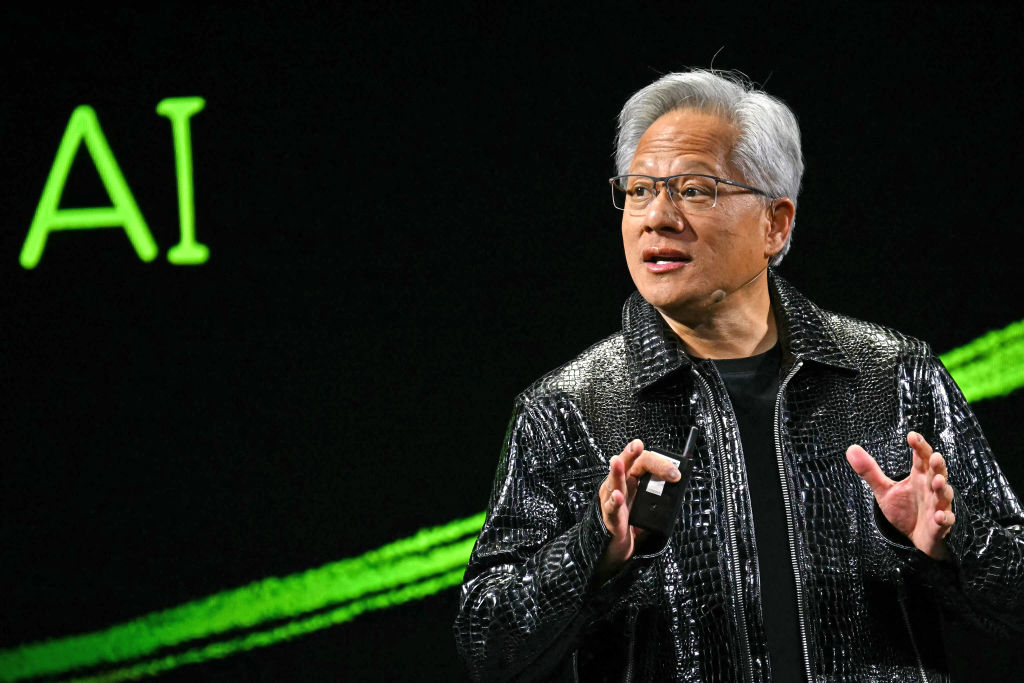
What AI boosters ignore is that technological progress may not change political relations quickly enough to avert catastrophic climate outcomes. (Patrick T. Fallon / AFP via Getty Images)
“There’s no question that in four or five years’ time, we’re going to use a lot more fossil fuel,” Nvidia CEO Jensen Huang told Ezra Klein of The New York Times. “But also, in the next decade in front of us, at no time in history are we better prepared to move to sustainable energy,” he added. “If you want to turn a corner on climate change, if you want a future that’s sustainable, lean into AI.”
It is perhaps surprising, given the tone of much mainstream discussion of artificial intelligence, that the man at the helm of the world’s most valuable company, which produces chips essential to the new technology, was agnostic about whether AI would stop climate change. “It could be solar, it could be nuclear, it could be fission, fusion, hydro, you name it,” Huang said in his hour-long interview with Klein. The future would be great, but he was uncertain about how. His rhetoric is a prime example of how the language of climate politics, and of climate obstruction, has changed since the emergence of powerful AI models.
Save Us How?
In a way, Huang’s rather vague promises are a return to the rhetoric of the early days of climate politics, when economists like Nobel Prize winner William Nordhaus won renown for models that heavily discounted the future compared to today. By this thinking, spending lots of money now to avoid climate damages later was not worth it because future humans would be so rich that they could afford the climate costs. The model was called “DICE”; humans should roll one.