Focus on the Real Drivers of the Affordability Crisis
The principal sources of the affordability crisis are less consumer goods and more child care, health care, and education. The Left’s response to that crisis should focus on universal, solidaristic, and visible social programs.

The price of eggs or gas induces a sense of sticker shock for many Americans. But decommodifying systems of social reproduction like child care and health care remains the most urgent and potentially transformative task of the Left. (Jeffrey Greenberg / Universal Images Group via Getty Images)
Over the past five years, the price of consumer goods has dominated American political discourse. From Donald Trump to Zohran Mamdani, winning candidates have used “affordability politics” to articulate popular dissatisfaction with economic conditions. From the price of eggs to gas to burritos, the terms of discussion in the media, the campaign trail, and the proverbial kitchen table have revolved around the cost-of-living crisis embodied in these consumer goods.
Although figures on the Right and center of the political scene have used inflation and affordability politics to bolster their agendas, during the second Trump administration, it is the Left and center left that have principally benefited from the salience of price talk. Indeed, the Democrats’ 2026 midterm messaging strategy has centered on blaming Trump’s Republicans for the cost-of-living crisis that Trump himself successfully pinned on Joe Biden just two years ago.
That aggressive focus on the cost of living and a promise of consumer affordability will likely continue to be a successful playbook for both left and right anti-incumbent campaigns in the coming years. But in order for a political movement to actually address the cost-of-living crisis once in office, it needs a clearer picture of where those costs are coming from and how they have changed over time.
Our affordability politics must go beyond lowering the price of eggs. And trends in American household spending underscore perhaps the central task of the Left: expanding the welfare state with universal, solidaristic, and visible social programs.
Where Do Americans Spend Their Money?
Anyone purchasing gas, groceries, cars, or airline tickets in the 2020s has experienced sticker shock since the onset of inflationary pressures catalyzed by COVID-19, tariffs, the artificial intelligence bubble, and the disastrous wars in Ukraine and Iran. But a longer view reveals a different picture.
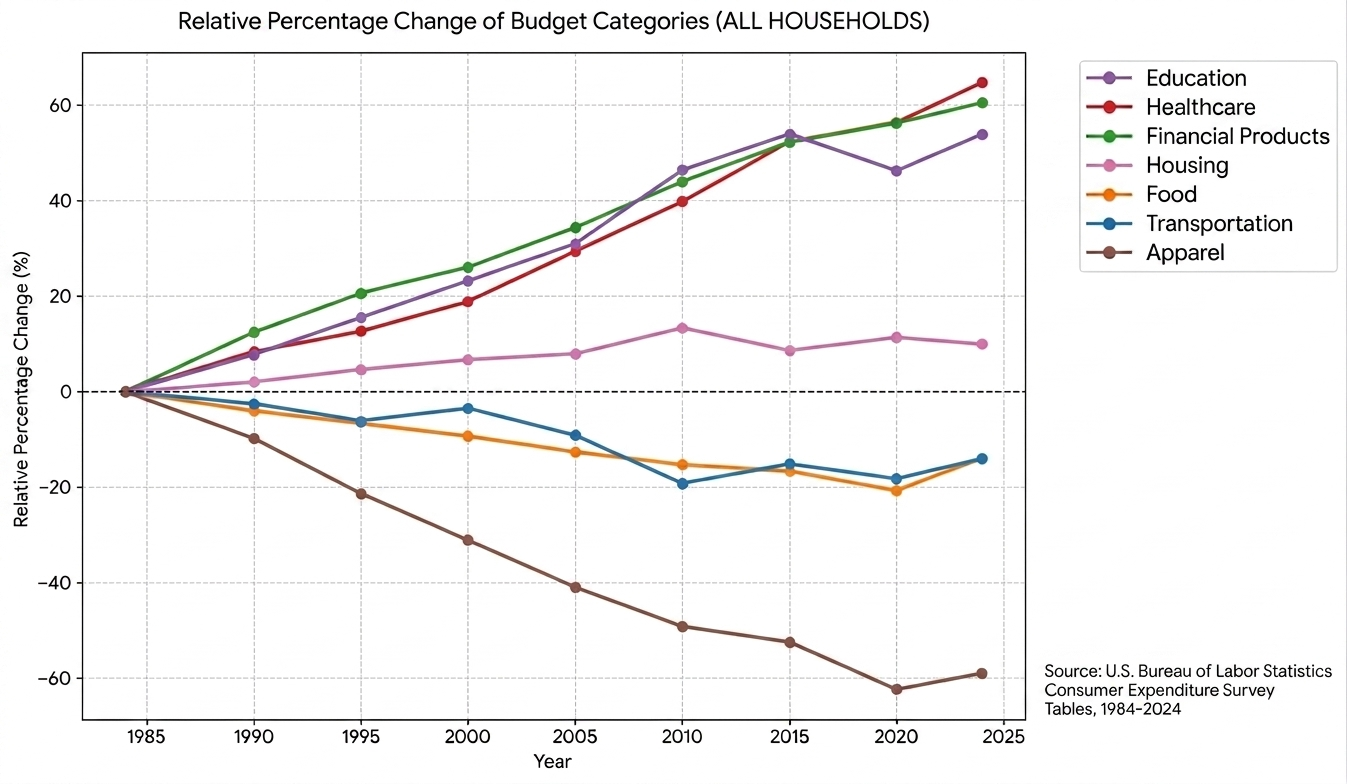
Compared to forty years ago, Americans today spend less of their total disposable income on food, transportation, clothing, and personal care. And they spend significantly more than they used to on health care, education, housing, and financial products (retirement contributions, nonmedical insurance, etc.). While we can see a modest rise in food and transportation budget shares from 2020–24, it does little to change the overall trends.
When we look specifically at households with children, an even more dramatic story comes to the fore, in which the ballooning costs of education and childcare have nearly tripled their share of household spending.
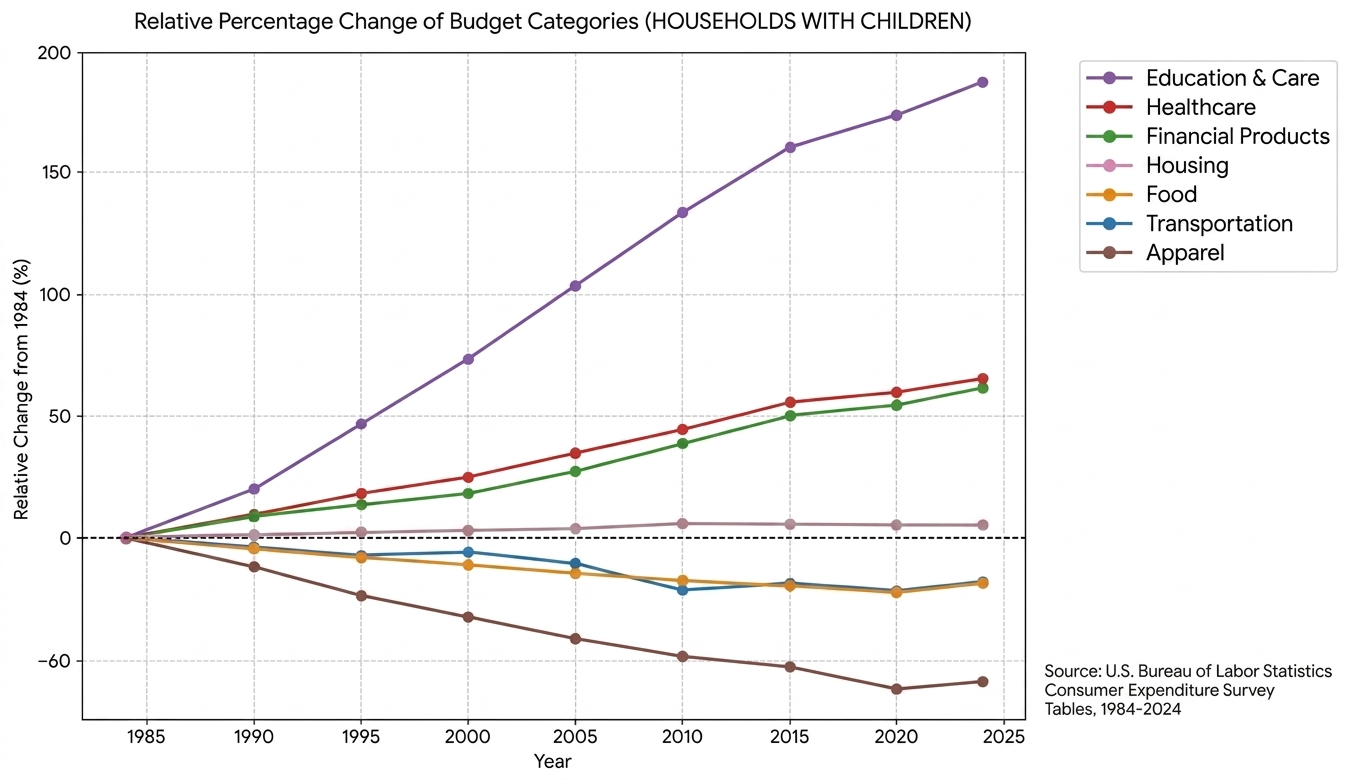
The roots of these contradictory dynamics lay in the neoliberal class compromise of the late 1970s, which resulted in lower prices for consumer goods but much higher prices for the assets and services that sustain social reproduction.
After the labor and popular upsurges of the 1960s and ’70s were defeated, the weakened American working class accepted job cuts due to automation and offshoring, and the more vulnerable among domestic producers were forced to accept a new free trade regime that opened them up to global competition. While wages were lower, jobs more precarious, and employee benefits like pensions and health insurance increasingly scant, workers and their families could purchase food, clothing, electronics, and consumer durables (appliances, furniture, automobiles, etc.) at lower prices.
The shift of world garment production to the Global South during the globalization waves of the 1980s–2000s has driven down US household budget allocations for apparel by a whopping 60 percent. The declines are more modest but still meaningful (roughly 15 percent) in food and transportation. Again, these price changes are linked to the globalization of supply chains in the food, automobile, and energy sectors.
As this process unfolded, American workers and households were also increasingly forced to bear the monetary costs of their own social reproduction. Postindustrial developments in the US economy reinforced changing cultural mores to spur shifts in family and education. The end of the “breadwinner wage” and greater gender freedoms meant more women in the paid workforce, fewer households with parents acting as full-time caregivers, and greater numbers of people funneled into higher education to prepare for the medical, education, and knowledge economy careers that required such credentials.
Millions more Americans were paying for education, from daycare to graduate school. And the costs of that education kept rising.
Over this same period, the US health care system experienced a weakening of employer-based health coverage for unionized workers, and increasingly powerful and consolidated insurance, medical device, hospital, and pharmaceutical corporations. These dynamics, along with longer lifespans, have driven astronomical rises in costs across the board. With the partial exception of Obamacare’s expansion of Medicaid — which was limited in red states by the reactionary Supreme Court — any federal attempts to bring down out-of-pocket health care costs have been thin gruel.
It is worth pausing here to reflect on an interesting paradox: in 1984, when US residents spent a much lower percentage of their household budgets on health care, the United States placed much higher in global rankings of health. Educational quality is more difficult to compare internationally, but it’s clear that drastically higher household expenditure on education has not propelled the United States to the top of global rankings.
Since the 1980s, Americans have increasingly purchased services of social reproduction through market mechanisms — paid childcare, university education, privately bought insurance, out-of-pocket health care costs, elder care, 401(k) contributions — relying less and less on things like unpaid gendered household labor, collectively bargained health care benefits, defined benefit pensions, and free or cheap higher education. The marketization of social reproduction, combined with runaway cost spirals in education and especially health care, has fundamentally reshaped the budget priorities for average US households.
The rise of health care, education, and retirement saving costs is the dramatic story. Housing, perhaps surprisingly, has stayed relatively stable, its share of household expenditure rising only 3 percentage points between 1984 and 2024. But unsurprisingly, it remains the largest single item in US household budgets.
Comprising roughly a third of average household expenditures, the cost of shelter is the single largest drain on American bank accounts. The high and rising cost of housing in metropolitan areas has been a key driver of left-wing political success in major US cities, with Zohran Mamdani’s campaign emblematic of this phenomenon. The residential real estate market is incredibly complex, with drastic regional and subregional differences, so there won’t be a one-size-fits-all approach to addressing this issue. But the basic playbook pursued by the Mamdani administration — strengthening rent stabilization, cutting unnecessary red tape to aid more construction, repairing and building more social housing where possible — is a good start at the local level.
We desperately need more federal funding and support for affordable and social housing, especially given the fiscal constraints that states and municipalities face. But in general, the complexity and diversity of the American housing market makes it unsuitable as a centerpiece of national policy and messaging for the Left. For starters, a majority in the country are homeowners and thus at least partially benefit from rising prices.
Furthermore, while expensive metro areas have seen huge rises in housing costs, the dynamic is different in much of the country. Nationwide, housing as a percentage of household expenditures rose from around 30 percent in 1984 to 33 percent in 2024. But in the New York City metropolitan area, that number is over 38 percent. The wide variations in housing expenditures as a percentage of household budgets between and within regions makes it categorically different from other expenditures whose regional discrepancies are minimal.
Housing costs are clearly a major issue across American society. But the most drastic structural changes in household expenditures over the past decades are found in education, health care, and retirement contributions.
How Do Cost-Of-Living Politics Work?
If the data clearly shows that food, transportation, and consumer durables have declined in their significance to American household spending, then why do the prices of those items maintain their centrality to cost-of-living discourse in this country?
In a structural sense, politicizing the price of consumer goods makes sense, because people tend to purchase those items frequently, and their prices are displayed in a visible and public fashion. In the case of gasoline, large signs showing its price are a key visual feature of the American landscape. It makes sense that people feel comfortable discussing the price of goods whose prices have — by virtue of public signage in grocery stores, restaurants, car dealerships, gas stations, and media advertisements — already been introduced into the available public lexicon. Across the country, the price of gas ranks just below the weather as universally accessible small-talk fodder.
By contrast, the cost of a medical procedure — along with the complex constellation of premiums, deductibles, and co-pays that structure the price of health care — is opaque and private. Not only are those bills sent directly and privately, the actual costs are rendered purposefully opaque, even to the intended recipient. Ditto for educational costs, where a Rube Goldberg–esque system of scholarships, loans, vouchers, tax credits, financial aid, not to mention “indirect” education costs like lodging, materials, and food all conspire to make the published price of an educational experience frustratingly incomplete.
The public/private dynamic at play in price information is reinforced, or perhaps driven, by the social and cultural distinctions between the “public” life of market activity and the “private” life of things like health and family. While people’s increasing willingness to speak publicly about the cost of things like daycare, eldercare, and hospital stays is a positive development, in general, most people would be much more comfortable complaining about the price of their Chipotle burrito than their colonoscopy or mental health counseling.
Some liberals have leaned on pop psychology to understand inflation politics. Economist Justin Wolfers wrote condescendingly in The New York Times that normal people are too irrational and emotional to understand the economics of inflation and concluded that a psychological trick of timing creates false anger at the economy. In this telling, you first get a raise, but then that gain feels snatched away by higher prices. While the consumer ends up affording the same amount of goods, it feels like theft because of the timing and sequencing.
By the end of that piece, however, Wolfers does manage to put his finger on something meaningful: people are particularly upset about prices right now, because Trump campaigned on lower prices, then implemented policies (tariffs, wars, AI bubble inflation) that raised prices.
By historicizing the political psychology of inflation, we get closer to real insight. Most Americans understand, at least implicitly, the terms of the class settlement that produced the post-1980s economic order. In exchange for degraded pay and working conditions, workers in the postindustrial West gained access to the cheap, plentiful, on-demand goods that were the fruits of Global South–based supply chains. It wasn’t a great deal from the vantage point of the average American — not to mention the ecological devastation and the expanded regimes of labor exploitation in the Global South — but Western populations did receive tangible benefits in the form of cheaper consumer goods.
When the terms of this social-economic contract were disrupted by the global supply chain shocks first of COVID-19, then of the wars in Ukraine and Iran, and also the electronics and energy demand suck of the AI bubble, people reacted poorly. If working people can’t even keep the thin consumer benefits of our capital-dominated social contract, then what’s the point of this whole charade?
Capitalism’s global hegemony is by no means waning, but the potency of “cost-of-living” discourse across the world reveals a depth of a social feeling that the expected benefits of capitalist growth are not matching expectations. That social feeling can be a resource for renewed socialist and working-class politics, but we needn’t accept all the premises of already-existing affordability politics to draw on it.
From Affordability to Decommodification
A socialist response to the cost-of-living crisis can be, on paper, pretty straightforward. First and foremost, avoid the Biden administration communications strategy of insisting that “the economy is great, actually.” Instead of waving away people’s anxieties about inflation in the cost of basic goods with statistics, we should instead reinforce the chorus of anger about rising costs for daily necessities. But we should also avoid the 2024 Trump campaign’s preferred strategy of focusing on particular consumer goods (like beef, eggs, or gasoline) and promising to bring their particular prices down.
Instead, shift the political conversation toward our home turf: empowering workers and unions, raising the minimum wage, and most of all, expanding the welfare state. Decommodifying the services necessary for social reproduction is a popular and viable political program that actually would make the greatest progress toward addressing people’s ability to afford their lives.
To be politically sustainable, these programs must be designed to be visible, universal, and generous. In other words, we must expand the welfare state in ways that are neither means-tested nor disguised through tax credits. The recent re-reemergence of Medicare for All as a legislative priority for progressives and socialists speaks to these logics. Not only would a single-payer health care system improve health outcomes, boost social solidarity, and decrease economic and social precarity; it would address a major vector driving the cost-of-living crisis.
Demands for tuition-free higher education, trade school, and early childhood care form another core plank in this version of an affordability agenda. Although less universal than health care (not everybody has children, or enrolls in postsecondary education), the benefits will be life-changing for those eligible. On the retirement front, removing the income cap for Social Security and embedding more robust cost-of-living increases would make the system solvent and ensure that the system is more than a threadbare safety net.
One can already hear the rising chorus of centrist and conservative pundits: “How are you going to pay for it?” While the full answer contains complexity and nuance, the short answer is and has always been “raising taxes.” And while progressive taxation is essential for structuring the welfare state, sustainable social programs require broad revenue bases across all sectors of society. As the late Marxist economist Anwar Shaikh showed, it was the working class that, historically speaking, largely funded its own welfare state.
While short-term political considerations push left-wing politicians to target new taxes toward billionaires and pied-à-terre owners, we need to be laying foundations for a longer-term program of tax raises. We cannot dissemble our way to a solidaristic welfare state but need to make the case openly that implementing Medicare for All would require raising most people’s taxes; for the vast majority of taxpayers, the abolition of out-of-pocket costs would more than make up for the increased rates. And beyond the dollars and cents, the peace of mind and freedom that comes with delinking health care from employment would be a liberatory experience for tens of millions.
The insistence on lowering the prices for specific consumer goods also runs into a longer-term problem. While sharp price hikes in recent years can, in many cases, be blamed on corporate price gouging and “greedflation,” supply chain bottlenecks, and disastrous foreign policy decisions, the baseline of super-low prices for food, transportation, and consumer durables is dependent on the exploitation of workers in the Global South, environmental devastation, and expectations of product disposability.
A political program that empowers workers in both the Global North and the Global South (while still remaining, for now, under capitalism) will raise the cost of most consumer goods. We should remove or mitigate the large structural costs of social reproduction that weigh most heavily on household budgets and give ourselves more room to pay more for consumer goods. If we want to give future political projects a fighting chance for a healthier, less exploitative, and more solidaristic world, we need to start laying the political and discursive groundwork now.
Decommodifying systems of social reproduction remains the most urgent and potentially transformative task of a Left that wins any sort of legislative power in a postindustrial democracy. Zohran Mamdani’s initial virality was fueled in part by pushing for lower prices at halal carts and creating public grocery stores, but his legacy will ultimately rest on his success in delivering on promises like universal childcare and freezing the rent.