We Have to Figure Out How to Design a Warming Planet
Architects and designers are often left carrying out the orders of developers interested only in maximizing profits. But a new book argues they have a vital role to play in transforming our built environment in a world transformed by climate change.
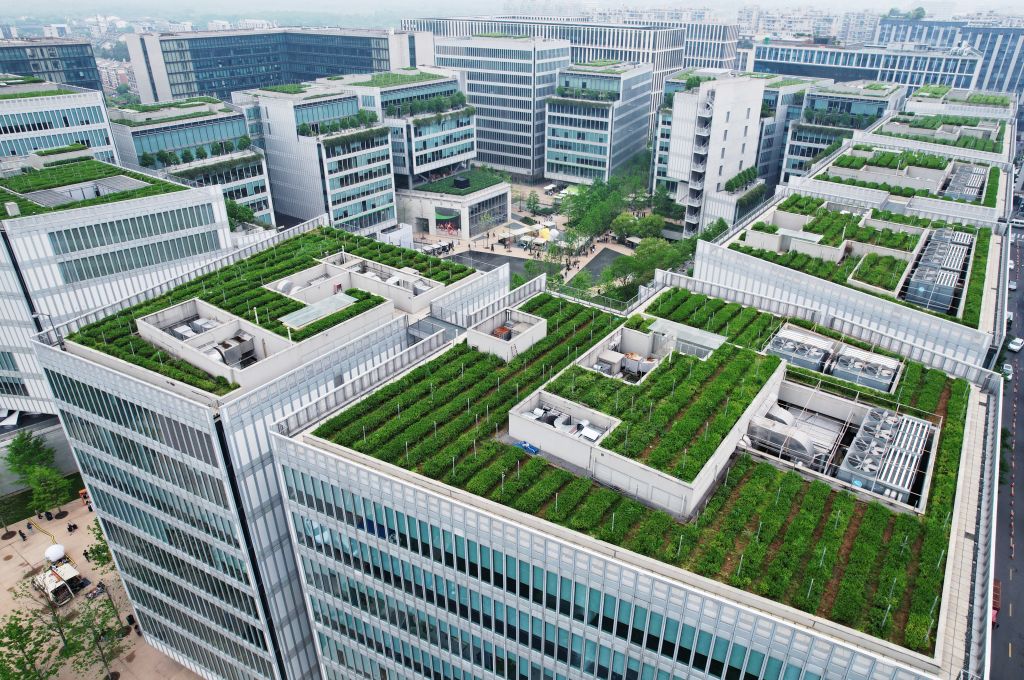
More than 6000 square meters of West Lake Longjing tea are planted on the roof of eleven high-rise buildings in Hangzhou, China, which can block the sun in summer, thereby reducing the energy consumption level of buildings and reducing carbon emissions. (Costfoto / NurPhoto via Getty Images)
Before we get into the nitty-gritty, we should start with the problem in its purest form: The world as we know it cannot go on. Something’s got to give. Ideally, that would be capitalism, but we don’t have enough time to pull that off before the planet catches fire. The planet is already catching fire. What to do, then? Everything — supply chains, information systems, labor practices, policy decisions, economic structures — is so inextricably linked that it feels impossible to know where to start chipping away. Recently a friend asked, hypothetically, why it would be worthwhile to make an ethical decision in one’s own personal life if the larger entities that structure that life certainly aren’t making ethical decisions. Isn’t their impact much larger than our own? It’s hard to argue with that.
In the design world, the responses to what I’ve come to think of as “scalar overwhelm” (often accompanied by a sense of nihilism) have ranged from cynical surrender — if you can’t beat them, join them: design for developers, make some money, and call it a day — to fantastical idealism: draw up “solutions” to the crises we face that will be hard to build and even harder to finance. Architects and designers are often left out of the funding and policy decision-making processes that structure and condition their work, meaning that the work they do is often reactive rather than proactive. More often than not, an architect’s job is to design to minimize up-front costs and maximize return on investment for developers.
When that’s your everyday task, it’s difficult to imagine how you might participate in ameliorating global warming, a crisis to which your job directly contributes — buildings and their construction account for about 40 percent of all greenhouse gases globally — but cannot directly solve. It’s not exactly up to you how the concrete panels you specified in your design plan are manufactured, what fuel the truck that transports wood to the job site uses, or whether the grid your building connects to runs on fossil fuels.