Tim Curry Was Never Not Having Fun

From Dr Frank-N-Furter to Pennywise the killer clown, Tim Curry played every role at full volume — and made a six-decade career out of refusing to be small.
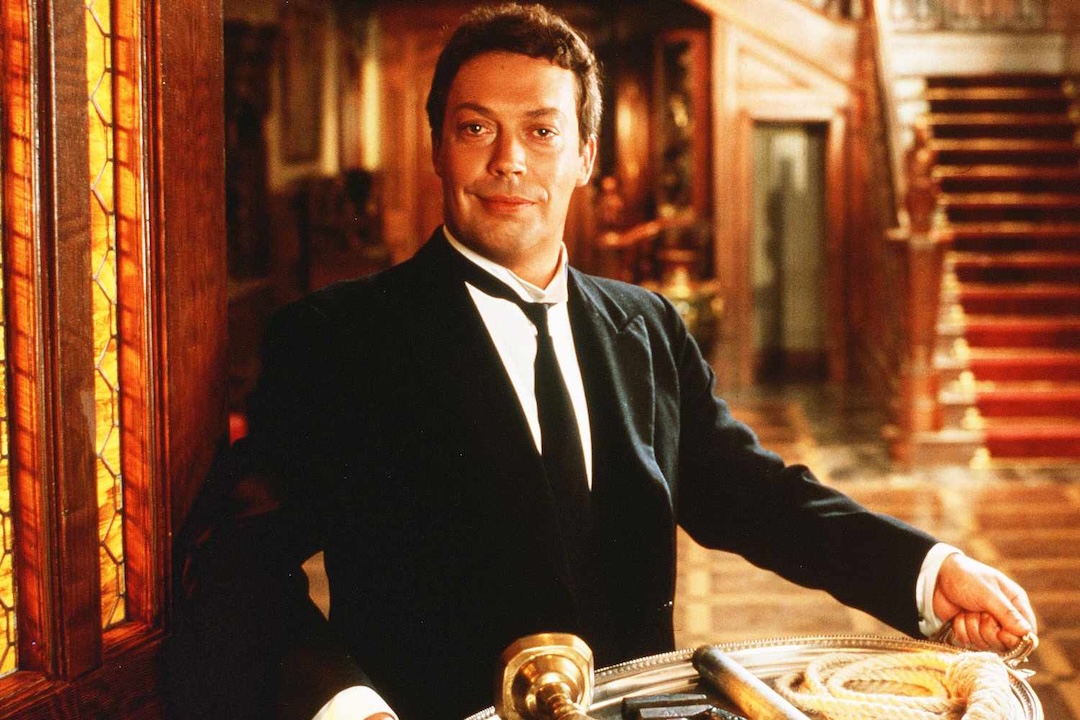
Tim Curry as the butler Wadsworth in "Clue."

Tim Curry got the same greeting from Eric Idle every time they met: “Butlers and villains.” Those were the only two roles Hollywood had for a British actor. He played both louder than anyone ever has. (Paramount Pictures)


It’s our miserable fate to lose Dolly Parton and Tim Curry in a one-two punch at the end of summer 2026. Both died at eighty years old, and it seems damned unfair that both didn’t live to be 120 and die mid-performance, which was Parton’s stated goal.

What unites Parton and Curry is their joy. Two happier people would be hard to identify in the notoriously tragic world of showbiz fame, where behind-the-scenes lives tend toward grim pathos. Dolly Parton was known worldwide for her almost incredible levels of wide-smiling, life-loving élan that she managed to communicate to virtually everyone she met, and to everyone she didn’t, via wildly popular songs and film and television performances radiating ecstasy.

Tim Curry’s Joker-esque grin was equally wide and contained something else, an almost salacious glee in performance. Nobody was going to have to ask him twice to get up there and provide some splendidly extroverted entertainment that would give the public something to cheer about. Like so many British actors, he approached his career with alacrity, eager to show up for almost anything. Theater, movies, television, music videos, audiobook and animated film and TV voice work — you name it, you’ll find Tim Curry there. He even cut a few albums.

And his celebrity impersonations? Chef’s kiss. He did a fond but unsparing take on Mick Jagger’s pop-eyed, twitchy, mouthy, chicken-dance strutting to “Satisfaction” that’s a thing of beauty and a joy forever.

Stage-trained, with a huge, expressive voice, he first made his mark in the 1968 London production of the landmark hippie musical Hair, and from there went directly into his breakthrough role of mad scientist and übersexy “sweet transvestite from Transylvania,” Dr Frank-N-Furter, in the legendary camp-rock musical The Rocky Horror Show. The show was such a smash, it went on to tour America from New York City to Los Angeles and made Tim Curry a household name. The 1975 Rocky Horror film version became a cult hit that was considered such required viewing among young people, it kicked off the “Midnight Movie” phenomenon on college campuses across the United States.

It was in LA that Curry found himself most feted, where, as he put it, he went from “grubbing around” trying to pay the rent to “sitting by Jack Nicholson’s swimming pool.”

But it was also where he found himself having to come to terms with the thorny experience of sustaining a showbiz career and negotiating media fame. His response was typically wholesome and practical: he began reading biographies of famous bygone movie actors to see how they’d managed it.

Typecasting in Hollywood is especially pernicious, and Curry found himself constantly asked to reprise the Dr Frank-N-Furter effect by playing exuberant roles in drag. An effortless wit, Curry joked that he countered this tendency once and for all by aging in order to become “chubby and plain.”

And he also discovered there were pitfalls to being a British actor in Hollywood generally, in that there were only a few roles on constant offer for Brits. This observation led to a three-word greeting always exchanged when encountering former Monty Python member Eric Idle: “Butlers and villains.”

However, cast Curry as a butler, and you’ll inevitably get the loudest, funniest, most garrulous, and overly self-dramatizing English butler that ever lived, and his delightfully braying Wadsworth in Clue (1985) is the result.

Curry was always such a big presence, it was deemed impossible to cast him as a self-effacing introvert or any kind of wallflower. If he’s onstage in The Pirates of Penzance, he’s playing the Pirate King and earning a 1982 Laurence Olivier Award nomination for Best Actor in a Musical. If he’s starting his voice-acting career in a Hanna–Barbera cartoon depicting the Garden of Eden, he’s playing the snake and hissing out all the best lines. And he’s never not employed doing cartoon voice work thereafter. He won a Daytime Emmy for the cartoon series Peter Pan & the Pirates (1990–91), playing — you guessed it — the colorfully craven Captain Hook.

“I’m a toon type of guy,” he said cheerfully.

Onstage in the 1980 Broadway production of Amadeus, he’s nominated for a Tony Award playing the obnoxious young genius Wolfgang Amadeus Mozart. In Clive Donner’s 1982 TV movie Oliver Twist, he’s the terrifying, murderous villain Bill Sikes. In Ridley Scott’s Legend (1985), he’s Darkness. In Muppet Treasure Island (1996), he’s “the sweet scoundrel pirate” Long John Silver. And in the first screen version of Stephen King’s It (1990), he’s inevitably the fanged clown Pennywise terrorizing children and guffawing with evil glee over it.

So many consistently, unabashedly oversize performances won a lot of affection from the public over the decades. Because, to put it brutally, we live in an ever-duller era when it comes to actors, especially, but also performers in general. There’s so much tiresome ego and artistic pretension and, underneath all that mess, cowardly fear of risk-taking that it’s a real thrill when someone like Tim Curry practically prances out front — he’s so glad to give his all for entertainment.

Curry titled his 2025 memoir Vagabond because of his own roving life and the fact that, as he explained, “in the 17th century, in the criminal code, actors were lumped together with thieves and vagabonds.” He was a heartening throwback to much more vivid days of yore when it came to performance, and with his usual congenial self-awareness, he was happy to announce the fact.

He had a rather rough childhood, constantly on the move as the son of a naval chaplain who spent most of his time at sea. At age twelve, Curry lost his kindly, humorous father — who was only forty-five — to an untimely stroke. After he became an actor, Curry channeled “his mercurial mother’s rages” into a range of dark, daunting characters.

In 2012, Curry nearly died of a stroke that partially paralyzed him. Terrified he might be confronting his father’s fate, confined to a wheelchair, and only gradually recovering his powers of speech, Curry still couldn’t imagine a life of inactivity. With his typical jaunty courage, he pivoted to memoir writing, then narrated the audiobook version.

It’s heartwarming to read that after many years of high-spirited partying, in later adulthood Curry had come to love his domestic life extravagantly. His idea of a great evening had become reading books in the company of his dog, and avid gardening — his father’s hobby when ashore. “If you’re English, somewhere around thirty a trowel appears in your hand, sort of like a prosthetic device,” he said.

Even after his stroke, Curry said he couldn’t imagine retiring. So it’s a bitter blow that forces outside himself have put an end to Tim Curry’s performing joys. Still, keep in mind that The Rocky Horror Picture Show is always playing somewhere in the world.