The American Plutocracy Wants Workers Trapped in Debt
The US government wrote off almost all the money it lent businesses during the pandemic. Now it’s wrecking credit scores and threatening to garnish paychecks to collect student loans. Debt can be forgiven easily enough — just not for the working class.
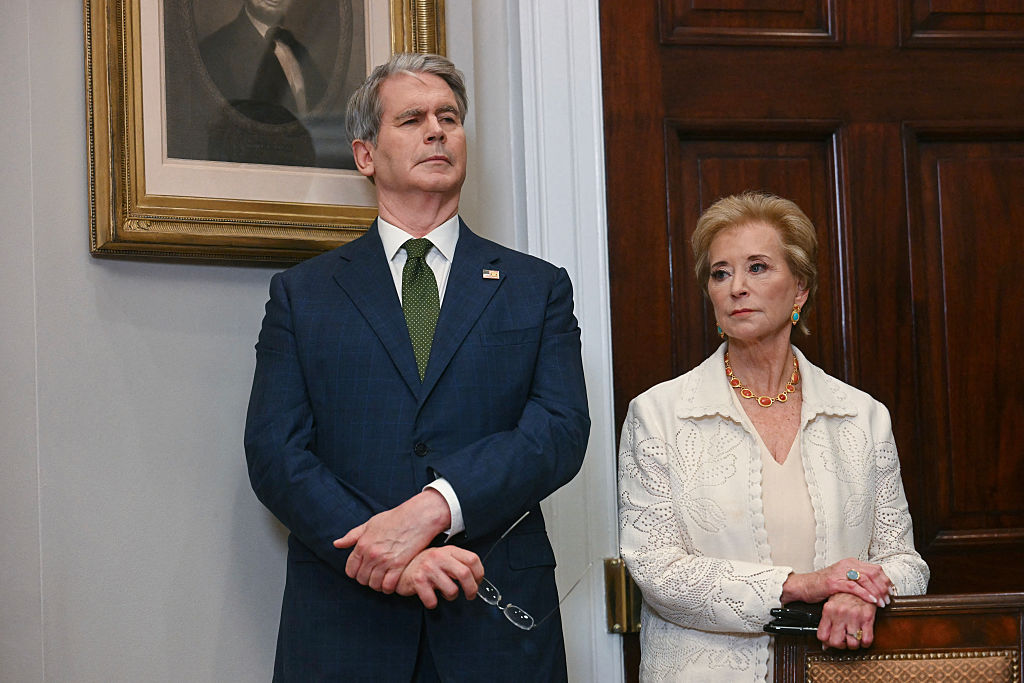
With a one-page form, the federal government wrote off roughly 92 percent of the money it lent businesses during the pandemic. But student loans? Not so fast. In the case of workers, it’s apparently impossible to make debt disappear. (Jim Watson / AFP via Getty Images)
In May 2026, the White House’s top economist went on Fox Business to make an argument that would probably have gotten him laughed out of any economics seminar twenty years ago. Kevin Hassett told Maria Bartiromo that “the consumer is really, really firing on all cylinders,” pointing to a fresh surge in credit card spending as proof that the economy was thriving. Days earlier, Treasury Secretary Scott Bessent argued that according to banks and credit card companies, “all quintiles of the distribution group is [sic] very strong.”
The reality couldn’t be further from that picture. Subprime auto delinquencies had just hit a thirty-two-year high, while farm bankruptcies were up 46 percent on the year. Personal debt had pushed past $18.8 trillion. None of that made it into Hassett’s or Bessent’s accounts.
Consumer Credit and the Purposeful End of SAVE
In January 2026, Donald Trump announced on Truth Social that he wanted a one-year cap limiting credit card interest rates to 10 percent, declaring that the public was being “ripped off” by companies charging 20 to 30 percent. Analysts estimated that the cap, if enacted, could save consumers roughly $100 billion a year in interest. Soon after, at the World Economic Forum in Davos, JPMorgan Chase CEO Jamie Dimon responded that such a policy “would be an economic disaster,” since it would restrict access to credit for the vast majority of Americans and hit small businesses hardest. Dimon also added that, no matter what, credit providers “would survive it by the way.”
Unsurprisingly, no nationwide policy along these lines was ever enacted. No executive order, no legislation, no enforcement mechanism. Just a populist promise that came and went, with the latest figures from the Federal Reserve Bank of St Louis showing that the average commercial bank interest rate on credit card plans is 20.94 percent.
Meanwhile, what does happen in practice is the systematic dismantling of consumer debt regulation. Russell Vought, the acting Consumer Financial Protection Bureau (CFPB) director, has kept gutting the bureau’s rulebook, rescinding sixty-seven guidance documents in 2025, from “buy now, pay later” lending guidance to debt collection practices. His justification was that the agency had been imposing rules “outside of the strictures of notice-and-comment rulemaking” and that it would issue new guidance only when that became necessary — a technical way of saying that the guardrails were not removed for lacking merit.
Despite Trump’s promises to protect consumers from predatory credit card interest rates, his administration has spent the last eighteen months dismantling the agency built to police how banks lend. The rhetoric and the substance aren’t in tension by accident. The rhetoric is free. The substance has to survive contact with the industries that fund both parties.
But the credit card saga was just the warm-up, or maybe the distraction, for what is underway now. With the termination of the Biden-era Saving on a Valuable Education (SAVE) plan on July 1, which pushed student debt back into collection, the administration has stated its reasoning outright.
Just over a year ago, in April 2025, Secretary of Education Linda McMahon announced the coming end of the pandemic-era pause on student debt collections in a Wall Street Journal op-ed that reads less like a policy memo than a manifesto. “Debt doesn’t go away; it gets transferred to others. If borrowers don’t pay their debts to the government, taxpayers do,” she wrote.
Student loans, McMahon argued, are unlike a mortgage or a car loan, since a college degree cannot be collateral. And since there is nothing to seize when a borrower stops paying, in her account the seizure has to happen somewhere else: for the roughly two million borrowers already in default and moved into active repayment, failure to pay can now mean a battered credit score and, if need be, having “their wages automatically garnished.”
The policy behind McMahon’s op-ed was not rhetorical. Collections and credit bureau reporting resumed in May 2025 after a five-year pause, and within a year, 20.5 percent of borrowers with a payment due were ninety or more days delinquent — the highest delinquency rate of this kind ever recorded. Close to 2.2 million people saw their credit scores drop by more than one hundred points the moment reporting switched back on.
The SAVE income-driven repayment plan was killed off ahead of schedule through a court settlement, with interest quietly accruing on borrowers stuck in litigation limbo the whole time. And despite wage garnishment and the withholding of tax refunds being announced, delayed, and announced again, the threat still looms over borrowers, as the Department of Education further restricts eligibility for debt forgiveness.
Looking at the big picture, this isn’t a pile of unrelated cuts but rather a systematic attempt to eliminate debt forgiveness for working households while personal debt collection and credit reporting resume. McMahon isn’t being shy about the rationale: disciplining workers directly through credit score downgrades and wage confiscation.
What the Theory Conveniently Leaves Out
What makes McMahon’s argument interesting rather than merely crude is that it isn’t really a general theory or philosophy about debt at all. It’s a theory about which debtors have to be disciplined.
During the pandemic, the federal government handed out $792.7 billion in forgivable loans to businesses through the Paycheck Protection Program (PPP). About 92 percent of that money was ultimately written off, much of it on a one-page form that didn’t require proof that the money had been necessary. Firms with a single employee got full forgiveness. Researchers estimated fraudulent PPP lending at roughly $64 billion, and forgiveness kept flowing anyway. Nobody at the Treasury wrote an op-ed about how business debt never disappears. Nobody built a wage garnishment pipeline for the loans that didn’t qualify. The money simply stopped being owed.
Compare that to the roughly $400 billion student debt relief plan that the Supreme Court struck down as executive overreach in 2023. In a rare moment of honesty, Joe Biden’s White House itself pointed out that “$760 billion in PPP loans were forgiven,” and that several of the Republican members of Congress calling that plan unconstitutional had personally benefited from PPP forgiveness.
That comparison came from a different administration than the one running collections today, but PPP forgiveness was processed under both Trump’s first term and Biden’s. Rather than a story about one president’s hypocrisy, this is a structural story about which class of debtors is regarded as a moral hazard and which is regarded as the engine of growth of the American economy.
In other words, contrary to McMahon’s narrative, debt absolutely can disappear. It just depends on who owes it.
This is the case my latest book, Debt and the Future of Workers: Financialization as Exploitation in the 21st Century, tries to make in full: the extraordinary growth of personal debt over the past five decades isn’t just a passive symptom of stagnant wages. In the absence of strong unions, it’s an active mechanism of labor discipline in its own right, increasingly doing the job that used to belong to direct wage-setting and workplace power. A worker carrying a mortgage, a car payment, a student loan, or a medical bill that reports to a credit bureau has a dramatically narrower set of choices about which job to take, whether to push back on a schedule change, and whether to walk away from a bad contract.
Wage garnishment in particular isn’t just an accounting mechanism or a safeguard against bad borrowers. It’s a legal claim on someone’s labor power that follows them into whatever job comes next. And this is where McMahon’s argument about collateral collapses: student loans are a form of debt bondage that turns an indebted worker’s career itself into the collateral.
Viewed in this light, we can see that the administration’s debt record — on first glance a grab bag of unrelated decisions about credit cards, student loans, and small business relief — is really rooted in a coherent position on who should absorb risk. Capital’s debt is provisional, renegotiable, and forgivable. Workers’ debt, by contrast, is a fact of nature that must be absorbed inside the household or else it will drag down the rest of the economy.
The Trump administration didn’t need to say out loud that they want American workers trapped in debt. Their escalating dismantling of debtor protection speaks for itself. Under these circumstances, collective action around personal debt and the definancialization of education are becoming more pressing than ever. Perhaps the recent historic win for 170,000 borrowers who got $11 billion in federal student loans forgiven points toward the way forward, and not just for student loans.