M. N. Pokrovsky Pioneered Russia’s Marxist School of History

M. N. Pokrovsky was the first scholar to present a Marxist view of Russian history. He became a very influential figure after the 1917 revolution, but the rise of Stalinism meant that he was posthumously written out of the history books.
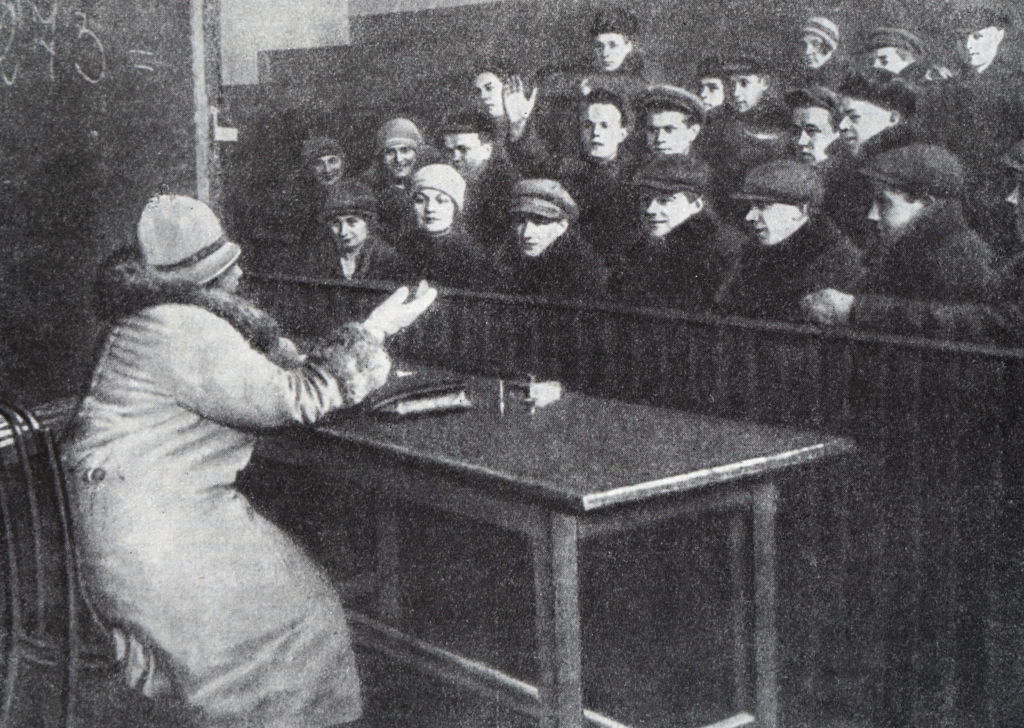
Classes at the Mikhail N. Pokrovsky Workers’ Faculty at Moscow State University, 1920.

Classes at the Mikhail N. Pokrovsky Workers’ Faculty at Moscow State University, 1920. (Universal History Archive / Universal Images Group via Getty Images)


Mikhail Nikolaevich Pokrovsky was the leading Soviet historian during the 1920s. He is credited with being the first person to present the history of Russia from a Marxist perspective. He was responsible for establishing the main academic institutions of the Soviet era, and for founding the leading historical journals.

However, the Soviet authorities denounced Pokrovsky’s writings after his death in 1932, branding them as schematic and anti-Marxist. It was not until Joseph Stalin’s death in 1953 that Pokrovsky was rehabilitated and his chief works were republished.

Education

Pokrovsky was born in 1868 in Moscow, the son of a senior civil servant. He studied history at Moscow University, where the eminent scholars Vasily Klyuchevsky and Paul Vinogradov taught him. Klyuchevsky lectured on Russian history, while Vinogradov tackled ancient and European history.

It was from these teachers that Pokrovsky derived his early approach to history. From Klyuchevsky, Pokrovsky learnt to appreciate the importance of the economic factor in shaping events, a phenomenon that he referred to as “economic materialism” and which he would later attribute to Karl Marx.

In 1891, Pokrovsky graduated with a first-class diploma and eagerly accepted the offer to study for a postgraduate degree. After three years of intensive study that included both Russian history and the history of medieval Europe, he passed his master’s examination in 1894. The next step would have been to research for his master’s dissertation, which would have been presented as part of Pokrovsky’s formal training as an academic.

However, this did not happen. Due to a disagreement with Klyuchevsky, Pokrovsky quit the university and went to teach history at an education college for girls. He nevertheless continued with his historical studies and was able to publish his first academic works in a multivolume collection of essays on European medieval history edited by Vinogradov.

Vinogradov was an Anglophile liberal who subscribed to the positivist doctrine that all countries pass through the same historical stages. He believed that where England had gone, Russia would later follow — that is, to a system of parliamentary government. This was the historical and political credo that Pokrovsky espoused prior to the 1905 revolution, and his contributions to liberal publications reflected this outlook.

1905

Through his colleague the historian Nikolai Rozhkov, Pokrovsky made the acquaintance of Alexander Bogdanov, who in 1904 was ending his spell of banishment in Vologda for his activities in opposition to the tsarist regime. He contributed an article to the literary and philosophical journal Pravda that Bogdanov edited.

When the 1905 revolution broke out, Pokrovsky participated in the literary lecturing group in Moscow that consisted of Bogdanov’s associates. Bogdanov himself led the Bolsheviks in St Petersburg. It was as a member of the literary lecturing group that Pokrovsky joined the Bolshevik faction of the Russian Social Democratic Labor Party (RSDLP).

In June 1905, Pokrovsky traveled to Geneva and met Vladimir Lenin, who invited him to write an article for the party paper Proletarii. In it, Pokrovsky argued that liberals should not be alienated, because they could be won over to social democracy. Lenin did not agree.

During the revolutionary events of 1905, Pokrovsky and the members of the literary lecturing group toured the Moscow region, giving lectures on behalf of the RSDLP and publishing a series of party newspapers. Even after the defeat of the December uprising in Moscow, Pokrovsky’s group attempted to continue the revolutionary struggle.

Early Works and Exile

In 1906, Pokrovsky published Economic Materialism, a pamphlet in which he outlined his views on how Marxist history should be written. In his view, the economic factor was paramount in explaining events. Personalities simply reflected the economic trends of the time, and material interests, reflected in the class struggle, were the driving force of history. According to Pokrovsky, there was no essential difference between Russian history and that of Western European countries.

In 1907, Pokrovsky was forced to flee Russia and seek refuge in Finland, where he began to work on chapters for the nine-volume History of Russia in the XIX Century. Other chapters were contributed by fellow academics, members of the literary lecturing group, and representatives of the RSDLP, including Julius Martov. Pokrovsky’s approach in the chapters was almost entirely factual, with little sign that he had followed the principles embodied in Economic Materialism.

In 1909, Pokrovsky moved to France, where he lived until the outbreak of the Russian Revolution in 1917. His main occupation in exile was writing the five-volume History of Russia from the Earliest Times. This was to be Pokrovsky’s main work, and he intended it to surpass in scholarship Klyuchevsky’s renowned Course of Russian History.

The work plays down the role of individuals in history and tries to find economic explanations for events — for example, in the changes in grain prices. In his subsequent work Study in the History of Russian Culture, Pokrovsky finds a new driving force in Russian history: the struggle between merchant and industrial capital.

Between the Revolutions

In his period of exile, Pokrovsky came into political conflict with Lenin. It was Lenin’s contention that the revolutionary era was over with the failure of the 1905 revolution, and that the Bolshevik tactic must be support for the RSDLP faction in the Duma. Bogdanov, however, believed that the Duma faction should follow party policy, and if it did not, it should be served an ultimatum to do so. In the event of noncompliance, the faction should be recalled from the Duma.

Bogdanov also considered that all the factors that had brought about the 1905 revolution were still in operation, and that a new revolutionary upsurge was in the offing. To prepare the workers for this renewal of the revolution, Bogdanov organized a party school on Capri in 1909 and one in Bologna in the following year.

Pokrovsky sided with Bogdanov against Lenin, and gave lectures on Russian history at the Capri and Bologna party schools. When Lenin organized Bogdanov’s expulsion from the Bolshevik Center, Pokrovsky gave Bogdanov his support, but he then left Bogdanov’s Vpered group in 1911 over disagreements on proletarian culture.

Pokrovsky, now outside both the Bolshevik and Menshevik factions of the RSDLP, found an ally in Leon Trotsky, who also stood outside both factions. Pokrovsky contributed to Trotsky’s publications Bor’ba and Nashe Slovo with articles on Russian history and foreign policy.

Pokrovsky was a specialist on the history of Russian foreign policy, and in his works on the subject, he stressed Russia’s often aggressive stance. For example, he argued that Russia’s attempts to acquire Constantinople and the Turkish Straits in the interests of merchant capital had contributed to the outbreak of World War I. After 1914, Pokrovsky’s antiwar stance brought him closer to Lenin and the Bolsheviks. In 1916, he helped Lenin publish his pamphlet, Imperialism, the Highest Stage of Capitalism.

Narkompros

After the fall of tsarism in 1917, Pokrovsky returned to Russia and was active in the October revolution in Moscow. On Trotsky’s invitation, he went to Brest-Litovsk for peace negotiations with the Germans. However, he became disillusioned with Trotsky’s tactics, which depended entirely on fomenting revolution in Germany.

As Anatoly Lunacharsky’s deputy at the Commissariat of Education (Narkompros), Pokrovsky was principally responsible for reorganizing the educational and cultural institutions of the new Soviet state. He organized and became chairman of the USSR Central Archives Administration. He founded the Socialist (later Communist) Academy, the Institute of Red Professors (IKP), the Association of Sciences Research Institutes (RANION), and the Society of Marxist Historians. Besides editing and contributing to a number of journals, Pokrovsky wrote the history textbook, the Brief History of Russia.

In 1922, Pokrovsky’s interpretation of Russian history was challenged by the translation of Trotsky’s book 1905, which had originally been published in German in 1909. In keeping with Trotsky’s theory of permanent revolution, 1905 insisted that Russia had no indigenous capitalist development and that its industry was entirely of foreign origin. A debate ensued in which Pokrovsky defended his idea that Russian tsarism was the embodiment of merchant capital. Trotsky’s opponents utilized his arguments in the contemporary anti-Trotsky campaign.

A photo portrait of M. N. Pokrovsky
A photo portrait of M. N. Pokrovsky published in 1930 by the State Publishing House.

Pokrovsky’s standing as a historian began to be undermined in 1924 with the publication of Nikolai Bukharin’s essay “Lenin as Marxist,” which established the principle that all scholarship should be conducted from a Leninist viewpoint. Since Pokrovsky’s main works were pre-Soviet, his critics could condemn them as “anti-Leninist.” With the support of Stalin, however, he avoided this fate for the time being.

Another difficulty for Pokrovsky arose in 1925 when a pupil of his at IKP, N. Vanag, published research showing that foreign capital controlled three-quarters of the whole Russian banking system on the eve of World War I. This meant that Russian monopoly capitalism was not an independent entity, but a component part of Anglo–French–Belgian finance capital. Vanag’s study was followed by others that reached the same conclusion.

Pokrovsky initially accepted Vanag’s findings and adjusted his conception of modern Russian history accordingly. However, he later rejected this line of argument, since Vanag seemed to lend support to Trotsky’s version of Russian economic development.

Death and Dishonor

When Pokrovsky died in 1932, he was honored as an outstanding Soviet scholar. There was a proposal that Moscow University be renamed in his honor. A two-volume collection of his essays appeared in 1933, indicating official approval of his work, especially his polemic against Trotsky.

But the anti-Pokrovsky campaign began soon afterward. Pokrovsky had assumed that the theory of “socialism in one country” would be bolstered by a version of Russian history that stressed indigenous economic development. In fact, what Stalin wanted was an interpretation of Russia’s past that focused on Russia’s weakness, its vulnerability to attack, and consequently its need for rapid industrial construction.

That was why Stalin chose Vanag to edit a new textbook on Russian history, and he was disappointed when Vanag misunderstood his assignment. He rebuked Vanag for not showing Russia’s subservience to foreign finance capital. The 1938 Short Course of the RKP(b), edited by Stalin himself, declared that the chain of imperialism had broken at its weakest link — Russia.

In 1936, a campaign against Pokrovsky began in the pages of Pravda and Izvestia. Official polemicists accused him of writing history in abstract sociological terms and of denying the possibility of objective history. Quoting Pokrovsky out of context, his critics charged him with teaching that “history is politics projected into the past.”

As an inverted tribute to Pokrovsky’s influence on Soviet scholarship, two volumes of anti-Pokrovsky essays were published in 1939–40 under the titles Against the Historical Conception of M. N. Pokrovsky (1939) and Against the Anti-Marxist Conception of M. N. Pokrovsky (1940). Among the contributors to the volumes were a number of Pokrovsky’s former students, including Anna Pankratova, who had previously written an effusive obituary of her teacher.

Pankratova now denounced Pokrovsky as an associate of both Bogdanov and Trotsky, and as someone who had collaborated with spies and wreckers and had not been guided by Lenin’s works. For the rest of Stalin’s life, Soviet periodicals only mentioned Pokrovsky and his views in a negative light, as an example of how history should not be written. With Stalin’s death, however, and the accompanying “thaw,” Pokrovsky was rehabilitated.

Assessing Pokrovsky

Between 1965 and 1967, a four-volume edition of Pokrovsky’s selected works appeared in Moscow. It contained the History of Russia from the Earliest Times, the Brief History of Russia, and a collection of essays. A biography of Pokrovsky by O. D. Sokolov, who edited the selected works, was published in 1971. After the fall of the Soviet Union, a great many studies of Pokrovsky were completed, and some of his main works were republished.

It is commonly said that Pokrovsky was a “Soviet historian” and that he was a “Marxist historian.” But these descriptions are not entirely appropriate. Pokrovsky’s chief works were written prior to 1917, and he resisted any pressure to align them with the Soviet ideological orthodoxy of the time.

His critics were right when they said that he was not influenced by Lenin. But his writings show little sign that Marx was an influence either. There is, of course, Pokrovsky’s concern to discover an economic causation for the historical events he recounts, which may be taken for Marxism. But this approach comes less from Marx, than from Pokrovsky’s teachers Klyuchevsky and Vinogradov.

Pokrovsky is in fact a Russian historian in the prerevolutionary tradition. While he is a major figure in the history of the Soviet Union, he also belongs to the history of Russian historiography more generally.