Indonesia Still Hasn’t Come to Terms With Suharto’s Crimes

A recently unveiled statue in Jakarta is the city’s first public memorial to one of the many crimes of Suharto’s dictatorship. Its rarity exposes the culture of historical amnesia that’s making it easier to roll back democratic rights today.
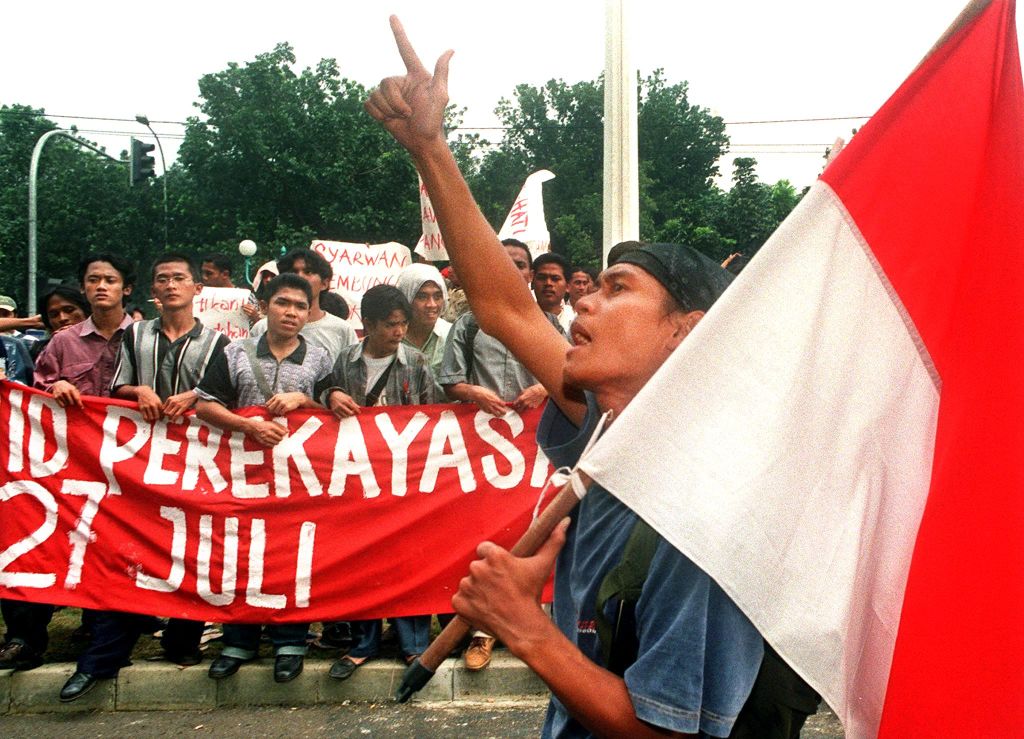
An Indonesian student holding the Indonesian national flag shouts antigovernment slogans while others hold a banner that says "Syarwan is the man behind the 27 July riot," during a protest at the Department of Home Affairs in Jakarta.

Nearly three decades after the fall of Suharto, human rights organizations describe Indonesia as a state undergoing democratic backsliding, accompanied by pressure on protesters and journalists and by an expanding military role in civilian affairs. (Kemal Jufri / AFP via Getty Images)


On July 27 this year, a black covering fell from a bronze statue in the courtyard at the headquarters of the Indonesian Democratic Party of Struggle (PDI-P) in central Jakarta. The sculpture revealed a woman with her mouth open in a cry, her arms wrapped around five figures whose heads bend beneath an unseen weight.

Designed by the politically engaged Indonesian sculptor Dolorosa Sinaga, the monument marks the thirtieth anniversary of Kudatuli — Kerusuhan Dua Puluh Tujuh Juli, or the July 27 riots. This was one of the final great acts of political violence carried out by Suharto’s thirty-two-year New Order dictatorship.

Political Landscaping

Megawati Soekarnoputri, the PDI-P chair and the woman whose political rise the 1996 attack was intended to stop, pressed the button that unveiled the statue.

Around her stood party leaders, former officials, human rights lawyer Todung Mulya Lubis, former minister Mahfud MD, Jakarta Governor Pramono Anung, Ahok (an ethnic Chinese political figure targeted by Islamic activists), members of Mohammad Hatta’s family, and the sculptor Sinaga herself. Afterward, Megawati placed flowers before the monument, telling those gathered that she had “never been able to forget” what happened on July 27, 1996.

The ceremony was solemn, meticulously choreographed, and unmistakably partisan. Attendees sang the national anthem, but also party fight songs and even a song devoted to Marhaen, the possibly apocryphal farmer who inspired Sukarno’s radical populism. Popular historian and recently elected member of the House of Representatives Bonnie Triyana declared that Indonesia’s July 27, 1996, was comparable to France’s July 14, 1789: a step on the path to revolution.

Most importantly, the statue did something extraordinarily rare in Indonesia: it placed the victims of state violence into the monumental landscape of the capital.

Selective Memory

Jakarta is a city crowded with statues of right-wing generals, presidents, soldiers, and masculine national heroes. The New Order, one of the last century’s most successful states for the practice of propaganda, utilized monuments as instruments of government.

At Lubang Buaya, the Crocodile Hole, Suharto erected the massive Sacred Pancasila Monument and an adjoining museum complex to impose the army’s account of the 1965 coup attempt. Its bronze generals, heroic poses, lurid dioramas, and historically suspect stories of communist treachery helped legitimize the mass killing and imprisonment of alleged Communist Party of Indonesia (PKI) members. The regime commemorated the handful of its own dead while erasing the millions of people it had tortured, raped, and killed.

Against this landscape of politicized memory, the Kudatuli statue is unique. It is the only large and permanent monument in central Jakarta that explicitly condemns an act of New Order violence.

There are important smaller or more peripheral memorial sites: the museum at Trisakti University, where four students were shot in May 1998, and the May ’98 Memorial at Pondok Ranggon cemetery in East Jakarta, which honors the victims and survivors of a Sinophobic pogrom that included over a thousand deaths and mass sexual violence. But there is no comparable civic statue in the capital’s political center that so directly indicts the New Order state.

Elsewhere in Indonesia there is a small plaque at a mass grade hidden away in the mountains of central Java, as well as Taman 65, a privately owned courtyard founded by the children of a schoolteacher and PKI cadre who was killed by his neighbors in Bali.

Military-Managed Democracy

To understand the monument, one must first strip away the phrase “party dispute” that has so often obscured the meaning of Kudatuli. Under Suharto, elections were rituals of managed consent.

Only two opposition parties were permitted to exist alongside Golkar, the official regime party. Candidates were vetted by military intelligence, and civil servants were expected to support Golkar. Political campaigning outside tightly controlled election periods was prohibited.

The army did not merely defend the government. Through its “dual function” role, it administered political life, occupied civilian offices, disciplined labor, supervised universities, and decided which forms of opposition could be tolerated.

In 1993, Megawati was elected chair of the Indonesian Democratic Party, or PDI. She was an unlikely revolutionary. The daughter of Indonesia’s founding president, Sukarno, and sincerely committed to restoring democracy, she cultivated a restrained and frequently enigmatic public image.

In contrast with her charismatic father, she was a relatively quiet figure during the 1980s and ’90s. As historian Yosef Djakababa notes, it was only after 1998 that she adopted a more active public persona. In 1999, she founded the Indonesian Democratic Party of Struggle. The word “struggle” was essential to this rebranding.

Rallying Point

During the New Order period, her name still carried an emotional force that Suharto could not control. By the mid-1990s, frustrated workers, students, urban poor residents, and members of an emerging democracy movement increasingly treated Megawati as a symbol of opposition.

The regime responded with a bureaucratic coup. In June 1996, government-backed party officials convened an extraordinary congress in Medan and installed a more compliant figure, Suryadi, as PDI chair. The congress had the support of the government and military but was rejected by Megawati’s supporters. They refused to surrender the party headquarters at Jalan Diponegoro.

For the next month, its courtyard hosted the Mimbar Bebas, or Free Speech Forum. At a time when public criticism could lead to surveillance, dismissal, or arrest, the headquarters became something almost unimaginable under the New Order: an open microphone.

That was the real danger. The building was no longer merely a party office. It had become a meeting place where the regime’s political enemies could recognize one another.

Clampdown

On the morning of July 27, trucks delivered hundreds of men wearing PDI red shirts and headbands to Jalan Diponegoro. They claimed to be Suryadi supporters but were really soldiers and hired ruffians. Riot police followed but initially stood aside as the attackers threw stones and Molotov cocktails at the people inside.

Shortly before nine in the morning, police stormed the compound alongside the pro-Suryadi forces. Witnesses reported beatings and arrests as the podium of the Free Speech Forum was destroyed. Indonesia’s National Human Rights Commission later concluded that the violent takeover had been conducted by Suryadi’s supporters together with the security forces and that the authorities had intervened excessively and one-sidedly in the PDI conflict.

The violence spread through central Jakarta. Amid the largest protests in decades, buildings and vehicles burned. According to Komnas HAM’s accounting, five people were killed, 149 wounded, and twenty-three disappeared.

The five officially identified dead were Uju bin Asep, Asmayadi Soleh, Suganda Siagian, Slamet, and Sariwan. Their names rarely appear in accounts that reduce Kudatuli to a chapter in Megawati’s political biography. The monument’s five bowed bodies should return attention to them.

Red Scare

The attack was followed by a broader political crackdown. Suharto’s government accused the small left-wing People’s Democratic Party (PRD) of orchestrating the unrest. The military revived the most powerful weapon in the New Order’s political vocabulary, charging young activists with representing a “new PKI.”

Students, labor organizers, lawyers, and opposition figures were arrested. Human Rights Watch found no evidence for the government’s claim and argued that the red scare tactics of blaming supposed communist conspirators diverted attention from the state’s own role in removing Megawati and storming the headquarters.

Kudatuli therefore mattered far beyond the PDI’s ranks. It exposed the machinery behind Suharto’s orderly facade: hired civilians, manipulated party factions, military intelligence, riot police, anti-communist accusations, selective arrests, and courts prepared to turn victims into criminals. Far from being an aberration, the violence was an inherent feature of the New Order system.

Monument Against Amnesia

Dolorosa Sinaga’s statue reverses the visual language of New Order monumentalism. It does not show a uniformed man pointing toward the future. It has no triumphant general, no weapon, and no granite celebration of state power.

At its center is a woman who is screaming and embracing the vulnerable. Megawati described the work as an expression of “revolutionary patience” born from conviction, courage, and perseverance.

The embrace can be read as a depiction of Megawati protecting her followers. But it can also represent the political work of memory itself: holding together those whom state violence attempted to scatter, silence, or disappear.

From a hauntological perspective, its location is equally important. The monument occupies the ground upon which the violence occurred. Jakarta residents pass sites of repression every day without markers explaining what happened there. Offices are rebuilt, shopping centers replace burned buildings, and traffic flows across landscapes stripped of political memory.

In Sumatra and East Java, Indonesians pass by rivers once choked with the bodies of slain PKI members. In Bali, rumors hold that some of the most expensive beach resorts sit on top of sandy mass graves. At Jalan Diponegoro, however, the scene of the crime is now marked.

Limited Reckoning

However, its location also reveals the limits of Indonesia’s reckoning. The monument stands inside a political party headquarters, not in a national memorial park or state museum. It was commissioned by the institution that inherited the attacked PDI faction, not by the Indonesian government.

The republic still has no national museum devoted to the crimes of the New Order and no comprehensive memorial to the victims of 1965–66, the Petrus shooting of alleged street criminals of the 1980s, anti-Islamist violence in Tanjung Priok in 1984 and Talangsari in 1989, military operations in Aceh and Papua, the disappeared activists of 1997–98, or the shootings at Trisakti and Semanggi during the fall of Suharto in 1998. Nor does the state memorialize the decades of imprisonment, torture, and sexual assault of TAPOL political prisoners.

While the state built monuments to the ideological justifications for its violence, survivors and their families have been left to commemorate the violence itself.

Uncomfortable Questions

The PDI-P deserves credit for refusing to let Kudatuli vanish. But the monument also confronts the party with an uncomfortable question. In the thirty years since the attack, Megawati has served as Indonesia’s fifth president and the PDI-P has been at the center of national government. Why have the crimes of the New Order still not been resolved?

Perpetrators have not been held accountable. The fate of the disappeared remains uncertain, and families continue to demand justice. The unveiling therefore marks an achievement of memory but also an admission of political failure.

The contradictions have become even sharper under President Prabowo Subianto, a former special forces general (and Suharto’s former son-in-law). In 2025, parliament passed revisions expanding the range of civilian positions that active-duty military officers can occupy. The vote was unanimous and was led by Parliamentary Speaker Puan Maharani, Megawati’s daughter and a senior PDI-P figure. Democracy activists warned that the law risked reviving the military’s New Order–era presence in civilian government.

This is the danger of treating the New Order as a closed historical period. It was not simply the rule of one old man in dark glasses. It was a political arrangement that combined military authority, oligarchic wealth, bureaucratic control, managed elections, anti-Left paranoia, and impunity for state violence.

End or Beginning?

Suharto may be long dead, but many of those relationships survived Reformasi. Human rights organizations now describe Indonesia as a state undergoing renewed democratic backsliding, accompanied by pressure on protesters, journalists, and activists and by an expanding military role in civilian affairs.

That is why the Kudatuli monument matters. It breaks the near monopoly that generals and state officials have exercised over Indonesia’s monumental history and announces that the victims of power also belong in the nation’s public landscape.

But a statue must not become a substitute for justice. It cannot release military archives, or identify the men who organized the trucks, recruited the attackers, issued commands to the police, ordered the arrests, and concealed the missing. Nor can it compensate families or prosecute perpetrators.

The monument’s deepest value will depend on whether Indonesians treat it as the end of remembrance or its beginning. Kudatuli should not become merely another origin story for the PDI-P or another chapter in the mythology of Megawati. It should become a place from which to ask why the democratic republic born from Reformasi still protects so many of the institutions and individuals responsible for authoritarian violence.

The woman in Dolorosa Sinaga’s sculpture is holding five bodies. But her mouth remains open. She is not only mourning the past. She is shouting at the present.