Gen Z Isn’t Apolitical. It’s Lost Faith in Capitalism.
Gen Z is often dismissed as apathetic. But interviews with leading scholars suggest otherwise: a generation coming of age amid crises in housing, work, and political institutions is not losing faith in politics but in the promises of capitalism.
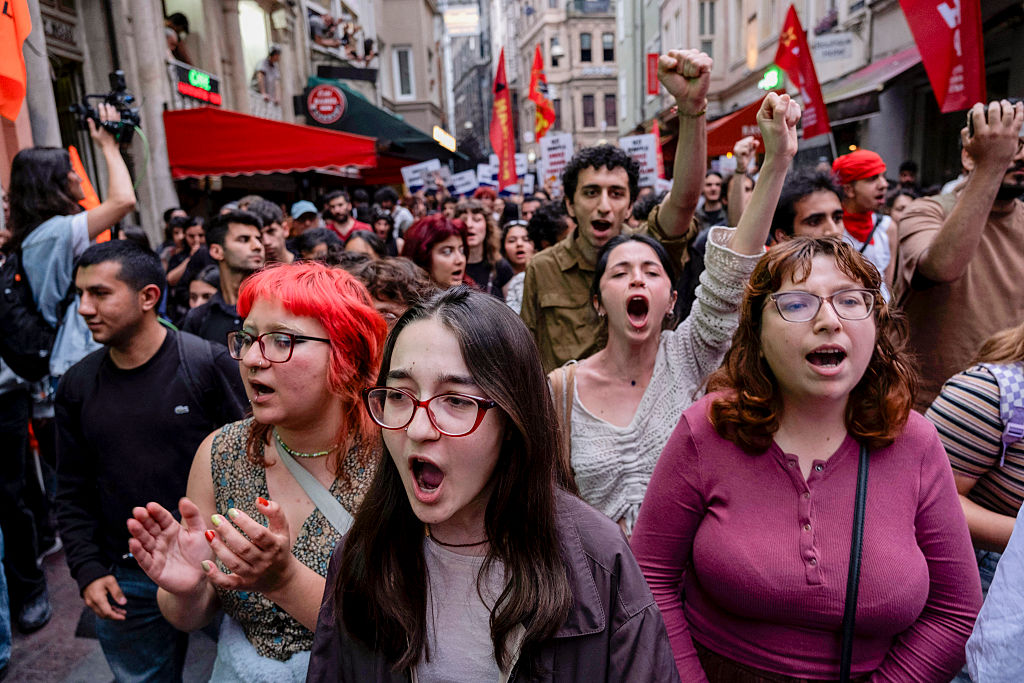
Gen Z boycotts brands, amplifies hashtags, and joins protests without joining parties. Its politics can look disorganized or ephemeral, but beneath the disorder may lie something much older: the rise of class consciousness. (Tolga Sezgin / Middle East Images / AFP via Getty Images)
Generation Z is often described as distracted, cynical, politically inconsistent, or allergic to institutions. But this description misses the deeper rupture. What distinguishes this generation is not a lack of politics but the collapse of faith in the institutions and rules that once gave politics, work, and adulthood a recognizable structure.
For decades, capitalism promised young people a sequence: education would lead to work; work would lead to stability; stability would lead to a home, a family, and a life with some measure of dignity. This promise was never distributed equally. For many, it was always fragile. But for Generation Z, it has now become almost impossible to believe in.
Across very different societies, young people are entering adulthood through the same narrow door. Behind that door lie precarious jobs, unstable housing, student and consumer debt, algorithmically managed labor markets, climate anxiety, and political institutions that appear either too weak or too captured to change anything meaningful.
This generation does not trust parties, leaders, or institutions. Yet it also votes, boycotts, protests, organizes online, quits jobs, and channels its anger through digital platforms. Most importantly, it can turn everyday life into a political battleground. Its politics is fragmented, fast moving, leaderless, and often reabsorbed by the very markets it rejects. But it is politics nonetheless.
In interviews conducted for this article, Guy Standing, Emre Erdoğan, Christian Fuchs, and Anu Muhammad described different parts of the same crisis: the making of a generation with no secure occupational future, no stable social contract, and no convincing reason to believe that capitalism can still deliver on its promises.
A nineteen-year-old university student living in Istanbul puts it more bluntly: “I don’t have an ideology. I just have a world order that I hate.”
That sentence captures something larger than youthful anger. What we are witnessing is a generational rupture. Generation Z has not withdrawn from politics. It is simply disillusioned with the old language and model of politics. And it has grown up in a world where old political vocabularies can no longer make sense of the insecurity it faces.
Generation Z does not exist outside class relations. Changes in capitalism have reshaped the class structure and the conditions of work, and Gen Z has come of age within these new relations. What we describe as “Gen Z politics” should not be understood as the politics of a homogeneous generation but as a generational expression of a broader transformation in class relations.
A Generation Without an Occupational Future
The British economist and labor theorist Guy Standing has spent years describing the rise of a new class: the “precariat.” This is not simply a group of people with bad jobs. It is a class shaped by insecurity itself: unstable employment, irregular income, debt, the absence of occupational identity, and the constant requirement to retrain, rebrand, and remain available for work that may never become secure.
Standing understands the contemporary economy as “a globalized rentier age”: “We are living in the globalized rentier age of capitalism; income, wealth, and power are increasingly flowing to those who own wealth and to elites who own the main forms of property,” he says. “The vast majority of young adults will face unstable and insecure jobs. They will live with low and uncertain wages and will be in almost constant debt.”
For Standing, the issue is not merely that young people have worse labor conditions than previous generations. The issue is that each new generation is being drawn more deeply into the precariat than the one before it.
As he puts it, “Each new generation is more involved in this class than the previous one.” For standing, the work possibilities for young people are so bleak that they have “no occupational future.”
“Individuals in the precariat are also forced to constantly search for jobs, retrain themselves, and find new sources of income,” Standing says. “Most of these activities are unpaid and invisible. Therefore, people cannot develop an occupational identity and cannot position themselves within a stable career line.”
This is the collapse of one of capitalism’s classic promises. The old story about work in liberal democracies was that it would give young people not only wages but direction, belonging, and a future. In the new labor market, work often gives them only exhaustion, uncertainty, and debt.
Standing also emphasizes that this condition produces bodily and psychological consequences. Chronic uncertainty does not remain outside the body. It turns into stress, illness, and fear.
“Especially young people, but everyone in the precariat generally, has to cope with chronic uncertainty,” he says. “This means facing ‘unknown unknowns’; that is, there is neither robustness to withstand shocks nor resilience to recover. The individual consequences of this are debt, stress, and increasing illnesses.”
This is not a temporary labor market problem. It is a political condition. When young people can no longer imagine a stable future through work, they also begin to lose faith in institutions that still speak as if such a future exists.
The Rules No Longer Work
Economic insecurity alone does not explain Generation Z’s politics. What makes the present rupture deeper is the collapse of the belief that society has clear and legitimate rules.
Political scientist Emre Erdoğan, whose research focuses on social trust, youth, and political behavior, describes this as a broader crisis of the postwar social order. Erdoğan argues that young people’s insecurity reflects the breakdown of the institutions that once gave capitalism legitimacy. “The post-1945 consensus has ended,” Erdoğan says.
“The United Nations order has ended. The system established by the World Bank, IMF, and World Trade Organization has collapsed. The welfare state has collapsed. What we call the safety net no longer exists. When you fall, who will hold you? The answer is: family, relatives, fellow countrymen. Not the state.”
Standing’s analyses explain the economic condition, and Erdoğan explains why it becomes political. Young people are not only struggling to find work. They are also struggling to understand which rules they are supposed to follow.
“You can no longer say to young people, ‘If you work hard, you will succeed,’” Erdoğan says. “We do not know how to succeed. People increasingly do not believe in the rules. There is no consensus on what is required to be successful in this society. Young people struggle not only to find jobs but to understand what rules they should follow. This uncertainty, over time, turns into a perception of structural injustice rather than a feeling of individual failure. And this perception feeds anger.”
This distinction matters. If young people believed their problems were merely personal failures, the result might be shame, withdrawal, or quiet despair. But when insecurity is understood as structural injustice, anger becomes political.
A Greek Erasmus student in Istanbul describes this distrust starkly: “If I ever vote, it will probably be in protest or to destroy something, not because I trust some politician.”
This is not merely cynicism. It is an expression of anomie: a condition in which the rules of social life lose their legitimacy. The young person may still vote. They may still participate. But the act is no longer rooted in trust. It becomes an act of refusal.
Erdoğan has a single word for this condition: “resentment.”
In Turkey, this resentment appeared powerfully during the Gezi Park protests in 2013, when an environmental protest grew into a mass anti-government movement. While Gezi predates the political world of Gen Z, the resentments that Erdoğan identifies have since reappeared in more recent forms of protests: student movements, urban protests, online campaigns, consumer boycotts, and leaderless acts of refusal.
Around the world, Generation Z has repeatedly been at the forefront of political upheaval. This is not due to a shared generational ideology; it is a result of the shared experience of precarity and institutional distrust. From climate strikes to the women-led uprising in Iran to youth mobilizations in Bangladesh and Nepal to India’s recent “Cockroach” protests, Gen Z has repeatedly emerged as a disruptive force in moments of political crisis.
Anger is not new. What is new is its speed, its mobility, and the way it travels across streets, screens, workplaces, campuses, and markets.
Digital Capitalism and the New Terrain of Struggle
It is tempting to say that social media is the driver of Gen Z’s politics. But that would be too simple. Digital platforms did not create exploitation, debt, insecurity, or police violence. But they have changed the terrain on which these conflicts are seen, organized, accelerated, and monetized.
Media theorist Christian Fuchs, whose work focuses on digital labor and capitalism, argues that platforms should be understood not as the cause of contemporary uprisings but as mediators of social struggle under digital capitalism:
Social media is not the cause of contemporary protests, rebellions, and revolutions. Given that young people are highly proficient in technology, it is natural that they use all kinds of digital media in protest communication, coordination, and organization. Precarious labor is certainly an important factor in some Generation Z protests. However, we cannot say that these protests are ‘created’ by social media platforms. In digital capitalism, these platforms do not create exploitation and social struggles but rather mediate them.
The politics that have emerged among many members of Gen Z cannot be reduced to TikTok, Instagram, X, or any other platform. But they also cannot be understood outside them. Generational cohorts do not erase class. Rather, generational experience shapes the conditions under which class relations are experienced. Digital media has become one of the main spaces where Gen Z’s anger circulates, where protest is organized, where identities are formed, and where even opposition can be turned into content, data, and profit.
The contradiction lies in the conditions under which many young people now work. Even those who reject the system can be drawn into speculative digital markets, influencer economies, platform labor, and algorithmic competition. They may protest capitalism in the morning and be forced to perform for its platforms at night.
Digital capitalism does not stand outside young people’s lives. It structures their work, their communication, their attention, and increasingly their sense of self. Fuchs describes digital capital as global, while digital workers are local, isolated, and fragmented.
The problem is not only that platform labor is poorly paid. It is also that it is organized in ways that make collective power harder to build.
“Digital labor is often individualized and fragmented,” Fuchs says. “Workers operate disconnected from each other, and the possibilities for collective organization are weak. This makes them both more fragile and more easily exploitable.”
In other words, the digital economy creates a workforce that is constantly connected but politically separated. Millions are online; everyone is visible; everyone is producing something. Yet workers often face the market alone.
Fuchs argues that if capital has globalized, labor must also organize globally. “We need a transnational and global digital labor union where digital workers around the world unite against digital capital.”
This is where the discussion moves beyond youth culture. The question is not whether young people are more ironic, anxious, online, or impatient than previous generations. The question is this: Are new forms of labor and communication reshaping class formations? And if so, can these new forms of class politics escape being absorbed by the platforms through which they circulate?
Youth as Victim and Political Force
Anu Muhammad, a Bangladeshi economist known for his critiques of capitalism, sees unemployment and precarious work as inseparable from the capitalist market economy. But he also emphasizes that these conditions do not produce a single political outcome.
“The ruling classes see this situation as an opportunity to use young people,” Muhammad says. “Young people face uncertainty, precariousness, and hopelessness from an early age. While these conditions turn some into part of the system, they push others to question and oppose this order.”
This is one of the central contradictions of Generation Z politics, which mirrors the broader crisis of capitalism itself. Conditions of insecurity do not produce a single politics. They can produce resignation, nihilism, or adaptation — or opposition and revolt. One part of youth may become an apparatus of the system, while another becomes part of the resistance against it.
The 2024 uprising in Bangladesh showed the volatility of youth discontent. Similar patterns can be seen elsewhere. Young people are not always organized through parties. They are not always guided by coherent ideologies. Their movements are often unstable and internally contradictory. Yet they repeatedly appear at the center of political ruptures.
These dynamics are disconcerting to older political institutions. Parties often expect young people to enter politics through familiar channels: membership, campaigns, elections, ideological loyalty. But Generation Z often enters politics through crisis: a housing struggle, a climate disaster, a corruption scandal, a campus protest, or a viral video that crystallizes a broader injustice.
The result is a politics that is difficult to contain. It can be fast and morally intense. It can be amorphous. It can disappear and reappear. It can refuse leaders. It can distrust negotiation. But it cannot simply be dismissed as apolitical.
No Trust, but No Withdrawal
One of the paradoxes of Generation Z is this: distrust does not always lead to withdrawal. Young people may distrust institutions and still vote. They may hate the political system and still take to the streets. They may mock traditional politics and still develop strong moral judgments about work, consumption, identity, climate, war, and inequality.
One young person I spoke with described the collapse of the old career promise with brutal clarity: “Climbing the career ladder? I am just trying not to stay under the ladder. The house and car that previous generations had at the age of twenty-five are beyond even a dream for me.”
This is not merely a complaint about money. It expresses the breakdown of an entire moral economy. The old promise said that effort would be rewarded, that adulthood would become more stable over time, and that the future would be something one could reasonably plan. For many young people, that promise now looks like a historical relic.
Yet this loss of faith does not mean that young people have stopped acting. On the contrary, their politics often appears in places older generations do not recognize as political.
Politically active members of Gen Z boycott brands. They quit jobs. They build mutual aid networks. They amplify hashtags. They expose employers. They join street protests without joining parties. They use irony as a weapon. They turn consumption into judgment and digital visibility into pressure.
Some of this is easily commodified. Some of it is shallow. Some of it disappears as quickly as it appears. But the fact that it is contradictory does not mean that it is meaningless.
Standing sees in this process the possibility that the precariat — of which Gen Z makes up a disproportionate share — is slowly beginning to recognize itself as a class.
“We see that the precariat is slowly becoming ‘a class for itself’ worldwide,” he says. “In other words, being in the precariat is no longer seen as a sign of shame or failure but is increasingly recognized as a result of today’s global capitalism.”
This recognition is politically explosive. Once insecurity is no longer experienced as private failure, it can galvanize collective action.
A New Political Imagination
Generation Z is more than a demographic cohort. It is also an outcome: of decades of neoliberal restructuring, declining labor protections, rising debt, unaffordable housing, weakened welfare states, digital exploitation, and political systems that increasingly fail to represent social reality.
Its anger is contradictory, fragmented, and often co-opted by the market it rejects. It can become protest, but it can also become content. The young people who want to refuse the system are nevertheless often integrated into the platform economy.
But this does not make Generation Z apolitical. It shows that political expression is emerging in forms that older institutions struggle to read.
This generation is not outside politics. But it increasingly feels itself to be outside the old institutions of politics. Its politics do not necessarily begin with parties, programs, or ideological traditions. It begins with insecurity, humiliation, blocked futures, and the feeling that the rules are rigged — or no longer work at all.
The old language of politics asks whether these young people are left wing, liberal, conservative, populist, radical, or apathetic. But the deeper question may be different: What happens when a generation no longer believes that the system can offer it a future?
Capitalism’s crisis today is not only that it produces inequality. It is that its central promise has lost credibility. The old story — work hard and you can succeed — no longer convinces the generation expected to inherit the world.
Whether Gen Z’s rage and disillusionment produce resignation, reaction, or solidarity remains to be seen. What is clear is that more and more young people no longer see insecurity as a private failing but as a shared condition. Recognizing what appears to be a private misfortune as a shared public condition is where politics begins. It is what propels collective action and demands for structural change.