Kate Bronfenbrenner, the Union Organizer’s Scholar

Kate Bronfenbrenner, who retired this year from Cornell University, has studied how workers win unions, how employers stop them, and how organizers can learn from one another for four decades. Her findings have changed how unions think about organizing.
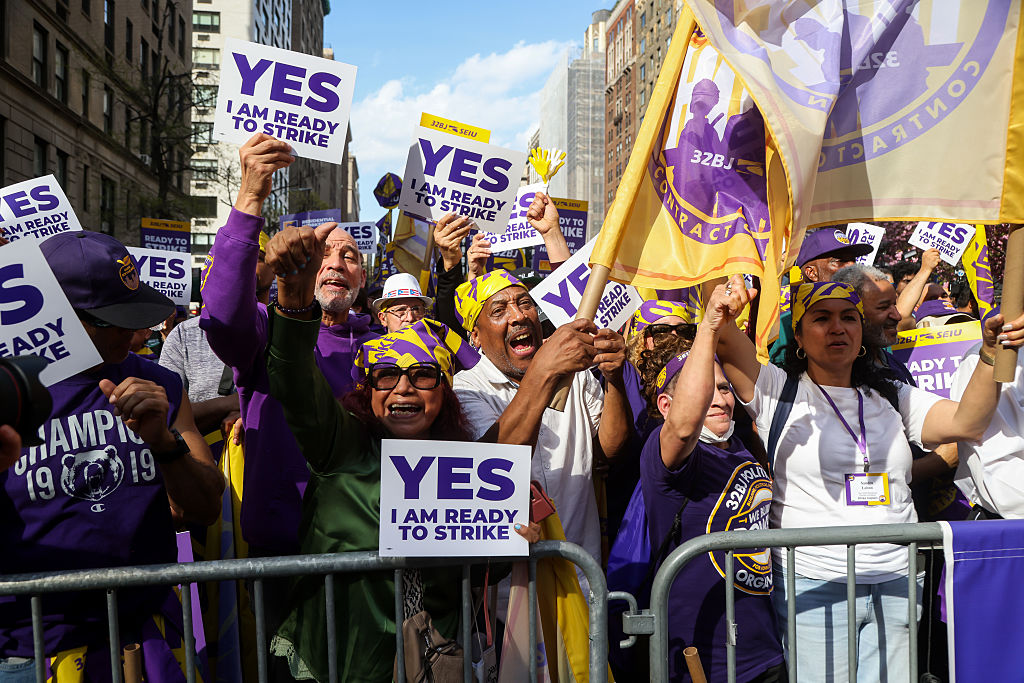
32BJ SEIU residential building service workers during a rally in New York City on Wednesday, April 15, 2026.

The contemporary labor movement’s approach to union organizing and strategic corporate research is deeply indebted to labor scholar Kate Bronfenbrenner. (Michael Nagle / Bloomberg


Kate Bronfenbrenner started by asking union organizers to walk her through their campaigns, from beginning to end.

Bronfenbrenner, who retired this year from Cornell University’s School of Industrial and Labor Relations (ILR) after more than twenty-five years teaching and researching there, has spent four decades studying why some union campaigns succeed while others fail.

What happened after workers first began talking to one another? When did management realize there was an organizing drive? Who served on the organizing committee? Why did one campaign succeed while another failed? Those questions first emerged in her dissertation research in the late 1980s.

“There was no silver bullet, no formula,” she said. “It was more that unions were running very weak campaigns. The building blocks of organizing weren’t even being done, the basic things — knowing who you’re organizing, knowing who the employer was, having a committee that was representative of the unit and played an active role in the campaign. We’re not talking about fancy tactics. We’re talking about the basics.”

Over the next four decades, Bronfenbrenner’s research on union campaigns, employer opposition, and global corporate restructuring became standard reading in organizing departments. The Strategic Corporate Research Summer School at Cornell trained generations of union researchers and organizers and will continue after Bronfenbrenner’s involvement: This summer, the program was held for the first time at the School of Labor and Urban Studies in the City University of New York (CUNY).

Bronfenbrenner’s work reached well beyond academia. The AFL-CIO distributed her research to organizers around the country, and unions brought her in to train their staff. “Probably the most effective thing I did was the Blueprint for Change,” a major assessment of successful union organizing strategies around the country, she told me. The AFL-CIO “gave it free to every organizer in the country, every union,” and “I think there are organizers who changed how they’re organizing.” Few labor scholars can claim as big of an impact on the labor movement as Bronfenbrenner.

An Organizer Before an Academic

Bronfenbrenner had not planned to spend her career studying union organizing. She grew up in Ithaca, New York, the daughter of immigrants from Germany and Russia. Her father, a child-development scholar who worked on the creation of Head Start, spent time in Mississippi during the civil rights movement. Her mother organized locally for Eugene McCarthy and George McGovern. As a teenager, she skipped school to attend demonstrations at Cornell, leaving notes explaining that she was participating in acts of civil disobedience before returning to serve detention.

She spent two years at Kenyon College before transferring back to Cornell, where she studied prisons, welfare rights, and indigenous history. After graduating, she moved to Seattle, where she helped run a food bank and organized around welfare rights alongside legal-services attorneys, part of a network of labor, welfare-rights, anti-racist, antinuclear, and community organizations.

“We actually mapped out and discovered that, for all of us, the people we were fighting against all lived in one gated community in Seattle,” she recalled.

From there, she moved to Mississippi, expecting to organize pulpwood cutters with the United Woodcutters Association. “The night I got there,” she recalled, “I hear, ‘Thank God we got another woman. She can help with the bookkeeping and the housekeeping.’” Bronfenbrenner ended up building a credit union and tool cooperative with predominantly black pulpwood cutters, who were trapped in debt to the dealers who bought their timber and financed their equipment. She taught workers how credit unions functioned using drawings, because many had no more than an elementary school education.

After the Mississippi campaign collapsed when employers classified the woodcutters as independent contractors, Bronfenbrenner moved to Massachusetts and went to work for Service Employees International Union (SEIU) Local 285, where staff organized new workers, bargained contracts, handled grievances and arbitrations, lobbied legislators, and represented existing members. There were no separate organizing or servicing departments. “You did everything,” Bronfenbrenner recalled.

Her organizing career was interrupted by a random violent crime. In 1977, a stranger gained entry into Bronfenbrenner’s Seattle apartment and attacked her. She survived, but the attack damaged her spine, leaving her permanently physically disabled. She returned to organizing after nearly a year away from work, but over time bargaining, picketing, and the other physical demands of the job became harder. Friends in the labor movement suggested labor education.

Kate Bronfenbrenner with United Steelworkers leader George Becker.
Kate Bronfenbrenner with United Steelworkers leader George Becker. (Courtesy of Kate Bronfenbrenner)

Bronfenbrenner had sworn she would never get a PhD. “I wanted to be an organizer,” she told me. “I didn’t want to go back to college.” She returned to Cornell for graduate school and worked as a labor educator at ILR, teaching union members and staff while beginning research on problems unions were confronting in their workplaces. One of her first projects examined the growing use of part-time, temporary, and leased workers. Instead of running campaigns herself, she was now teaching, researching, and speaking with union leaders about the changing workforce.

Bronfenbrenner would spend more than twenty-five years at ILR without receiving tenure. Academia has not always placed the same value on the kind of engaged research she did, much of it intended to be used by organizers.

Learning to Ask

That work soon brought Bronfenbrenner to the attention of Virginia Diamond, then–assistant director of organizing at the AFL-CIO. Diamond approached Bronfenbrenner after a presentation she gave in 1988 to the federation’s executive council on organizing part-time, temporary, and leased workers. Diamond asked whether she would be interested in conducting the first real national study of union organizing. Bronfenbrenner, on the hunt for a dissertation topic, was available.

“A week later, eight boxes come to my office,” she recalled. Inside were surveys the federation had attempted to collect from organizers around the country, asking about union and employer tactics and the workers being organized. The project was far larger than the dissertation she had expected to undertake. “And I did not realize that if I did it once, I’d be asked to do it again, and then again, then again.”

Most industrial relations research focused on the legal and economic environment surrounding elections rather than on organizing itself. Bronfenbrenner instead tracked down the lead organizer for each campaign and reconstructed the organizing drive. She later replicated and expanded the work in the public sector with sociologist Tom Juravich. In their 1995 paper, “Union Tactics Matter: The Impact of Union Tactics on Certification Elections, First Contracts and Membership Rates,” they wrote that there had been “surprisingly little micro-level research that looks intensively at the organizing process itself.”

“There was a general belief that employer tactics were determinative,” Bronfenbrenner told me. “But by interviewing organizers and researching the companies, you could actually see what tactics mattered, what demographics mattered, what made campaigns succeed.”

Bronfenbrenner found that “union tactics — what unions actually do during a campaign — as a group matter more than employer behavior or any other set of factors.” They found that unions could improve their odds by beginning “to act like a union and build strong rank-and-file organizations from the very beginning of the campaign.”

The strategies associated with higher win rates included representative committees, personal contact, escalating pressure tactics, rank-and-file volunteers, a focus on dignity and fairness, and preparing for the first contract during the organizing campaign.

Before submitting the dissertation, Bronfenbrenner sent a summary to every organizer she had interviewed, a practice she continued with later studies. “For a lot of organizers, it was like, ‘Thank you. Somebody’s paying attention to us, listening to us,’” she recalled. “It mattered that they got the results.”

Soon the New York State AFL-CIO and unions including the United Auto Workers (UAW), SEIU, and UNITE HERE were bringing her in to train organizers.

Union leaders readily embraced her findings on employer coercion and the weakness of labor law. Her findings about unions themselves were a harder sell. Many campaigns were underfunded, lacked representative committees, or relied on organizing staff that bore little resemblance to the workers they hoped to organize.

“They loved the fact that I was tracking employer opposition and how terrible it was,” Bronfenbrenner said. “But they didn’t like the fact that I said, ah, but union tactics matter. You know the odds of changing what employers do, but the one thing you can change is what unions do.”

The surveys also asked organizers systematically about race and gender. Allies in the AFL-CIO warned her that some affiliates would be furious. Women and workers of color made up much of the workforce being organized, while organizing staffs remained overwhelmingly white and male. Campaigns led by women and organizers of color had substantially higher win rates than those led by white men. Bronfenbrenner moved the demographic questions to the end of the survey so hostile respondents would finish it before abandoning it.

“No one had had these kinds of conversations in depth before,” she said. Most organizers appreciated being asked.

What Organizers Do

By the time Bronfenbrenner began surveying organizers in the late 1980s, employers were using remarkably similar anti-union campaigns.

“The majority of unions were still organizing by standing at the gate and handing out cards,” she told me. “Most didn’t have organizing departments. They didn’t invest significant resources in organizing. They didn’t even know who owned the companies.”

“But they found a system that works,” Bronfenbrenner said of the employers. “Their management tactics really haven’t changed that much, except by adding technology. They know that threats and interrogation and promises and surveillance — all of that works.”

Bronfenbrenner’s 2009 report, No Holds Barred: The Intensification of Employer Opposition to Organizing, drew on a random sample of 1,004 National Labor Relations Board (NLRB) elections held between 1999 and 2003 and detailed surveys of 562 campaigns. The report described an NLRB election process in which it was “standard practice for workers to be subjected to threats, interrogation, harassment, surveillance, and retaliation for union activity.”

Employers threatened to close facilities in 57 percent of campaigns, threatened wage or benefit cuts in 47 percent, and discharged union supporters in more than a third. In two-thirds of elections, workers were required to attend one-on-one anti-union sessions with supervisors at least weekly. “Since the rise of the union-avoidance industry in the 1970s,” she wrote, “we have witnessed a significant increase in the intensity and aggressiveness with which private-sector employers have opposed organizing efforts.” As corporations restructured and globalized, “corporate anti-union strategies have become more sophisticated.”

“The unions had not really figured out how to combat that,” she told me. “They were sending out lots and lots of leaflets and flyers, but not actually developing the committees to counteract the opposition within the workplace.”

Campaigns that were well-organized still ran into a problem she hadn’t fully appreciated in the early surveys. Managers might discipline workers, hire them, or bargain with them. But decisions about ownership, investment, or shutting down a plant increasingly originated somewhere else.

The Research They Wanted

Some employers responded to Bronfenbrenner’s research in court. After she testified in 1997 at a congressional town hall meeting in Pittsburgh on employers’ anti-union conduct, Beverly Enterprises sued her for defamation. The nursing home company objected to her description of it as “one of the nation’s most notorious labor law violators” and sought $225,000 in damages. The company also sought Bronfenbrenner’s confidential surveys through discovery.

Bronfenbrenner regarded access to the data as the real danger. Organizers had answered her surveys on the understanding that their identities and campaigns would remain confidential. “These SLAPP suits were designed to try to make all scholars afraid to do corporate research,” she told me, referring to “strategic lawsuits against public participation.” She feared that if she were ordered to surrender the confidential material, she might ultimately have to refuse. “I thought I was going to have to go to prison,” she said.

A federal judge dismissed Beverly’s suit in May 1998, finding that Bronfenbrenner’s remarks were protected because they had been made in a legislative proceeding. But the case made her work a target of employer groups and conservative critics. “Cornell constantly got called with complaints,” she said. “People wanted them to fire me.”

Years later, Bronfenbrenner flew to London to speak at a meeting of the International Bar Association. She learned while she was boarding that the panel had been changed: management consultants and employer representatives would be appearing alongside her. Bronfenbrenner came to believe it had been reorganized to expose her to a libel suit in England, where, she had been warned, defamation law was considerably more favorable to plaintiffs than in the United States.

A British barrister met her at the airport. For the next hour, he prepared her for the session. His instructions were simple: answer every question by reading from her published work, and say nothing more.

“They kept trying to provoke me,” she recalled. “But no matter what they said, I read.” No libel suit was filed against her.

Strategic Research

Public sector unions wanted the same kind of analysis Bronfenbrenner had done for private sector organizing. Bronfenbrenner had by then taken a job at Pennsylvania State University, where she and Juravich taught in programs for the United Steelworkers.

“We got asked to do the Ravenswood project,” Bronfenbrenner recalled, “which became an ethnographic project that took six years.”

The cover of the book
The United Steelworkers’ fight against Ravenswood in the early 1990s became a key example of strategic corporate campaigning in the US labor movement. (Cornell University Press)

The campaign had begun in 1990, when members of United Steelworkers Local 5668 were locked out of Ravenswood Aluminum in West Virginia after contract talks broke down amid company demands for concessions and disputes over safety. By the time Bronfenbrenner and Juravich began studying it, the dispute had expanded far beyond the mill. The union had traced the company’s ownership through Marc Rich’s commodities empire, identified its customers and business partners, and built pressure in the workplace, the community, and internationally. Workers had to hold together through a lockout that lasted nearly twenty months.

In Ravenswood: The Steelworkers’ Victory and the Revival of American Labor, Bronfenbrenner and Juravich follow the strategic campaign. Decisions affecting the lockout originated with owners, lenders, customers, and investors who never set foot in West Virginia.

In 1992, the company settled. The locked-out workers returned to the plant with a contract, and the episode became a key example of strategic corporate campaigning in the US labor movement. Ravenswood also changed the questions Bronfenbrenner was asking. Increasingly, the important decisions lay beyond the employer that workers saw every day.

Across Borders

After Ravenswood, Bronfenbrenner increasingly focused on companies whose operations, suppliers, customers, and workers crossed national borders. Her 2000 report, Uneasy Terrain: The Impact of Capital Mobility on Workers, Wages, and Union Organizing, examined how the threat of moving production affected organizing and bargaining even when companies never ultimately relocated. She began tracing ownership, subcontracting, and production across multinational firms rather than one workplace at a time.

In February 2006, that work culminated in a three-day conference in New York titled “Global Companies–Global Unions–Global Research–Global Campaigns.” Bronfenbrenner and labor leaders including Rich Trumka, Bruce Raynor, and Ron Blackwell had spent nearly four years preparing it, and more than 560 unionists and researchers attended. Much of the conference was organized around multinational corporations rather than countries or individual unions, bringing together workers employed by different parts of the same company. Participants from the Global South were there not simply to describe conditions in their countries but to help plan campaigns alongside workers elsewhere.

The conference organized research around ten multinationals, including Walmart, Alcoa, Sanofi-Aventis, Starwood, Kraft, and Exxon Mobil. Together they reconstructed each company — its ownership, customers, suppliers, finances, and operations — before asking where workers might actually exercise leverage across borders.

One of the researchers was Aaron Brenner, then a financial analyst whose clients included mutual funds and hedge funds who also wrote occasionally for Labor Notes. “It wasn’t enough to get the unions in a room,” Brenner, who is now a senior capital markets analyst at the United Food and Commercial Workers, recalled. “You needed to give them the research and analysis that allowed them to design campaigns.”

Brenner presented the Walmart research to unionists who had studied or organized the company in Mexico, Britain, and Canada. Brenner later said the conference was followed by a “mini-boom” in strategic-research jobs in unions in the United States and abroad. The proceedings became Global Unions: Challenging Transnational Capital Through Cross-Border Campaigns, edited by Bronfenbrenner.

In the late 1990s, David Chu, then head of strategic research at the AFL-CIO, approached Bronfenbrenner about creating a program to expand unions’ research capacity. The first Strategic Corporate Research Summer School was held at Cornell in 2001. Bronfenbrenner developed the corporate-research model used in the program with Keith Mestrich and Tom Juravich.

The course required forgetting that you were organizing workers. Participants were asked to think like the company instead. How did it make money? Who owned it? Where was it borrowing? Who sat on the board? Which customers, suppliers, lenders, investors, or government agencies mattered most? Which decisions were made locally, and which somewhere else entirely? Only then did they begin thinking about organizing strategy.

Each team worked on a real company, usually one drawn from a participant’s own campaign. Over the course of the week, they reconstructed its ownership, finances, customers, suppliers, logistics, and governance before asking where workers might actually exercise leverage.

This year, after Bronfenbrenner’s retirement, the program moved to CUNY’s School of Labor and Urban Studies under the direction of labor scholar Stephanie Luce. Nearly 150 people applied for roughly sixty spots this year, including union researchers, organizers, rank-and-file members, and recent graduates.

Only after taking over did Luce fully see how much work Bronfenbrenner had put into each session. Bronfenbrenner read every application and built the student groups herself, matching participants whose skills and experience might complement one another.

“She’s extremely conscientious about the quality of her research,” Luce said about Bronfenbrenner, “but also the ethics of what the research is for, never losing sight that at the end of the day this is about rank-and-file worker power.”

Kate Bronfenbrenner, second from left, at a retirement party organized by former students.
Kate Bronfenbrenner, second from left, at a retirement party organized by former students. (Courtesy of Kate Bronfenbrenner)

The Big Companies

Amazon is the kind of company Bronfenbrenner thinks unions have to organize.

“I think Amazon has multiple points,” she said. “Certainly, the distribution centers matter, but also the drivers matter, the ships matter, the airlines matter.”

Bronfenbrenner doesn’t think unions can avoid companies such as Amazon and Walmart simply because they’re difficult to organize. “The answer is not to organize small,” she said. “You’ve got to organize the big companies, even though that’s harder.” She pointed to national campaigns by the Steelworkers, UAW, UNITE HERE, Communications Workers of America, SEIU, and the Union of Southern Service Workers as examples of unions experimenting with forms of organizing that do not fit neatly into the traditional NLRB election model.

“If labor isn’t taking on the very same corporations that are telling Trump what to do. . . . ” she said. “You just have to take on those companies, and that means private equity, and that means Walmart and Amazon.”

The question comes up again after an election.

“How you define victory is problematic,” she said. “If you define victory as winning an election, that’s a big mistake. That’s just a step. But if you define victory as: you got the employer to make a change, and then you start fighting these fights all along, then you’re going to be able to get a majority of workers slowly but surely.”

The Starbucks union drive is a prime example. Workers at a Buffalo Starbucks won the first successful union election at a company-operated Starbucks in the United States in 2021, but organizers continued taking the campaign to other stores rather than waiting for a first contract. “If the union had just said, ‘Oh, we’re not going to move ahead until we get a first contract at Buffalo,’ there would have been no campaign with Starbucks.”

The same went for labor law reform: it mattered, Bronfenbrenner said, but whatever legal rights workers had, “you had to organize.”

The Next Campaign

At the final Cornell session last summer, Brenner recalled what Bronfenbrenner had told him years ago during that first week of the program that he attended: “She explained that I could get a job with a union, that unions needed my skills, that the labor movement needed my skills.”

“As it turned out,” he recalled, “I didn’t learn that much more about researching companies. But I learned a ton about analyzing them for the purposes of organizing and bargaining.” Brenner eventually returned to the Summer School as an instructor, teaching alongside Bronfenbrenner for roughly two decades.

For Chris Brooks, a former Labor Notes staffer who served as UAW President Shawn Fain’s chief of staff (and is currently a Jacobin columnist), “Bronfenbrenner is not just one of the smartest and most rigorous labor academics in the country, she is also one of our movement’s best strategists.”

“It’s the tragedy of our movement,” Brooks said, “that so few have listened to her or taken these lessons to heart.”

Today strategic corporate research is taught at the AFL-CIO, Rutgers, the University of California, Los Angeles, CUNY, the University of Massachusetts, and by unions and labor organizations in the United States and abroad.

Through her decades of research, Bronfenbrenner changed the way organized labor uses research in assessing where companies’ pressure points are and how to fight back against anti-union tactics. Very few people were doing such work when she started. Now, as she retires, many aspects of her approach have become common sense across much of the labor movement.

“Getting members to go through the hoops of fire that it takes to organize, it’s a big ask,” Bronfenbrenner told me. “It is always amazing to me that workers do organize rather than that they don’t, because it is hard to organize, particularly in this very divisive society, coming together and building solidarity.”