For 60 Years, The Battle of Algiers Has Inspired Resistance

When The Battle of Algiers premiered at the Venice Film Festival, 60 years ago this month, the French delegation refused to attend. From the moment of its shooting, in the aftermath of Algeria’s liberation war, Gillo Pontecorvo’s film was deeply political.
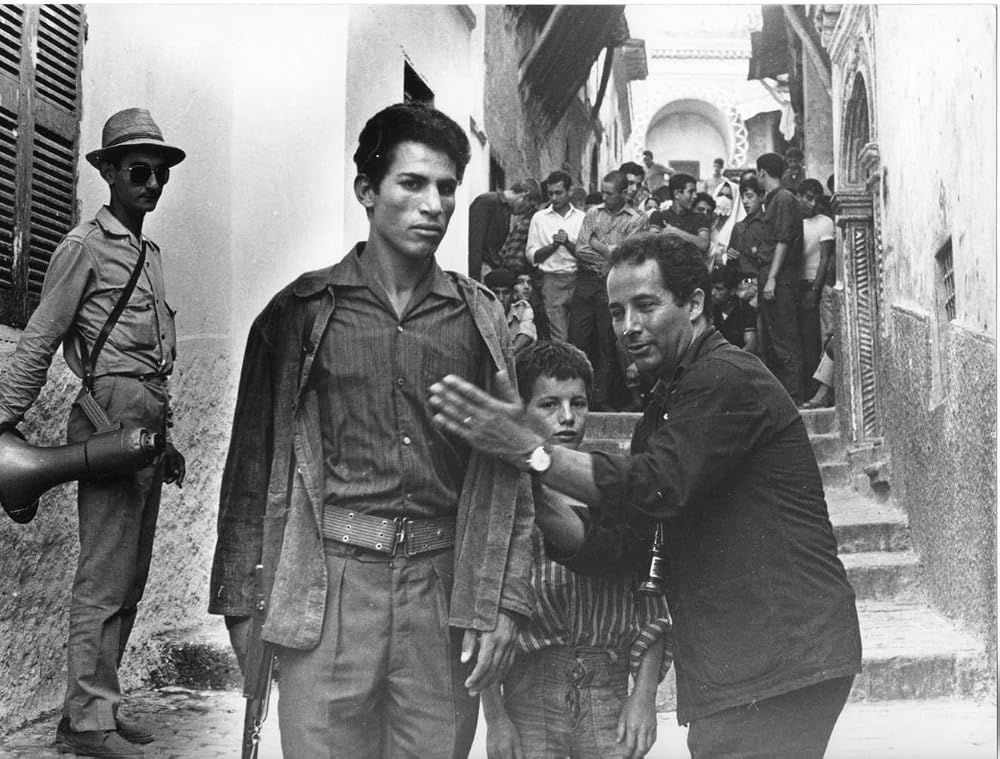
A production still from La Bataille d'Alger, featuring director Gillo Pontecorvo and lead actor Brahim Hadjadj.

It was hard for Gillo Pontecorvo and his colleagues to fund The Battle of Algiers, but they enjoyed strong support in Algeria itself. Nonprofessional actors joined an epic production, as a newly liberated Algeria replayed its struggle for the big screen. (Igor Film / Casbah Films)


Even before Gillo Pontecorvo’s The Battle of Algiers premiered at the Venice Film Festival on August 31, 1966, the film had generated a lot of buzz. The jury presided over by Italian writer Giorgio Bassani gave the film the Golden Lion, the main award of the festival, “for the courage with which it tackled such a difficult and highly controversial historical and political issue, or for the vigor with which it was able to master such a subject.” Beyond the praise, the film was also met with various polemics, which continued well after its release.

The French government’s delegation to Venice refused to attend both the screening and the award ceremony at the end of the festival because, in the words of its head representative (civil servant and author Philippe Erlanger), “we interpret the inclusion of the film in the festival as a sign of hostility toward France.” French film critics — who as always flooded the Italian city for the festival, as they represented the largest group of foreign journalists — did see the film but largely did not speak of it favorably: to mention just one, in Le Monde Yvonne Baby wrote how “Gillo Pontecorvo made the mistake of emphasizing — with irritating intensity (to which the music contributes greatly) — the heroism of the Algerian fighters, and of constantly filming, in close-ups and in a tragic twilight, tense, pained faces whose expressions. . . .  evoke no emotion whatsoever.” France was not ready to talk about the Algerian war just four years after the humiliating withdrawal from the North African country.

But what is Pontecorvo’s film about, and why does it still make sense to talk about it sixty years later?

Pioneers

The film largely focuses on a long and emblematic episode of the Algerian War (1954–1962), the eponymous battle in the Algerian capital in 1957. Starting with the French paratroopers’ raid on the house of a small group of militants (most notably Ali La Pointe, one of the leaders of the Algerian National Liberation Front [FLN]), with a flashback the film takes the viewers to La Pointe’s political and guerrilla upbringing. It shows the evolving struggle in Algiers, from learning how to control the Casbah to the attempt to bring the fight to the rest of the city. The coda depicts the largely spontaneous December 1960 riots that would eventually lead to independence in 1962.

Starring almost exclusively nonprofessional actors and actresses, shot in a realist, quasi-documentary style entirely in Algiers, it was produced after former Algerian guerrilla fighter turned film producer Yacef Saâdi, who wanted to make a film that glorified the independence war, met with Italian director Pontecorvo and screenwriter Franco Solinas, who were interested in making an anti-colonial film focusing on a paradigmatic and symbolic struggle but able to strike universal chords. Both Italians and Algerians were already working on separate projects when they met in 1964 and decided to join forces. As sometimes happens with art, the result far exceeded their hopes, with The Battle of Algiers becoming an almost instant classic, and a film that enjoys “endlessly renewed contemporary resonance,” as film historian Nicholas Harrison noted. It continues, for example, to be screened and discussed vis-à-vis Palestine and as an example of how urban guerrilla tactics can still be applied in contemporary wars. New aspects and new protagonists of the film are also discovered or rediscovered: the cover of Jeremy Harding’s recent book Analogue Africa features a photo of the Algerians and Italians working together on the film (among others, cinematographer Marcello Gatti), and we can also spot a young Sarah Maldoror, only recently recognized as one of the pioneers of anti-colonial and African cinema.

The Making of the Film

Algiers had just finally become independent when Saâdi created a film production company (Casbah Films) and started planning to make a film on the liberation war. France, which had colonized Algeria in the 1830s and considered it an integral part of its own national territory, did not want to let it go after having lost most of its colonies, including neighboring Morocco and Tunisia and, after a long and bloody war in Indochina. Cinema played its part: filmmakers around the war traveled to Algeria to document the events or made films in solidarity from their countries, and Algerian cinema was born in the flames of the war. Saâdi, backed by the FLN-led government, chose to make a film with Italians precisely because they had been active in solidarity with the Algerians struggling for independence. Pontecorvo wasn’t the first choice, as multiple sources report, but he and Solinas were already working on a project on Algeria, whose working title was Para, which had been in the making since the early 1960s. The two traveled to the country just after independence to look for locations and better understand the Algerian context. After some difficulties finding a producer — Pontecorvo would later tell journalist Irene Bignardi in his interview/memoir that potential producers would tell him “nobody is interested in Arabs or blacks” — the director decided to join forces with Antonio Musu and create their own production company, Igor Film, which joined forces with Casbah Films.

Fundraising wasn’t easy: the Italian director and producer risked their own money, while the Algerian government also invested in the film. In June–July 1965, Pontecorvo was already in Algiers, but most likely the actual shooting began in July or August. The dates are important: June 19, 1965, was a landmark day in Algerian history, as with a bloodless coup d’état Houari Boumédiène replaced Ahmed Ben Bella, who had been the first president of independent Algeria. The well-known tale that Algerians saw the tanks in the streets and thought it was the filming of The Battle of Algiers, whereas in fact a putsch was taking place, is probably unrealistic (from the documents we’ve been able to consult so far it seems that the shooting started after that date). Nonetheless, this episode speaks plenty to how important and deeply felt the film was in Algiers during its making. Hundreds of Algerians joined in as extras, the city was used as a location for months (the shooting ended in December), and newspapers enthused about it, “The city was offered to Gillo and his crew as though it were an immense set populated with interesting faces, some of whom came to be selected as extras and for small roles,” wrote Bignardi.

The shooting was itself a major event in Algeria in the second half of 1965, at the same time as other Algerian films were being made, and the national cinema was being restructured and reorganized in terms of production but also distribution and the creation of new film institutions. The film was edited and postproduced in the first half of 1966, first by neorealist editor Mario Serandrei and then, after his sudden death, by the young Mario Morra. Unsurprisingly, when in June 1966 the film was screened for the first time in Algiers for its world premiere (ahead of Venice), in the presence of the Algerian authorities but also of those who starred in the movie, it was met with great enthusiasm. Loris Gallico, the Algiers correspondent of the Italian Communist Party daily l’Unità, noted how the film was also “an excellent example of collaboration between Algerians and Italians.”

In fact, without overdoing it with an Italian-centered narrative, we can say that Pontecorvo’s film (and others produced by Saâdi’s Casbah Films) was instrumental in forming a group of film people who would then play a major role in shaping Algerian cinema. As Joan Mellen wrote, only a small crew of Italians traveled to Algeria: “The remainder of those who worked on the film were Algerians who, never having worked on a film before, were trained on the spot in various specialties. This, of course, was the intention of the Casbah Film Company, which saw the collaboration with the Italians as a means of training their own film people.” To mention just two beside Saâdi and the uncredited Maldoror, Moussa Haddad worked as assistant director (he would then make several Algerian films) and Ali Maroc, perhaps one of the most important Algerian photographers and directors of photography, was chosen as assistant camera operator. Several nonprofessional actors were chosen for small roles, but also for the role of Ali La Pointe (Brahim Hadjadj); left-wing French theater actor Jean Martin played Colonel Mathieu: he is usually mentioned as the sole professional actor in the film, but small roles were also performed by the great Algerian comedic actor Rouiched and the little-known Italian actor Franco Morici (who was uncredited).

A Diplomatic Affair

The months prior to the Venice screening saw intense diplomatic maneuvering between France and Italy (and to a lesser extent Algeria), visible in the press and in the archives of their respective foreign ministries. Film festivals were diplomatic events where national cultural authorities submitted the films for consideration, rather than them being picked by a selection committee. In Venice in 1966, however, film director Luigi Chiarini (the founder of the Italian film school during the Fascist period who remained active and powerful in postwar Italy) and his team could issue a small number of direct invitations. This is just what happened to Pontecorvo’s film that year: the official Italian film was Un uomo a metà by Vittorio De Seta (which was “officially nominated for the competition”), while Algeria had no official representation.

The political and diplomatic polemics had started much earlier. When the script was submitted to the Italian minister of tourism and entertainment in order to access public funding, the evaluation board noted: “We understand that French circles have reacted to the news of this film. We do not know, however, exactly what kind of reactions these are.” The presence of the film at the Venice film festival was considered by French authorities an “unfriendly act” but no real veto was ever imposed. This was also the long-standing consequence of Italy’s position on the Algerian War: Italian governments and Ente Nazionale Idrocarburi (ENI), the Italian oil and gas public company, expressed direct or indirect support for Algerians while never really breaking with France.

French authorities made requests to delete scenes seen as “against” France, like those that depict torture. Ahead of the screening in Venice, Amintore Fanfani, the minister of foreign affairs, wrote to none other than Prime Minister Aldo Moro (later kidnapped and killed by the Red Brigades): “The reactions from Paris, at this moment, are not completely reassuring.. . . .  I would be very grateful if you would consider the possibility of personally intervening with my colleague Corona [the minister of culture at the time] and with the Biennale’s Presidency. . . . ”, the Biennale being the institution that organizes the Film Festival and the other major such events (arts, architecture) in Venice.

During the festival, when it became a concrete possibility that The Battle of Algiers would win the Golden Lion, Fanfani even sent a message to the prime minister advising against it getting the main award. Finally, during the making of the film and after, Saâdi and Pontecorvo had a complicated relationship with French authorities: in September 1966 the former guerrilla fighter was denied entry to France, while an internal memo of the Cannes Film Festival termed him the “head of the Algerian terrorists.” Pontecorvo, who was Jewish, had fled to France after the Italian Racial Laws were enacted in 1938 and was deeply influenced by French culture: despite this, he was also expelled and readmitted to the country only after an appeal. Pleading his case, he wrote a passionate letter, today preserved among his papers at the Turin Film Museum.

A Nomadic Work

After receiving the main award in Venice, the film immediately gained cult status. Different factors contributed to this, from the fact that Algiers had become the so-called capital of the Third World (a city where revolutionaries from half of the Global South found a home), to the 1968 protests and movements that embraced the film and widely screened it. This was notably the case of the Black Panthers and other US radical groups: this was, after all, “the film that in the late 1960s was required viewing and something of a teaching tool for radicalized Americans and revolutionary wannabes opposing the Vietnam War.” In a piece from the time, Black organizer and militant Francee Covington wrote that “If [Frantz Fanon’s] The Wretched of the Earth is the ‘handbook for the Black revolution,’ then The Battle of Algiers is its movie counterpart.” The film has often been examined via the ideas and practice of the Algerian-Martinican psychiatric and political leader, Fanon. The Black Panthers showed it hundreds of times: it was even cited as evidence in a trial against the group, because it was contended that it was “used for training purposes by the Black Panthers and required viewing for all members.” As Algiers became the Mecca of Revolution, “the film by Gillo Pontecorvo [did] much to promote the image of Algeria and its liberation war throughout the world,” in the words of Algerian film historian Ahmed Bedjaoui: among others, one could find among Pontecorvo’s personal papers an invitation to screen the film in postrevolutionary Cuba.

In Italy, the film was a box office hit despite being hotly challenged by the country’s far right. In one case, upon a rerun of the film in 1972, Rome’s Nuovo Olimpia cinema was assaulted by a group of neofascists, seriously injuring one of the spectators. Predictably, its presence in France was yet more complicated. The film was never formally censored by the French board of film censorship. Rather, as Andrea Brazzoduro reports in his book on French veterans’ memories, it was “a victim of the complex mechanisms of self-censorship and repression that shape the French attitude toward the memory of the war.” Eventually, n 1970–71, the film was screened in theaters in France and seen by thousands, but the cinemas and organizations that screened the film were also attacked both verbally and physically, as Benjamin Stora and Patricia Caillè note. But then the film largely disappeared from both the big and small screen in France, and only at the beginning of the 2000s, when it was shown on TV could most people finally see The Battle of Algiers.

Sixty years on, The Battle of Algiers is not only one of the films that best portrayed a historic anti-colonial struggle. More than that, as Andre Nette writes in a new book on political cinema, “one of the most arresting aspects of watching Gillo Pontecorvo’s La battaglia di Algeri over half a century after its release is how contemporary the images of Western soldiers involved in a bloody counterinsurgency campaign in an Arab country feel today.” When the Pentagon screened it in 2003, during the Iraq War, it was to study guerrilla techniques. And if countless university courses include the film in their programs, it is because it still helps foster discussions on violence and national independence, anti-colonialism and political Islam, and much more. These issues will not be losing their topicality any time soon. We may be talking about this film for many decades more.

The author would like to express his thanks to Jennifer Burns, Luca Caminati, Andrea Gelardi, Alan O’Leary, and Youri Hammache-Sigour.

Share this article

Contributors

Luca Peretti works as an assistant professor at the University of Cambridge. He has coedited volumes on terrorism and cinema, Pier Paolo Pasolini, Italian cinema and Algeria, and Italian cinema and the former Portuguese colonies, and written a book on the history of the unrealized project for an Italian film on the Algerian war.

Filed Under