Zohran Mamdani’s Public Grocery Plan Is a Serious One
A grocery industry expert argues that as our food supply becomes increasingly consolidated, expensive, and even dangerous, socialist Mayor Zohran Mamdani’s publicly subsidized grocery plan takes bold steps to provide good, affordable food.
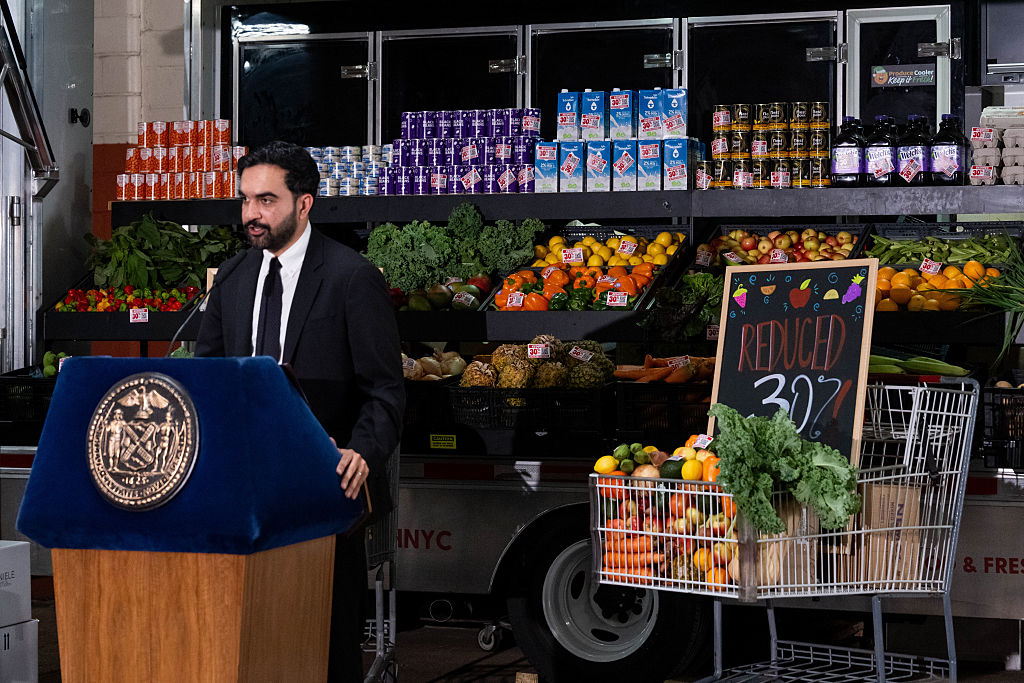
Critics of Zohran Mamdani’s publicly subsidized grocery store program have lost the plot on what should be the whole point of food policy: to make good food affordable to all. (Adam Gray / Bloomberg via Getty Images)
Mayor Zohran Mamdani’s pledge to open five publicly subsidized grocery stores in New York City is quickly becoming a reality. On July 27, 2026, Mamdani announced details of the plan, including a 30 percent discount to market prices of a “core basket” of healthy groceries such as fruits, vegetables, eggs, and milk; a request for proposals process to select private sector operators; and an operating subsidy that the city will use to fund the lower prices.
According to estimates by the New York City Economic Development Corporation (NYC EDC), for which I am currently consulting, shoppers could save over $1,000 a year on groceries. Two locations have already been announced, including sites in the Bronx and East Harlem. City council has approved $70 million in capital funds for store build-outs, while operational funds are still being decided. The city’s annual budget is over $125 billion; the funds needed to open and run NYC Groceries are less than one-tenth of 1 percent of that budget, a literal rounding error.
According to a 2025 poll, support for the public grocery idea in the city is overwhelming. A coalition including trade unions, community groups, cooperative businesses, and food security advocates has been working closely with the city to plan and implement the idea. The result is an idiosyncratic model that may point the way forward for other cities.
Mamdani’s initiative is a compelling yet imperfect intervention in the food supply. Grocery prices have increased over 35 percent since 2020, with many categories such as beef, coffee, eggs, snacks, and beverages experiencing even higher inflation. Consumer prices continue to climb even though producer prices have stabilized or, in some cases like cocoa, decreased. Along with other Donald Trump–era policies and trends — like the Iran war, which has driven up food and gas prices; immigration crackdowns, which have left food rotting in the fields and increased fresh produce prices; a gutting of the regulatory sector leading to an outbreak of explosive diarrhea; draconian cutbacks to Supplemental Nutrition Assistance Program (SNAP) benefits affecting over four million Americans; and an increase in GLP-1 usage — Americans are now buying a lot less food.
According to a Bain/Nielsen IQ study, grocery unit volumes were down 1.8 percent in June, a 2 percent deterioration in a single year, adding up to billions in fewer grocery transactions. In New York alone, over 1.5 million residents face food insecurity, while low-income consumers spend upward of 25 percent of their income on groceries.
The inspiration for the NYC Groceries idea comes from an unlikely place: The military commissary system, which has been around for over 150 years and fully subsidizes all groceries through public funds for service members and their families at a 23.7 percent discount. The commissary is loved by working-class shoppers and is a well-established channel of retail trade in the grocery industry, serviced by farmers, packaged food brands, and corporate wholesalers.
Unlike the commissary system, the stores will be operated by a private sector expert. The stores will not be operated by the city. This could mean a local supermarket chain, a grocery cooperative, a nonprofit operator, a retail services cooperative, or a wholesaler with a retail arm. New York City, unlike most grocery markets, is not monopolized by Walmart or Kroger and has many diverse private sector operators that could run these stores. The public sector grocery stores will also be run as a public service, not as a for-profit, and the typical retail profit margins (1–3 percent) will be folded into consumer savings. They will be open to all New Yorkers, with no means testing for entry.
Mamdani’s key proposal, a core basket of pantry items that will be discounted at 30 percent of market prices, also diverges from the commissary model, which discounts all prices to an average of 23.7 percent to the market. This 30 percent discount will be subsidized by the city to cover the gross margin (operating costs such as labor, utilities, general and administrative expenses, etc.), while rent and taxes will be covered by the city. Operators will have the option of selling other, noncore products at market-rate prices to cover their full overhead.
The subsidies will be calculated through item-level discounts multiplied by unit volumes sold, the same way promotional discounts are calculated for grocers by their trade partners. This is a straightforward calculus for experienced operators. The subsidies will be approved through the city budget, just like funds for public transit, libraries, sanitation, and water. The stores will also not be food banks or pantries, selling donations or leftover “food waste” downstream from producers. They will offer the freshest, highest-quality products, showing that good food should be a public service.
The store employees will get living wages, comprehensive benefits, and have significant labor protections. Operators will be required to ensure card check recognition, an easier and fairer way for employees to unionize should they so choose; to respect employer/management neutrality in union drives, pledging not to fight union efforts; and to not bring on anti-union consultants. The administration’s goal is to make these stores a great place to work and build a career, which is very rare in the grocery industry, which typically sees store labor as a resource to be strip-mined, streamlined, and exploited.
The stores will be thoughtfully designed, laid out, and merchandised so that cash-strapped New Yorkers have a premium shopping experience. The stores will sell a mix of branded items, private labels, and locally grown products geared to the specific communities and markets they serve. Products will be familiar and mainstream, and driven by consumer demand and market trends as opposed to particular ideologies of what the working class should be eating.
Mamdani’s public groceries plan could be a model and inspiration for other cities to run with. But it is not without flaws. The military commissary is publicly owned, funded, and operated; ironically, this means the Department of Defense’s public sector grocery purchasing practices are closer to communism than a socialist mayor’s. Outsourcing operations separates the risk from the responsibility, and the city will need to work closely with operators to keep the program running well and ensure operators don’t bail if the going gets tough.
The upside is that selected operators will come with a ready-made supply chain, with wholesale, manufacturer, grower, and private-label contracts, operational expertise, administrative, accounting, and informational technology systems that the city will not have to invest in and build from scratch. NYC EDC has a lot of experience with the private sector, such as the NYC Ferry system, but grocery is a complicated business.
The administration is facing a lawsuit from a coalition of small supermarket operators and bodega owners who oppose the idea out of fear that the city is using tax dollars to hurt their businesses. Many of these store owners already receive enormous subsidies to their operations through public supplemental food programs like SNAP and Special Supplemental Nutrition Program for Women, Infants, and Children (WIC). But if the city were smart, it could work with store owners near the NYC Grocery sites to increase the affordability goals. If local stores have seen their business impacted, let them receive subsidies on core basket items to lower those prices and be subjected to the same rigorous accounting, reporting, and price controls as the NYC Grocery stores.
The city should also create a retail and wholesale services arm through the NYC EDC. This would ensure long term consistency in the program while building in marketing, administration, and supply chain efficiencies, such as cooperative warehousing, wholesaling and private label sourcing, including utilization of the Hunts Point Cooperative Market, regardless of who operates the stores. Such retail service organizations are very common in the grocery industry as a means for independents to stay competitive with larger chains.
Mamdani’s idea to only discount a “core basket” of products is also odd, since it leaves the door open for price gouging on noncore products. Operators will want to make higher margins on noncore items and create a two-tiered pricing model that has the potential to stigmatize value-conscious shoppers. The fastest-growing grocers in the United States are deep discounters such as Aldi, Lidl, and Walmart, and are known unequivocally for low prices across the store.
The administration has also passed on implementing a “Values-Based Purchasing” framework for the stores and is instead just incentivizing the operators to purchase from local suppliers. Values-Based Purchasing is modeled on the sourcing standards of more upscale chains such as Whole Foods and Erewhon, and encourages subsidized public sector supply chains to prioritize fair labor, animal welfare, environmental sustainability, economic justice, and healthy foods. Values-Based Purchasing is already required in public purchasing by New York City, and via the Good Food NY Bill passed by both New York State legislative bodies, is currently awaiting a signature by Gov. Kathy Hochul to make it state law. So this omission is bizarre and shortsighted, and will mean the city may likely end up selling products made in conditions and with ingredients that aren’t in line with the administration’s professed values.
And the biggest risk is how the administration tacks progress to its goal of affordability. A simple calculation of how many discount subsidies are distributed is the easy part, but how the city estimates and communicates how five stores improve the lives of cash-strapped New Yorkers and point the way to a better and more just food system is a much broader and more compelling calculus.
Despite its shortcomings, Mamdani’s public grocery sector plan is among the most compelling innovations in a food supply that is increasingly consolidated, expensive, corrupt, and lately, downright dangerous. And it aims to do one thing that much of the grocery sector, especially Mamdani’s critics, have lost the script for really well: to make good food affordable to all.
And that should be the whole point.