Who Is Ukraine’s Recovery Really For?

The recent Ukraine Recovery Conference again saw governments and financial institutions discuss the country’s postwar reconstruction. Organized labor was absent, even as Kyiv introduces a new labor code undermining workers’ protections.
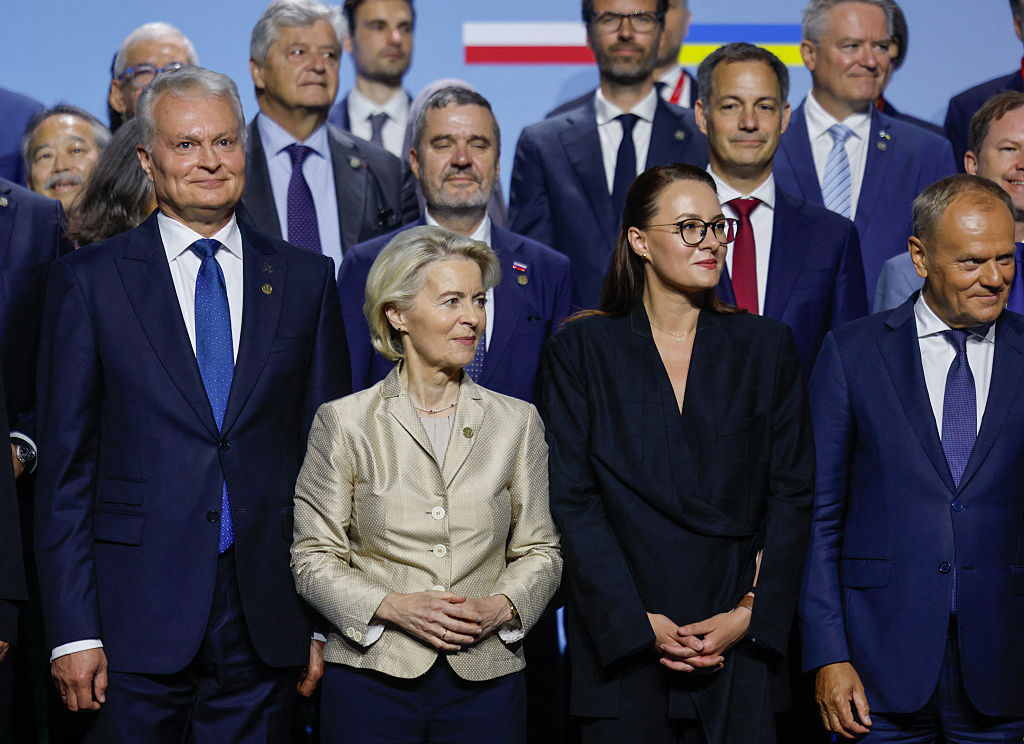
Lithuanian President Gitanas Nauseda, European Commission President Ursula von der Leyen, Ukraine's Prime Minister Yulia Svyrydenko and Polish Prime Minister Donald Tusk pose for a family photo of the Ukraine Recovery Conference (URC 2026) in Gdansk, Poland, on June 25, 2026.

Last month’s Ukraine Recovery Conference in Gdańsk drew heavily on the symbolism of the Solidarność union, born in the Polish port city. Yet organized labor had no say at the conference, organized to suit international investors.(Wojtek Radwanski / AFP via Getty Images)


More than two hundred businesses were present at the Ukraine Recovery Conference in Gdańsk, Poland, at the end of June, eighty-two of them from Ukraine. But out of Ukraine’s eighty-three sectoral trade unions, none had so much as a stall, let alone a seat on a main panel. That asymmetry is telling; and for Ukrainian activists, taking part in the conference was something of a cold shower.

Dressed Up as Solidarity

For Natalia Zemlianska from the Trade Union of Producers, Entrepreneurs, and Migrant Workers, the issue was clear: “Why bother listening about labor rights, workplace safety, or decent wages, if people are now viewed exclusively as a convenient raw material for pouring concrete with donor money?” Her comment summed up the reality on the floor better than any official statement could.

By many accounts, this was one of the biggest Recovery Conferences held since the full-scale Russian invasion of Ukraine in 2022. In addition to numerous government delegations, international financial institutions, and civil society groups descending on Gdańsk for two days, there was a record number of participants and businesses involved and even a former US astronaut.

Weeks earlier, Kyiv’s decision to name a military unit after the World War II–era nationalist Ukrainian Insurgent Army (UPA) stirred up tensions in Warsaw, given that Poland holds it responsible for wartime atrocities. A line of politicians making loud statements and returning their awards didn’t help to calm things down, and both Ukraine’s president, Volodymyr Zelensky, and Foreign Minister Andrii Sybiha decided against attending. Yet in the end, the row barely affected the conference proceedings.

Held in the port city where Solidarność was born, the Gdańsk conference freely borrowed its symbolism. Still, it framed both the trade unions’ and Ukraine’s struggles mainly as a fight for freedom and values. Throughout the agenda, Ukrainians “who keep the country running” were discussed primarily as a workforce, as “human capital,” as the population that needs to be lured back from exile.

These workers were talked about by donors, politicians, and businesspeople, without representation of their own. To get the idea: more than 5,000 out of 7,500 participants came from the business sector, compared with a handful of Ukrainian trade unionists, uninvited to the stage, for whom the conference corridors became the only place to make their case.

This exclusion wasn’t purely imposed from the outside. Zemlianska herself says that the Ukrainian government didn’t invite the unions, but the unions didn’t push especially hard for a seat either. The clearest example is Serhii Byzov, head of the Federation of Trade Unions of Ukraine, the country’s largest union body, who canceled his own trip to Gdańsk at the last moment. For some reason, he decided to intervene in a symbolic foreign policy controversy over the UPA rather than press the case for protecting workers’ rights and developing social dialogue at a conference he himself considered crucial.

This year’s Ukraine Recovery Conference closed with over 160 signed agreements worth more than €10 billion, though this wasn’t the best take-home check so far. Besides, some €3 billion of that came from a €90 billion European Union loan facility that is only partly about postwar reconstruction, the bulk of it earmarked for fiscal stability, energy resilience, and defense spending — which is to say, helping Ukraine survive, not recover. This amount would, in fact, have been dispensed anyway.

Officials also floated something bigger: a proposed €100 billion Ukraine Reserve in the EU’s next seven-year budget. However, Anna Jarosz-Friis, director of the Ukraine Service within the Directorate General for Neighbourhood and Enlargement Negotiations of the European Commission, explicitly emphasized that it will be tightly conditional on Kyiv delivering prescribed anti-corruption reforms and addressing rule-of-law concerns, rather than being a blank check.

In any case, the gap between any of that and what’s actually needed is staggering. The World Bank now estimates total reconstruction costs at over $580 billion, approximately three times Ukraine’s entire annual GDP. Against that number, a conference measured in the low tens of billions is hardly a plan, however record-breaking the turnout.

The Labor Code Is the Real Test

If you want to know how seriously the government takes the workers it keeps invoking, look past the words and at the bill currently headed for a vote in parliament. A serious conflict has been unfolding since the beginning of this year, which has largely been absent in Gdańsk. Kyiv’s new labor code draft tilts bargaining toward individual contracts over collective ones, gives employers greater flexibility over dismissals and working hours, and makes industrial action more difficult.

Deputy Economy Minister Dariia Marchak defends the bill as overdue “modernization,” pointing out that Ukraine’s current code dates from the Soviet era. But her argument conveniently omits that neighboring Poland managed to update its labor code, adopted around the same time, without dismantling its central protections for workers. She says nothing about the specific provisions in her own bill that shift power decisively toward employers and instead prefers to talk about increased flexibility and some secondary improvements, such as allowing mothers of children under three to take foreign business trips, enabling digital employment contracts, or extending the minimal annual vacation by four days.

MP and Independent Trade Union Confederation Chair Mykhailo Volynets is blunter, calling it a signal to potential investors that they will be provided with millions of cheap, rights-deprived workers. “Turn Ukraine into a labor camp — drive Ukrainians to work 24/7 in conditions without rights, so it’s more interesting/profitable for us to earn money in your market,” he wrote on social media, mocking the pressure exerted by Western businesses. Volynets also argues the draft was developed with foreign funding and that its most vocal backers come from the business sector, while the concerns of unions and human rights groups have been dismissed outright.

This didn’t have to happen. Last year’s conference in Rome brought the sense of an institutional breakthrough: government, employers, and unions solemnly signed a tripartite memorandum promising that no labor law changes would proceed without union consent. This memorandum looked, as Zemlianska put it, like a real safeguard against the kind of quiet, behind-closed-doors rewrite of the labor code now on its way to a vote, an ironclad commitment to social dialogue. Yet that promise is now being openly ignored, while Ukraine’s future integration into the EU keeps getting invoked as the reason for the reforms. Meanwhile, the minimum wage and subsistence minimum, in her words, remain fictional figures with no connection to what people actually need to live on.

Vitalii Dudin, a labor lawyer and social activist, sees no external pressure forcing any of this. The World Bank’s Doing Business ranking stopped scoring countries on labor market deregulation more than a decade ago, and nobody is requiring Ukraine to prioritize this kind of reform to move toward EU membership. Whatever is driving this labor code, it isn’t Brussels holding a gun to Kyiv’s head. It looks homegrown.

Selling Off Infrastructure

The same imbalance showed up elsewhere at the conference. One of its main goals was to catalyze investments for Ukrainian businesses, focusing on energy, critical infrastructure, and logistics. Kyiv presented thirty projects worth $5 billion and secured at least €500 million in targeted investment from the European Bank for Reconstruction and Development.

Dudin’s interpretation is sobering: he says that with most of Ukraine’s oligarchic economy already carved up or destroyed by the war, critical infrastructure is one of the few remaining assets left for privatization and profit-making. Typically, these are enterprises that were never designed to turn a profit. Forcing them into a commercial model risks the kind of tariff hikes that hit ordinary households hardest, and rushed concessions risk something more than money, a real loss of state control over the systems that keep the country running.

The workers who maintain that infrastructure have carried enormous risk through the war. But as Dudin reminds, the implementation of the law meant to increase compensation for injuries sustained under shelling sat virtually blocked for three years, precisely because the people it targeted had no seat at the table where it was decided. The Recovery Conference in Gdańsk reproduced that same absence on a larger scale: infrastructure workers were at most an object of discussions being had by others.

A Country Worth Coming Back To

Behind the fight over the labor code and the fight over who controls critical infrastructure lies the same point that researcher Nina Potarska raised at one of the side events: reconstruction is discussed in terms of investment, institutions, and infrastructure. Instead, the real question is what kind of country the millions of Ukrainian refugees are being asked to return to.

Higher wages matter, but by themselves they don’t explain whether someone comes home. That decision also depends on housing, schools, health care, transport, and childcare. Deputy Economy Minister Marchak, to her credit, said something similar at a different meeting: that government action only matters if it helps more people imagine a future in Ukraine, which depends on jobs, care services, and housing together, not any one of them alone. And even Prime Minister Yulia Svyrydenko long understood this. As economy minister three years ago, she was already flagging that Ukraine’s “lost” human capital wouldn’t return without both jobs and rebuilt homes and infrastructure waiting for them.

The scale of the problem is enormous. More than four million refugees remain in Europe, and by United Nations High Commissioner for Refugees modeling, even a decisive Ukrainian victory would bring back only around two-thirds of them over the following years — a fragile peace, less than half. And yet the main conference sessions treated all of this as a footnote: everyone focused on the billions for energy and infrastructure, while Ukrainians themselves were mentioned mostly as the labor force needed to deliver those projects, not as people with stakes and demands of their own.

There is an important lever here that also got almost no attention at the main event: public procurement and imposing conditions on businesses working for public contracts. Potarska maintains that this isn’t a narrow technical question of cost efficiency but one of the most powerful tools available for shaping the labor market that emerges from reconstruction, if it rewards fair wages, decent conditions, apprenticeships, and local employment rather than simply the lowest-price bidder. But nobody at the conference was talking about using it that way.

Who Gets to Decide

Zemlianska’s closing verdict on the conference is hard to argue with: for officials and capital, ordinary Ukrainians are useful for photo ops and reports back to European donors about “public engagement.” But when it comes to actually dividing up the billions, the doors close on them again.

Vitalii Dudin holds on to a more hopeful reading. He suggests that the public recognition workers have earned during the war, especially those keeping critical infrastructure running under fire, will eventually make it impossible to silence them indefinitely. It’s a reasonable hope. It is not, on the evidence of Gdańsk, a description of where things currently stand.

Ukraine’s reconstruction is becoming a struggle over who gets to shape the country’s postwar economy. The people currently locked out of the room are the ones who’ll still be there rebuilding the country after the delegations go home.