These Veteran Candidates Are Attacking Vets’ Health Care
Many candidates for public office in the US tout their status as military veterans. Yet many of those same candidates, like US Senate hopeful Seth Moulton, want to privatize and undermine veterans’ health care.
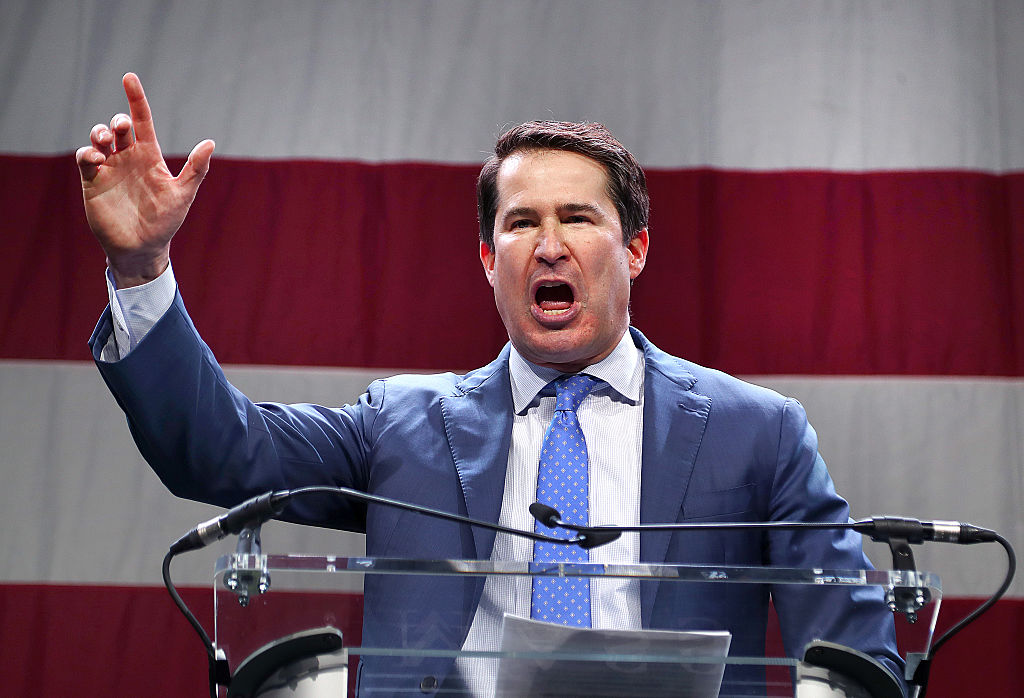
Electing two, three, many Seth Moultons will not help the overwhelming majority of veterans who value the VA and hope it survives the Trump era. (John Tlumacki / The Boston Globe via Getty Images)
In this crucial midterm election year, men and women who served in the military are wooing voters by presenting themselves as tougher, more effective foes of MAGA incumbents and even long-serving Democrats. In Massachusetts, a fifty-year-old former Marine captain, whose career has inspired other vets to run for office, is playing the vet (and youth) card in his September 1 primary challenge to nearly eighty-year-old Senator Ed Markey.
“We can’t just have people who seem like tired old Democrats,” says US Representative Seth Moulton, who is giving up his House seat to challenge Markey. To illustrate his point, Moulton recently did some rhetorical muscle-flexing, when a fellow post-9/11 combat vet — Department of Defense Secretary Pete Hegseth — told a congressional hearing in May that the US war on Iran was “an astounding military success.” Moulton pushed back, arguing that the conflict was an unpopular boondoggle.
Across the country, other anti-MAGA “service candidates” have questioned billions in new Pentagon spending on another Middle Eastern war and criticized a simultaneous Donald Trump assault on domestic social programs, immigrants and labor, civil liberties and voting rights, and environmental protection.
Unfortunately, not every Democrat who served in the military is equally vocal about saving the Department of Veterans Affairs (VA) from a failed bipartisan experiment with privatization that began a decade ago under Barack Obama’s administration. During Trump’s second presidency, not only is public provision of health care for nine million former service members at risk; so are the good union jobs for one hundred thousand veterans employed by the VA as their caregivers.
Where politicians stand on the issue often reflects their own class background, their rank in the military, and the material circumstances they faced after returning to civilian life.
Undermined by Outsourcing
As Jacobin has reported for years, the direct care capacity of the VA has been seriously undermined by outsourcing to the private health care industry. Most Democrats in Congress in 2018 — including Moulton — helped President Trump pass the VA MISSION Act, one of his biggest first-term legislative victories. This accelerated a disastrous shift from in-house to private sector care via the Veterans Community Care Program (VCCP).
Since then, tens of billions of dollars — which should have been spent on the VA’s own high-quality specialized treatment — has instead been diverted to over 1.7 million private doctors and hospitals. This coming year, nearly a third of all VA spending on medical services will go to Medicare-style reimbursement of outside vendors who have less training and experience caring for veterans.
As a new RAND study found, vets referred outside the VA had only marginally improved access, while the cost of their care increased. In Massachusetts, the Boston Globe reported that Bay State VA facilities are suffering from staff cuts, fragmentation of patient care that was much better coordinated when delivered in-house, and longer in-house wait times.
Ivy League Officers
Vets who come from working-class backgrounds and/or who held blue-collar jobs need VA care and benefits far more than former members of the officer class. The latter include Hegseth and Moulton, who graduated from Ivy League schools and then did postgraduate work at the same one (Harvard) before getting hired as a broker on Wall Street and a corporate manager, respectively.
So it’s not surprising that neither appreciates the importance of VA care to lower-income vets; instead, both men believe that “government health care” has failed and favor its privatization. In contrast, US House candidate JoAnna Mendoza’s defense of the VA is personal, powerful, and reflects her poverty-stricken past as the daughter of immigrant cotton pickers in Arizona.
In her race against Representative Juan Ciscomani, a pro-Trump Republican, she is playing up a résumé that includes combat duty in Iraq and Afghanistan, plus serving as a rare female drill instructor in the Marines. As she told the Times last month, she was sexually assaulted twice by fellow members of the Marine Corps (only one of whom was punished) and, as a result, struggled with alcohol to the point of getting busted for drunk driving in 2012.
She’s sober now, and “a queer single mother” who gets her health care from the Tucson VA Medical Center. A former Medicaid recipient, she “opposes privatizing Medicare” because it is leading to “higher prices and worse care for patients.”
Her VA-related positions are exceptionally detailed and reflect firsthand experience with a range of services. In Congress, she says will fight to fully fund and protect the VA from “reckless DOGE cuts,” plus:
She will work to expand VA specialty care in rural communities, increase access through telehealth and mobile services, and fix transportation barriers by improving eligibility and reimbursement rates. She will support legislation that strengthens mental health services, expands housing support, and invests in job training and transition programs. She will also work to modernize VA electronic health records to improve coordination of care and strengthen protections against predatory “claim sharks” who exploit veterans seeking benefits.
A Petition to Collins
In North Carolina, former Army paratrooper Richard Ojeda won a Democratic primary in that state’s deep-red 9th congressional district. He is now waging an uphill fight against Richard Hudson, a well-connected House Republican. The descendant of union coal miners who immigrated from Mexico to West Virginia, Ojeda says he wants “to go to Congress and raise hell for the working class . . . the people who punch a clock, serve this country, raise families, and still feel abandoned by the political establishment.”
He is a vocal defender of the rights of immigrants and workers, supporting public education and Medicaid expansion rather than cuts, and rallying fellow VA patients against Department of Government Efficiency (DOGE)–driven staffing shortages. Earlier in his campaign, Ojeda took an unusual step in electoral politics by organizing his own future constituents to take grassroots action to defend VA care.
He collected ninety thousand signatures on a petition protesting the Trump administration’s attacks on VA patients and their unionized caregivers. Then he and his supporters personally delivered the petition to agency officials in Washington. It demanded that VA Secretary Doug Collins reject an “unlawful executive order” issued by Trump that “rips out long-standing civil rights protections and opens the door to denying VA care based on marital status, sexual orientation, religion, or even voting for a Democrat.”
During his successful Democratic primary campaign this year, Ojeda found encouraging signs that former Trump supporters are having second thoughts as “they’re looking around at the wreckage so far, the ICE kidnappings, the censorship, and the economic pain.” More people, he believes, “are realizing that they were pawns in the oldest con in the book — blame immigrants, blame workers, blame anyone who doesn’t look or pray or live the way you do.”
As he told us for our new book, Courage or Complicity?, “People are waking up. They’re angry, and they damn well should be. We have to talk to people who were misled by Trump and give them something to believe in other than a cult of personality. If you give people something worth fighting for, they will fight for each other.”
Stop the Exploitation
In Omaha, former National Guard member and Navy veteran Dan Osborn figured out a few years ago that not enough fellow Nebraskans would vote for him as a Democrat. In 2026, he’s making his second highly competitive bid for the US Senate as a labor-backed independent.
Osborn became a public figure in his home state by leading a successful eleven-week strike by five hundred fellow workers at a Kellogg’s cereal factory in Omaha. Before working in that plant for eighteen years and becoming local union president, he dropped out of college and joined the military. When Kellogg’s fired him after the strike, he became a working member of Steamfitters Local 644 and began repairing boiler systems.
Osborn’s wide-ranging blue-collar agenda highlights the need for labor law reform, minimum wage increases, paid family leave, stronger rail safety enforcement, and consumer protection measures. His campaign platform makes the singular bold-faced demand: “Stop Privatization of the VA!” He goes on to explain, as few other candidates have done, who is harmed and who is helped by outsourcing VA functions:
Privatization was sold as a solution for rural veterans who live far from VA facilities. The reality is that veterans in private systems face longer wait times, less coordinated care, and providers who are not trained in the unique health needs of those who served. The private sector is not equipped to handle the mental health challenges, burn pit exposure, and service-related conditions that our veterans carry home with them. Companies like UnitedHealth are lobbying aggressively to steer veterans and their healthcare dollars into private hands.
Osborn is also the rare politician with uncertain medical coverage of his own, because he doesn’t have job-based, union-negotiated medical benefits when he takes months off from work to campaign. Unlike Mendoza and Ojeda, he never sought a disability rating from the VA based on a service-related condition, which would have allowed him to use its hospitals and clinics in Nebraska.
Now, with help from a local veterans’ service organization, he is trying to become VA eligible. He told us that he is “very grateful for the existence of the VA, and the workers who are meeting the needs of veterans in our communities. The men and women who have signed on the dotted line to serve our country deserve every benefit they receive.”
Doubling Down on VA Criticism
Seth Moulton, on the other hand, first burnished his résumé as a “political rebel” by bucking House Speaker Nancy Pelosi eight years ago and helping then–GOP minorities in Congress, in Trump’s first term, greatly expand VA privatization.
During his four-month vanity campaign for the presidency in 2020, Moulton touted his past work with Republicans on passage of the Faster Care for Veterans Act. Signed into law by President Obama, this bill directed the VA to experiment with an online self-scheduling app for its patients — an innovation that, according to Moulton, allowed them to make doctor appointments “from their smart phones or computers with the click of a button.”
However, as Rick Weidman pointed out when he was legislative director of Vietnam Veterans of America: “Scheduling apps just mean that one veteran gets ahead of someone else in line.” The real challenge, then and now, is properly funding and staffing VA hospitals and clinics so they have enough caregivers to assist all the new patients coming through the door. “You don’t do that with a scheduling app,” Weidman told us four years ago. You do that by filling thousands of VA vacancies, which now, thanks the Trump administration, have become even more numerous.
In his current bid to replace Ed Markey in the Senate, Moulton has made some populist head feints that conflate valid criticism of corporate health care with his usual VA bashing. Several months ago, one of us received this fundraising text sent from “Seth for Massachusetts”:
Steve, private equity killed another Massachusetts hospital. They gutted Steward Health Care, pocketed millions, and left communities without emergency rooms. People are dying for Wall Street profits. I’ve seen government healthcare fail at the VA, and I’ve watched private equity destroy our hospitals. That’s why I’ll fight for a public option that actually works — and ban hedge funds from playing God with our healthcare.
To better understand what this supposedly more workable “public option” for veterans might look like — and how it might differ from the VA’s existing nationwide public health care system — we repeatedly contacted Moulton’s campaign, by email and phone. We also sought further information about his own personal experience as a VA patient, which in a Boston Globe interview more than a decade ago, he claimed was bad. No one from his campaign ever responded.
Turning to Moulton’s campaign website, however, we learned that his alternative to “one-size-fits-all government health care” for former service members is “a health plan that competes directly with private insurers and lowers premiums for everyone.” It will, of course, “recruit the best doctors and managers to run it and learn from all the VA’s mistakes.”
A Profile in Courage?
VoteVets, the leading Democratic Party–aligned independent spender on vets running for office, has already dumped more than $12 million into 2026 races. Moulton and Mendoza are among its endorsed candidates; Ojeda and Osborn, who has twice spurned the Democratic label, are not.
VoteVets seems to ignore the fact that Moulton has been such a poor soldier in the “fight against ongoing attempts to privatize our Department of Veterans’ Affairs health care,” one of its own stated policy priorities. To be fair, others in Congress who joined Moulton in voting for the VA MISSION Act of 2018 — which supercharged privatization during the Trump-Biden-Trump administrations — didn’t lose VoteVets support either, including Senators Tammy Duckworth (D-Ill), Mark Kelly (D-AR), Jack Reed (D-RI), and Gary Peters (D-MI), who is not running for reelection this year.
In a new book called Courage Can Save Us — praised in the New York Times as a “thoughtful, hopeful” account of “service candidates” with “a common mission” — progressive populists like Mendoza, Ojeda, and Osborn are never mentioned. But the ex-marine from Massachusetts gets a gushing chapter hailing him as one of “ten extraordinary Americans” whose role, as a veteran engaged in politics and policymaking, is critical for “the fight for our future.”
By no coincidence, the author of the book is Rye Barcott, a former Marine Corps captain who served with Moulton in the Middle East. Barcott is now cofounder and CEO of With Honor, which he describes as “a cross-partisan organization that fights polarization by supporting principled veteran leadership in public office.” Not mentioned in the book or its acknowledgements is Jeff Bezos, the world’s fourth richest man and a distinctly polarizing figure in multiple domains. In 2018, he helped launch the With Honor Fund with a $10 million personal donation; his brother Mike still serves on the group’s advisory board.
With Honor Action, an allied group, recently unveiled “new data showing a wave of military veterans stepping forward to serve in Congress: 752 veterans across all fifty states have run or are running for federal office this cycle, the highest number With Honor Action has tracked since it began monitoring veteran candidates in 2018.”
If elected or reelected, how many of the corporate Democrats and MAGA Republicans on that list of 752 will be real champions of other vets? Based on the track record of those already serving on Capitol Hill and currently supporting rather than opposing VA privatization, the answer is not many. Electing two, three, many Seth Moultons — and/or sending him to the Senate — will not help the overwhelming majority of vets who value the VA and hope it survives the Trump era.