Take a Moment to Feel the Pain of the Rich
Once respectable opinion fretted about distinguishing the “deserving” poor from the “undeserving.” Today, as sentiment against the ultrarich surges, the Economist argues that it is in fact billionaires who deserve our gratitude, sympathy, and protection.
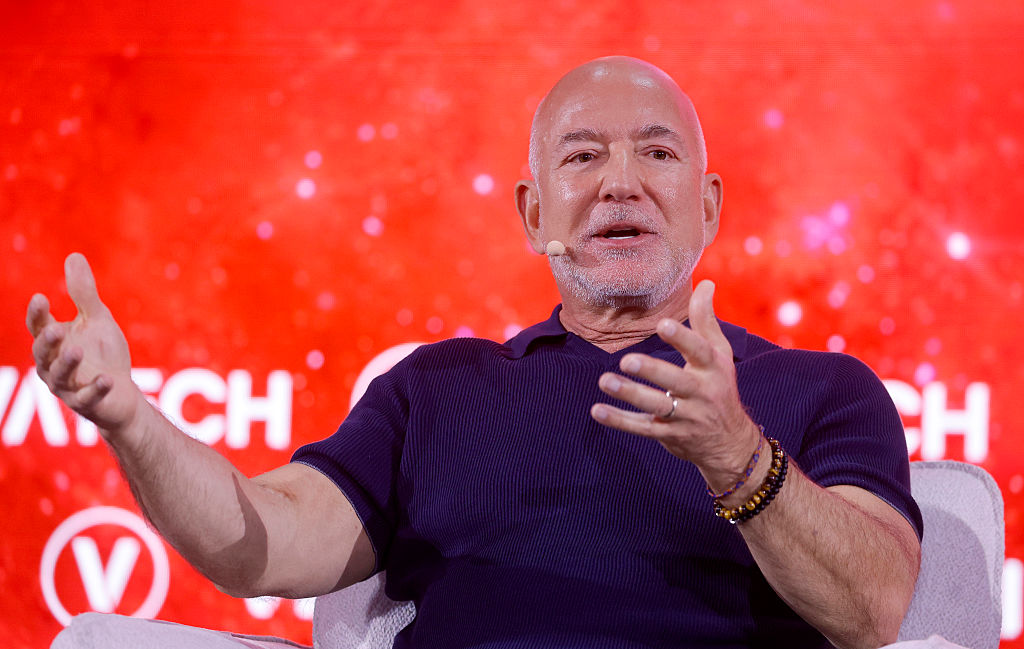
Under any reasonable definition of the word “made,” no one “makes” a billion dollars alone. No one ever has. Extreme inequality requires a legitimizing narrative. The Economist is happy to provide one. (Chesnot / Getty Images)
On June 23, 2026, the Economist published a story about billionaires titled, “The Rise of the Deserving Rich.” It claimed that “today’s billionaires are more likely than yesterday’s to have made their own money.” The claim is easily dismissed. The more interesting question is: Why did the magazine bother to publish it?
Under any reasonable definition of the word “made,” no one “makes” the equivalent of a billion dollars alone. No one ever has. But there have always been people who have possessed vastly more money than others. To sustain such inequality, a legitimizing narrative is essential. But do the Economist’s anonymous writers really believe what they are writing?
The penultimate sentence of the penultimate paragraph of the article — described by the magazine as an “expert analysis” — claims: “Mr. [Elon] Musk is self-made, which is all well and good, but he has made no secret of his desire to sway elections, both in America and abroad.” The writers then suggest that perhaps donations to political parties should be capped, rather than taxing the billionaires away. It’s worth asking: Who is telling this story, and why?
Wealth’s Wages
After mentioning a tiny number of female billionaires, while not pointing out how rare they are, the familiar trope of name-checking a few of the world’s richest male footballers is wheeled out, as if Elon Musk’s ability to accumulate astronomical wealth were somehow comparable to the ability to kick a ball. However, there is a connection that the expert analysts don’t mention.
The “compensation” of contemporary international footballers has relatively little to do with their talent alone. They happen to be playing at a moment when football has become more monetized than at any point in its history. Had they been equally brilliant a century ago, they would have received peanuts. It is the TV deals, the size of the world’s audience, and the accountants that make a few footballers so very rich today.
The idea that extraordinary talent deserves extraordinary compensation is our modern-day justification for an increasingly threadbare myth about inequality. What appears to have spurred the Economist to action is the growing opposition to that myth. The article notes that fundraising emails from Democratic Party politicians in the United States were, by 2026, three times more likely to castigate billionaires than they were as recently as 2024. Something is rapidly changing.
The Economist’s writers devised their own categorization of roughly 7,000 billionaires profiled since 2001 to make the claim that “for the first time, half the wealth of the world’s billionaires is reasonably fairly earned.” The adverb “reasonably” is doing heavy lifting here. Apparently, securing a billion is “reasonable” so long as it does not come from gambling, construction, defense, or mining. The magazine’s rationale is that these industries often require “political access,” implying corruption has played a role. In the “expert analysts’” own words: “It is hard to open a mine or a casino, for instance, without friends in the government.”
Praising the Dynasts
Almost all billionaires have never gotten their hands dirty. Few could program even the most basic software used by their companies or bolt together and wire even a small part of a machine themselves. Their talents tend to lie elsewhere: bean-counting, dealmaking, self-promotion, and ruthlessness. Even those who self-describe as “self-made” frequently benefit from forms of substantial inherited wealth, elite educational credentials, the security to take risks, and exclusive social connections unobtainable to regular people.
Praising billionaires is a little like praising kings and queens of old or the high priests, pharaohs, and emperors that preceded them. These figures were once worshipped, and elaborate narratives were constructed around them, elevating their greatness no matter how mad, bad, or incapable they might have been — or still are.
Societies create positions that must be occupied by figureheads, and someone will invariably fill them. What is interesting is when the stories propping up those figures begin to lose their shine. That is often when change is coming and society is evolving into something new.
The Economist examines the changing makeup of the billionaire class in order to suggest the system is becoming more meritocratic and robust. By its measure, roughly half of all billionaire wealth came directly from inheritance in the early 2000s; more recently, that proportion has fallen to a quarter. But this decline appears to reflect the falling concentration of billionaires in the United States and Europe — as enormous fortunes grow elsewhere around the globe — alongside corporate growth and rising asset values.
The very rich become much richer when the rest of us are less well organized. As the US and Europe shrink in economic importance and Asia rises, the composition and geography of billionaire wealth is transforming. In trying to explain the apparent rise in “deserved” wealth, the magazine notes that companies around the world have made annual average returns of 13 percent for shareholders. As the Economist acknowledges, a great deal of the rise in billionaire wealth has come from holdings in companies other than those that individual billionaires are associated with.
The magazine sees no connection at all between this increase in profit-making and the global cost-of-living crisis confronting a great majority of people. instead, it terms this “the affordability crisis” and reduces it to “a few years of high inflation hitting living standards.”
The Existence of Billionaires Is Not Unavoidable
At one point, the article concedes that democracy might function better with less billionaire influence. However, if democracy did function better, we would have no billionaires. No compelling case can be made for allowing anyone to accumulate so much wealth and therefore so much power over the lives of others. But there is little praise for democracy in this article. Instead, the acclaim is reserved for the money hoarders who, we are told, keep the modern world turning.
Interestingly, the place that has seen one of the greatest increases in billionaires in recent years is China. It is also one of the few countries in the world where the government has taken an active role in curtailing the growth of billionaire wealth. The Economist mentions Beijing’s crackdown on gambling in Macao, which hurt some casino billionaires, and the fall in wealth of one Chinese property developer from $21 billion in 2017 to around $4 billion today. It also notes that many Chinese billionaires have only recently tipped into the billionaire wealth bracket.
The Chinese government is unlikely to celebrate the concentration of wealth in its still-growing economy. Nor is it likely to accept the Economist’s conclusion that “a greater share of today’s billionaires spurs employment growth and productivity gains” and that this concentration of wealth “raises the economic cost of losing them” if they “decide to move away, or work less hard, to avoid taxation.”
The idea that a tiny number of extraordinarily rich people are the reason why there are more jobs in some places, or that workers become more productive because billionaires exist, would be laughable were it not peddled so earnestly and desperately today. The implication seems to be that democratic societies cannot tamp down on billionaire power. China’s example does not prove the opposite, as the number of new billionaires has grown so rapidly, but it does at least show that how many billions each might eventually accrue is a political choice, not an inevitability.
Stenographers for the Ruling Class
The Economist is owned by rich families, most of whom have family wealth measured in billions. Its largest shareholders include the Agnelli family (worth more than $20 billion) and the Smith family, through the Smith Financial Corporation (worth around £7 billion). Other very rich families, including the Cadburys and Schröders, also hold significant stakes.
Why would very rich families sponsor and shape the direction of a magazine called the Economist? One answer may be found in articles such as “The rise of the deserving rich.” At a moment when the very rich are under increased public scrutiny, the magazine has elected to produce a tract in defense of billionaires.
The article begins with the observation that “billionaires have never exactly been popular, but today they are loathed,” adding that it is now common to hear that “Every billionaire is a policy failure.” The Economist was founded 180 years ago by a banker and businessman. It has always championed a particular economic worldview aimed at particular people. Today, as economic liberalism faces renewed and energetic criticism, the magazine has responded with a defense of the rich. The very need to mount that defense is telling.
The title, “The Deserving Rich” is itself a revealing inversion of the old distinction between “the deserving poor” and the “undeserving poor.” The deserving poor were deemed well-behaved and adequately industrious to merit some pennies to live on; the undeserving poor were placed in the workhouse.
To those with riches, arguments for greater economic equality can feel like oppression. The rich worry that they are increasingly deemed undeserving and that one day they might be put in the equivalent of a workhouse. The article suggests that they are, in fact, worthy of sympathy and protection. Through publications they own or influence, the rich ask not just for our sympathy and pity but for our gratitude, understanding, and, ultimately, our continued subservience. Their shrill special pleading reveals how weak their arguments are.