Austria’s Communists Have Defended Red Graz
- Oscar Davies
Since 2021, the Communist Party’s Elke Kahr has been mayor of Austria’s second-largest city, Graz. In local elections June 28, voters passed a positive verdict on her five years in power, giving the Communists an even stronger majority.
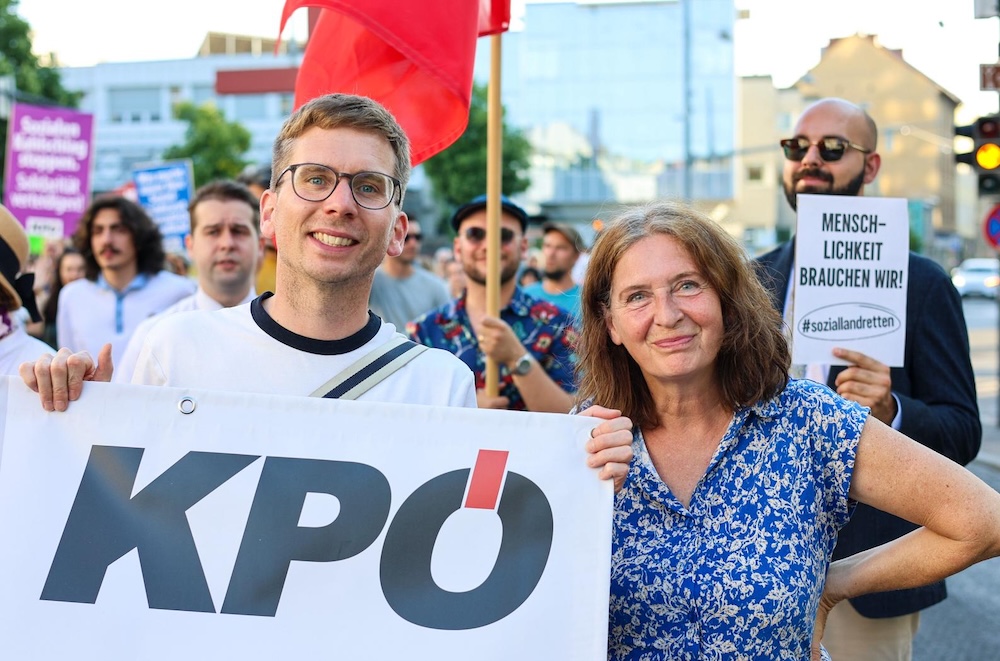
Robert Krotzer is photogtraphed with Graz’s Communist mayor, Elke Kahr. (Courtesy KPÖ)
- Interview by
- Magdalena Berger
On June 28, Austria’s second largest city, Graz, elected a new council. The Communist Party of Austria (KPÖ) secured 35.7 percent of the vote, once again emerging as the clear winner. Building on its historic 2021 success, the party — led by Mayor Elke Kahr — increased its vote share by nearly 7 percentage points. The win ensured Graz remains a political anomaly not just within Austria, but far beyond its borders.
The result is particularly remarkable given the political climate in Styria, the state of which Graz is capital. Since late 2024, Styria has for the first time been ruled by a governor from the far-right Freedom Party of Austria (FPÖ), Mario Kunasek. While the state government pursues a policy of harsh austerity and cuts to social services, Graz has stood firm as a very red island in a state that has experienced a significant shift to the right in recent years.
In the June elections, as in 2021, City Councilor for Health Robert Krotzer was ranked as the KPÖ’s number two candidate on the ballot, meaning he was one of the party’s top candidates. The thirty-nine-year-old is considered the designated successor to Mayor Elke Kahr. In this interview with Jacobin, Krotzer discusses the KPÖ’s election victory, the limits of local politics under neoliberal austerity, and the question of what socialist politics can realistically achieve given the current balance of power.
Magdalena Berger
The KPÖ’s last victory in Graz came as quite a surprise, but this time around pretty much everyone expected it. Did you feel there was additional pressure to repeat the successes of 2021?
Robert Krotzer
I wouldn’t necessarily say I felt additional pressure. But knowing what was at stake for the working class in this election was the decisive factor. Over the past five years we’ve managed to achieve a great deal, building a city that stands on the side of the people.
We’ve created a lot of social support infrastructure in Graz, particularly in the areas of housing and health care. That includes initiatives such as the Health Hub and district and neighborhood centers, all of which we have significantly expanded. There are also concrete support programs like the Social Card and the Mobility Social Card. The latter allows people with low incomes to buy a yearlong public transport pass for just €60. We’re the only place in Austria that offers that.
It was always clear that the KPÖ was the only party that wouldn’t cut those services. The fight to preserve them very much took center stage during the election. In Styria, we have the clear opposing example of the Freedom Party of Austria (FPÖ)–Austrian People’s Party (ÖVP) state government, which took a completely opposite path and cut a large portion of the social support infrastructure.
So, the big question in this election was: Would Graz also follow the rightward shift we are seeing in Styria, or would we manage to remain a holdout and continue along the path of urban development that’s social, solidarity-based, and environmentally sustainable?
Magdalena Berger
The KPÖ in Graz has garnered attention far beyond Austria’s borders in recent years. Why has a communist victory in Austria’s second-largest city held such appeal for so many people?
Robert Krotzer
In 2021, that was partly due to the surprise factor — we were completely stunned by the result ourselves. Of course, during the campaign back then, we noticed that we were gaining a lot of support and that there was also a lot of dissatisfaction with the ÖVP, which had been in power for a long time. But we hadn’t expected such a dramatic shift in the balance of power. In the 2017 election, there was still a 17-percentage-point gap between the ÖVP and the KPÖ.
It’s incredible to see that all the work of recent years, the political project and, of course, the KPÖ’s ideas and policies, have now been strengthened even more. That’s really something extraordinary. It’s something we should accept on the one hand with joy, but also with humility on the other. People put a great deal of trust in us, but they also pin a lot of hopes on us.
I think the enormous interest in what we’re doing is also linked to the times we’re living in. We’re currently witnessing the rise of right-wing, far-right, and neofascist parties — not only in Europe but worldwide. The idea of solidarity, a focus on the common good, and ultimately a political approach that doesn’t rely on wealthy lobbies or act as their servants, but instead puts the interests of the broad majority at the center — that was crucial both in 2021 and also now in 2026.
Magdalena Berger
The federal government is currently announcing one austerity package after another, which limits the scope for action at the local level. What room for maneuver does KPÖ Graz have?
Robert Krotzer
We’ve certainly had extra burdens put on us by both the federal and state governments. There was the tax reform that wasn’t balanced out financially and that was introduced by the ÖVP-Green federal government, which costs municipalities across Austria, including the city of Graz, many millions of euros annually. At the same time, the ÖVP-SPÖ (Social Democratic Party of Austria) state government introduced a care-funding law that shifts a significant portion of the costs onto the municipalities. Graz is particularly affected by that.
That’s why we didn’t enter this election campaign making promises we couldn’t keep. We ran a campaign that highlighted the social support infrastructure that’s been created and expanded in Graz in recent years — and emphasized that the priority now is to preserve it. If leeway opens up, we’ll naturally use it to build even more. But first and foremost, we’re currently fighting a defensive battle on the budget. We have to be clear about that, because the consequences of neoliberal tax and budget policies place an enormous burden on cities and municipalities as well.
We certainly don’t just accept that at a political or ideological level. Just as we took to the streets on May 1 under the slogan “Tax the rich. End austerity,” we must take the fight for redistribution to people’s minds, onto the streets, and into workplaces.
Magdalena Berger
In practical terms, how do you manage the pressure to cut costs coming from above? Can a local government actually, in a structural way, push back against austerity dogmas without passing costs onto its employees?
Robert Krotzer
We have already made several budget adjustments in recent years that did not come at the expense of our employees or the general public. Examples include eliminating dual-management roles and repeatedly cutting public funding for political parties — so we have made savings within our own ranks as well.
Here’s just one example among many, but it illustrates the difference quite well: under ÖVP Mayor Siegfried Nagl, there were four official BMW limousines, complete with chauffeurs. We replaced them with two Škodas, which, incidentally, are used only by ÖVP and FPÖ city councilors. As KPÖ elected officials, we don’t use them. Instead, we get from A to B on our own, whether by bicycle, public transport, or our own car.
Magdalena Berger
Many left-wing parties in Europe have used their position in government to push through reforms only to fail later because of constraints imposed by the system, or they just end up becoming part of the status quo. How do you make sure that won’t happen?
Robert Krotzer
The most important safeguard is our salary cap, meaning we pass on two-thirds of our income to people in need. But also the hours we set aside every day for members of the public to come to us with questions or issues, as well as our social support counseling and general close contact with people are just as important. Those things ensure we don’t lose sight of who we’re doing politics for, who we’re doing politics with, and whose interests we represent. That’s also how we avoid falling into the public management trap of treating politics like business.
Magdalena Berger
Your program states that you want to achieve socialism. Looking back at the last five years, what steps do you think you’ve taken in that direction?
Robert Krotzer
I think we need to take a very sober look at where we stand on that. There were periods in the history of the labor movement when the movement had a lot of power, even in Western Europe — trade union power, power on the streets, and parliamentary power as well. In those periods, they succeeded in getting many concessions from capital. But the current era is one of significant weakness for labor movements. This is the result of a decades-long offensive by neoliberal capitalism — on both the economic and ideological levels.
That’s why we have to realistically assess where we’re starting from and what the balance of political and societal power looks like. For us, the fight for public ownership is the top priority. The fact that the KPÖ is now even stronger also means that things like privatization of public housing, which is currently happening in many cities in Styria — like Bruck an der Mur, Zeltweg, and Judenburg — will not happen in Graz.
We will do everything in our power to preserve public ownership, for the benefit of the people. This is a crucial defensive battle against capital’s attempts to turn more and more areas of life into sources of profit. Once public housing is lost, it’s very difficult to reclaim it. Berlin is an example of that: the “Expropriate Deutsche Wohnen & Co.” initiative is in the end an attempt to reverse serious mistakes made in the 2000s, when public housing was sold off and privatized.
That’s the situation we find ourselves in. And then, of course, the goal is to expand public ownership and for the city to push back against private profit. That starts with housing, where affordable public housing provides an alternative to private rental housing, and it continues into the health and care sectors. We have municipal support homes that offer significantly better working conditions and pay than private providers. With those, we compete directly with the so-called free market.
Ultimately, it’s about establishing, defending, and expanding strong public services. In my view, that’s also an important test for a communist party who must demonstrate through their actual day-to-day governing that they can organize and manage public property in the public interest more effectively than the private market.
This isn’t a battle that will be won through one single demonstration of success but an ongoing, daily challenge for the city: ensuring we have affordable housing while also guaranteeing good working conditions and fair pay for city employees. Those sorts of things can also have a kind of magnetic pull. If you think about the KPÖ’s statewide program for Styria, in which we outlined steps toward socialism, the idea of a progressive welfare state with a strong public sector plays a central role.
We know we’re still at the very beginning of the process. Some ultraleftists dismiss the achievements, saying they’re insignificant and acting as if it’s possible to make progress in a vacuum without any oppositional forces. I would argue that in recent years we have achieved more in these areas than many other left-wing, socialist, or communist parties have been able to in practice, given the current balance of power. At the same time, it’s clear to us that we need successes and progress in the workers’ movement — like we’ve seen in Graz — in many other places if we’re going to put big business under pressure in the long run and overcome capitalist systems.
Magdalena Berger
Fundamentally, it’s about finding the right balance, isn’t it? Celebrating successes while not losing sight of the long-term goal.
Robert Krotzer
Exactly. This election victory isn’t the result of a four- or eight-week campaign, but of five years of work and being there for the people day in, day out. During periods like that, you have to earn people’s trust over and over again. That also means trying to win people’s hearts and minds through the experiences they have with the Communist Party.
It’s not as if anti-communism in Graz has ceased to exist, or as if there weren’t plenty of smear campaigns and attacks against Mayor Elke Kahr and the KPÖ. We were under constant fire for five years — from the mainstream media, from centrist and right-wing parties, and from the Austrian Economic Chamber and the Federation of Austrian Industries. Throughout those five years, they did little else but drum up opposition and campaign against Elke Kahr as mayor and against the KPÖ. For them, our election victory was a fluke of history that had to be undone as quickly as possible.
Defending ourselves against those attacks while at the same time gaining even more public support is no small feat. It also opens people’s minds up to our policies and ideas. It’s not that 35 percent of Graz residents have suddenly become communists — that would be very presumptuous. But they know their Communist Party, they appreciate the way we work, and we’ve managed to win many of them over to more far-reaching political ideas. That doesn’t mean socialism for everyone yet. But in a time of neoliberal and right-wing darkness, it is incredibly valuable when people see that it’s about the common good, about pushing back against corporate interests, and about gains in social programs — and that all of that is possible.
One of our biggest political enemies is resignation. Many people simply can’t imagine anything other than the idea that everything is constantly getting worse, that all politicians are the same, and that political parties just exist to enable political careers. I believe that providing examples to the contrary and fostering hope are crucial steps in pulling people out of the resignation. Then we can also win them over to more far-reaching political and labor union struggles. As an example, we’ve been able to organize several protests around the care sector in recent months and years. We need to do the same in other sectors as well. These are all pieces of a larger puzzle — and it’s not something that happens from one day to the next.
On top of our online outlets, we publish a newspaper called the Stadtblatt that is delivered to every household in Graz five times a year. In it, we write not only about local services, community successes, and the programs that have been successful in Graz, but also about the major issues of our time: war and peace, and the underlying causes of military buildup and warmongering. We also report on labor union struggles and remind people of the achievements of the workers’ movement. We try to make these topics tangible for people and show that they’re relevant to their everyday lives. To me, that’s an important initial step in engaging people in broader political struggles.
Magdalena Berger
Your success has become a symbol of hope for many people in recent years. How do you deal with playing that role?
Robert Krotzer
There often isn’t much time to ask yourself that question, because the day-to-day can be very demanding. People come to us with their questions and issues, and then the next day or the day after we’re facing other new challenges and have to prove ourselves all over again.
What keeps us going is the way our party is structured. We make sure it’s a friendly environment — or, as it’s sometimes called, there’s “revolutionary friendliness.” I can’t advocate for better living conditions and a better society while at the same time fostering a culture within my own organization and party where people don’t treat each other well. That’s why it’s important internally to cultivate a culture of friendship and solidarity. This also helps ensure that we can do our work in high spirits, even when it’s sometimes very demanding. We experience many small and large successes that we’re able to achieve together. That constantly gives us new energy and shows us that we’re making progress.
The fact that the work of the past five years has been recognized and appreciated to the extent it has is truly extraordinary. That’s never guaranteed in politics. Certainly not for the next election. But the work for that has begun again already.