Can the Left Tolerate Dissent?

The cohosts of F–king Cancelled say the quiet part out loud: a left that condemns internal dissent is a dead end for democracy.
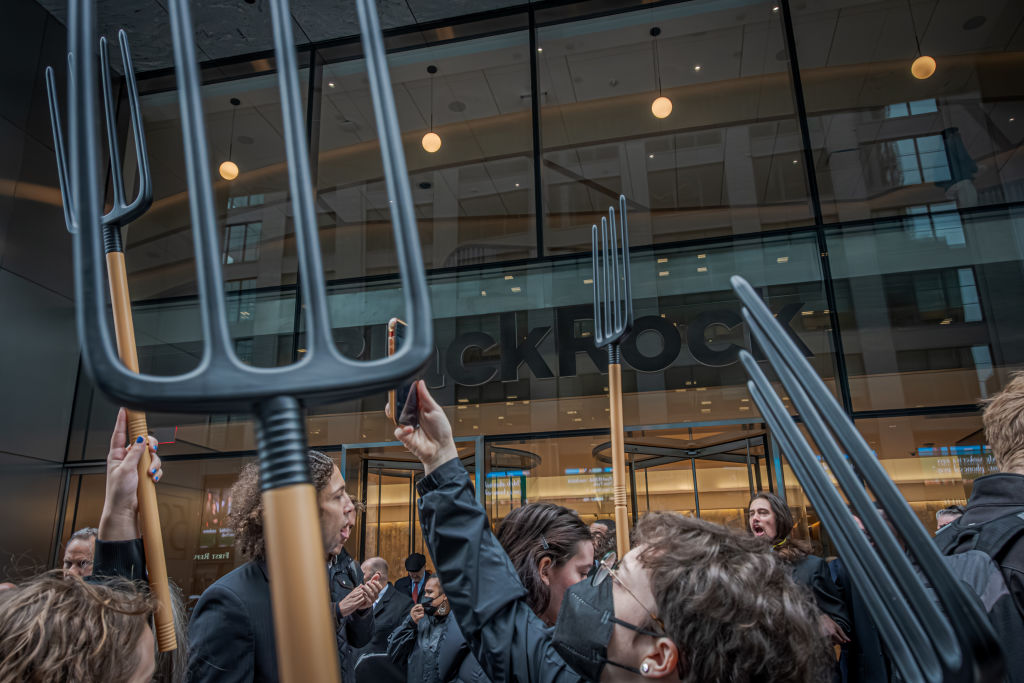
Protesters wield pitchforks outside of BlackRock headquarters in Manhattan on April 28, 2023.

Everyone says cancel culture is dead. If so, its ghost seems hell bent on repeating political habits. (Erik McGregor / LightRocket via Getty Images)


Clementine Morrigan and Jay Lesoleil, the Montreal-based cohosts of the podcast F–king Cancelled, have had a front-row seat to the secret the Left dares not name: the tendency toward deplatforming and cancellation. Through their podcast and Substack writings, Morrigan and Lesoleil have reflected on their experiences at the sharp end of this culture. What earlier generations of the Left would have recognized as dirty pool is now often celebrated as political virtue.

In a wide-ranging discussion with Jacobin’s Meagan Day, Morrigan and Lesoleil discuss identitarianism, mental health, emotional maturity, and the institutionalization of cancellation politics. Throughout, they are careful to spell out the costs that purity politics and a tolerance for cancellation impose on the Left’s organizing ability and democratic health.


Meagan Day

There’s a considerable contingent on the Left convinced that cancel culture is a phantom conjured by the Right — that it isn’t real and never was. So, I’ll put the question to you: Is cancel culture real? Did it happen? Is it still happening?

Clementine Morrigan

Yes, cancel culture is real. It helps to define our terms. Cancel culture is not simply criticizing someone publicly or saying you disagree with their ideas. It’s a targeted harassment campaign directed at an individual or organization, extending to everyone associated with them — friends, family, partners, acquaintances, anyone who continues to publicly support them. It demands total social withdrawal from the target; the goal is something like social death.

At the height of this, especially in 2020, someone would get called out online with no fact-checking whatsoever, no opportunity to state their side, and any attempt to defend themselves was itself recast as “refusing accountability,” which was taken as proof of guilt.

Everyone associated with the accused then experiences their own harassment: direct messages, public callouts demanding that they denounce the person, the implicit threat that maintaining the friendship makes them complicit in whatever crime has been alleged. And frequently the people driving all this have never met the person they’re canceling. The internet is international, so the accusers often know almost nothing about what did or didn’t happen, because they were never actually part of that person’s life.

Jay Lesoleil

And because of the internet, this happens on a scale that’s completely outside anything we evolved for — several orders of magnitude beyond anything a human being would naturally encounter.

We’ve all seen it happen. When people claim it isn’t real, what they usually mean is that it’s fine — that because no one literally vanishes, it doesn’t count as a real cancellation. But what would that even require? Someone dying or being locked in a box? If continuing to have a job or three friends means you weren’t really canceled, that’s a strange standard.

Clementine Morrigan

It really does reveal that the actual goal is total social annihilation. If the person still exists in any way, by that logic, they haven’t really been canceled. People are telling on themselves.

Jay Lesoleil

There’s also a persistent conflation between celebrity-culture cancellation and what happens to ordinary people on the Left. Those are related phenomena but not the same thing.

Clementine Morrigan

Right, and that confusion reflects a deeper failure to think seriously about power. People conflate boycotting a wealthy corporation, or calling out someone genuinely powerful and protected — a Harvey Weinstein, with lawyers and PR — with calling out a drummer in a local band or someone with a modest Instagram following who has no institutional protection at all.

Ad Populum

Meagan Day

Sometimes when people say cancel culture “isn’t real,” what they actually mean is that it’s real but good — which usually then boils down to the logic of “where there’s smoke, there’s fire.” In other words, if enough people who know someone believe something bad about them, it must be true. Can you talk about why that’s such a dangerous way to reason socially?

Clementine Morrigan

What’s bizarre is that the peak of this behavior on the Left coincided exactly with the peak of people posturing as prison abolitionists. That’s totally incoherent. One of the most basic principles of caring about incarcerated people is affirming the right to defend yourself and the right to a trial. Imagine a criminal justice system based purely on rumor and vigilante justice — that’s an obvious human-rights violation.

Cancellation is not prison, but it puts every major life stressor a person can experience — job loss, housing instability, loss of core relationships — onto someone simultaneously, without any fact-finding process at all.

If there’s “smoke,” fine — what specifically is the person accused of, and where does the accusation come from? Very often the accuser isn’t named, or the story has passed through several hands, and the original source is unclear. And even when you can trace it, the language is often incredibly vague — “causing harm,” “being an abuser,” “being a racist” — without any specific description of an actual act.

When I’ve been canceled, at the most extreme level, people have literally circulated the claim that I’m a member of NXIVM, the sex-trafficking cult. I’m a Canadian punk who lives in Montreal. There’s no link whatsoever. And yet people say this seriously to my friends.

Jay Lesoleil

If you imagine a village of a hundred people, and one of them keeps getting accused of holding a witches’ sabbath, sure, maybe you get a small-scale witch burning. But online, the number of participants is so enormous that no single body is keeping the allegations tethered to reality. Claims pass through so many rounds of the telephone game that they lose all contact with whatever actually happened. And because cancellation has become a kind of leisure activity — something people do on their phones on the bus — it just keeps generating more smoke, long after any fire.

Clementine Morrigan

Another way to put it is that there’s such a thing as a smoke machine. People often cite a statistic that something like 3 percent of accusations are false to argue that we should always believe survivors without question. I looked into that number once — it comes from studies of formal police reports of rape or assault. We can’t extrapolate from that to vague accusations posted online. Filing a false police report is not remotely the same act as posting an anonymous callout. And we don’t actually have good data on how often online accusations bear any relation to reality.

From my own experience, and from talking to a great many canceled people over the years, false accusations in this specific context are extremely common — not just outright fabrications, but ordinary interpersonal conflicts or legitimate political disagreements reframed as abuse or oppression.

Jay Lesoleil

And you also get accusations that aren’t really accusations in any first-person sense at all — five degrees removed, where no named individual is claiming anything happened to them, no one knows who, no one knows when, but it circulates as established fact anyway.

Clementine Morrigan

It’s entirely unaccountable. The people driving these campaigns aren’t accountable for whether what they’re saying is even true, despite the severity of the damage they’re doing.

Poisoning the Well

Meagan Day

People who say cancel culture isn’t real often also say, in the next breath, to just put the phone down and touch grass — grow a thicker skin. What do you say to that?

Clementine Morrigan

It happened to me in a spectacular, over-the-top way. I’ve had my tires slashed. I’ve had liquid shit poured into my car’s air vents. I’ve had posters put up with my face crossed out and false accusations printed under it. Someone once came up to me at a zine-tabling event and deliberately poured coffee over $500 worth of my zines. Telling me to touch grass is absurd; what’s happening in cases like this is stalking. It’s interesting that this denial comes from the same people who say we should “believe survivors.” Is my own testimony about what happened to me just false?

I know of one canceled person who was stabbed in the neck and murdered. Afterward, people online were harassing his widow, telling her he’d finally been held accountable. That’s the extreme end, but the threat of physical violence is common enough that people are genuinely afraid even when nothing physical has happened yet to them personally.

Beyond that, being lied about, misrepresented, having your sense of who you are flipped upside down and broadcast to the world is deeply painful on its own. Clinically, we know certain stressors reliably trigger mental-health crises — losing a major relationship, losing your job, being forced to move, major conflict. Cancellation routinely produces several of these simultaneously, and because it’s all searchable, it follows people indefinitely: a new employer Googles your name and finds “white supremacist” or “rapist” attached to it, regardless of the truth. It creates a genuine suicide risk. And the contempt people respond with — “come on, it’s not that serious” — is itself a symptom of the issue. Cancellation works by dehumanizing the target and revoking permission to feel any empathy for them at all.

Meagan Day

It occurs to me that in earlier states of humanity, we would not have expected to encounter so many people’s opinions about us to begin with, much less this degree of ostracization. Our brains aren’t built for it. In the small groups we spent most of our evolutionary history in, being ostracized entailed real risk — you could be left behind on the next migration.

Being widely hated causes real panic, even if it’s happening online. You can’t simply switch off that nervous-system response just because we now live in a different world.

Jay Lesoleil

Exactly — we’re profoundly social creatures to a degree that’s hard to overstate. Having a false story about you circulate publicly and get taken up by huge numbers of people registers as existentially dangerous, and your body responds accordingly. Speaking for myself, and on behalf of a lot of people who’ve written to us because of the podcast: this is traumatizing in a clinical sense. I have PTSD from it. I have triggers — things that send me into a week of dysregulated nervous-system response.

I can be building a new friendship, and, three weeks in, someone messages to say they can’t hang out with me anymore or demands an explanation of something they read online, and I can’t stay calm. That’s a real cost to real relationships, to my real mental health, not something confined to social media.

It also makes it hard to do actual political work. I’m a member of an organization, I do committee work, I make posters — but I can never be a public-facing spokesperson, because that risk is too high. We’ve noticed that a lot of people get canceled precisely because of leadership qualities — being well-spoken, taking initiative, starting projects. Someone objects that the project wasn’t run exactly how they’d have run it, and the person who actually did something gets dragged through the mud for it.

Most of these people don’t leave the Left; they just permanently retire from anything public-facing, because the trauma is too extreme. Cancel culture has this effect of kneecapping leadership, and the Left needs leaders. It can’t just be an ultra-decentralized Instagram movement.

Silencing Heresy

Meagan Day

Why does this seem to concentrate so heavily in left-wing and social-justice spaces specifically?

Clementine Morrigan

I think there are two components we haven’t fully named yet. One is identitarianism: the idea that identity is the single most important lens for understanding power. Combined with an essentialist flattening that lets certain people claim to speak for an entire identity group, it erases the fact that every identity group contains real political disagreement. Cancellation then gets deployed to enforce whatever position gets declared the “official” stance of that group; disagree, and you’re a bigot.

The second is scapegoating. We’re up against enormous, genuinely terrifying structural forces, and most people have very little lived experience of the organized left actually winning anything. That produces real powerlessness. It’s much easier to target someone in your own community, turn them into a symbol of the larger system, and get the emotional catharsis of punishing and exiling them. That produces a real if illusory sense of having accomplished something — and we’re basically addicted to that release at the direct expense of actual political effectiveness.

Jay Lesoleil

I think of cancellation as the activity, social media as the medium, and identitarianism as the content — the actual substance of what’s happening. There’s essentially no cancellation on the Left that isn’t identitarian in framing. You never see “this person was rude to their neighbor, so we don’t like them.” It’s always “this person was oppressive toward a femme of color” or something similar, because that framing is what carries the emotional weight in spaces that take that language seriously.

Outside of those spaces, the same language falls flat. But you find structurally similar dynamics in other high-stakes belief communities — religious communities doing their own version of casting out will reach for religious language instead, because that’s the content native to their activity.

Clementine Morrigan

I’ve done a lot of free consulting for political organizations facing cancellation campaigns, and one pattern comes up constantly: people join the Left out of deeply held conviction, real ethical commitment. Many of them are genuinely brave — willing to face down police, willing to risk arrest for climate action. They prepare themselves emotionally for those risks. What they haven’t prepared for is being totally misrepresented as having the opposite of their actual values by their own peers.

Leftists need to build the resilience to be misrepresented and to say, clearly, “I hear the accusation, here’s why I disagree,” which usually requires some working understanding of identitarianism itself. People will tell me, “Someone of this identity told me my action was racist — don’t I need to defer to that, stay in my lane, honor standpoint theory?” And I tell them: doing that actually reproduces essentialism, because you’re letting one person stand in as a spokesperson for an enormous, politically diverse group.

Politics and the Therapeutic Turn

Meagan Day

You’ve touched on the personality of people who get targeted. What’s the typical profile of someone who leads a cancellation campaign?

Jay Lesoleil

Half-joking, but: there’s a narcissist type who instrumentalizes it, doesn’t especially believe the substance of what they’re saying, and treats it as a convenient tool for removing people who are in their way. There’s also a more borderline-personality-organized type — chaotic, not thinking it through, just putting enormous raw feeling online and setting it on fire.

And then there are the followers, often traumatized people trying to follow the rules carefully out of fear of being targeted next, going along with whatever the current consensus demands to avoid becoming the next target themselves.

Clementine Morrigan

I’d add two things. Years ago, I wrote an essay called “I Called My Ex Abusive When They Weren’t” — a true story. I said it, I said it to multiple people, I let it circulate, and I’ve since made amends. I wasn’t maliciously spreading a lie. I have complex PTSD from childhood abuse, and trauma literally means having present-day nervous-system reactions calibrated to something that happened in the past.

In that particular relationship, my partner was avoidant, I was anxious-preoccupied, and there was a chronic sense of unmet needs and real unhappiness. But there were none of the actual features of abuse. My nervous-system reaction to it was disproportionate because of my history, and the community I was in at the time told me directly that my emotional reaction was itself evidence of abuse. That framing was deeply regulating for me in the moment — it moved me from helpless overwhelm into a fight response, which felt more stable and gave me someone to blame. But it wasn’t accurate.

A huge amount of my work outside cancel culture specifically is about trauma and abuse survivors, and I think the “believe survivors, no questions asked” framework is actually anti-survivor, because it’s trauma-illiterate. What actually helped me was a therapist — I’ve been with her for nine years — who’s deeply trauma-informed and told me plainly: that was an unhappy relationship, not an abusive one, and learning to tell the difference matters.

Therapists themselves are now under real pressure from this dynamic. I’ve been brought in to train therapists who are being told by colleagues they need to be “calling out white supremacy” inside the therapy room. If I’d gone online and called my own therapist an abuse apologist for gently pushing back on my framing, I could have ended her career. It takes real courage for a therapist to say that clearly now.

I’ve also come to think social-justice orthodoxy functions as a class signifier — a set of confusing, constantly shifting linguistic rules concentrated among academic, NGO, downwardly-mobile professional-managerial class (PMC) types. Knowing the rules works a lot like knowing which fork to use at a formal dinner: using them correctly signals in-group belonging. It becomes a class-signaling exercise fairly detached from any actual desire to do good in the world. I spent so long inside that world that, even now, when I’m no longer trying to perform it, I can instantly tell when someone else is trying and getting it slightly wrong.

Purity vs. Solidarity

Meagan Day

Individually, a lot of leftists are smart, capable of nuance, capable of real solidarity and cooperation. Collectively, the Left is often incapable of any of that. Given that solidarity is supposed to make us collectively stronger than we are individually, it’s striking that the aggregate often behaves worse than any of its individual members. Do you agree with that?

Clementine Morrigan

A lot of it comes down to cowardice, honestly. I understand why people are scared, but at a certain point I ran out of patience for it. It’s 2026; many leftists have worked hard to shift the culture, and it’s genuinely easier to push back on this now than it was six years ago. If you have nuanced views, or you’re willing to associate with people who’ve been canceled, people will come for you. We need to be able to name that clearly as dysfunctional and decline to engage with it. If we can’t, we’re not getting out of this.

Jay Lesoleil

There’s a disconnect between the principles we say we hold on the left and the principles that actually govern how we treat each other. I suspect a lot of that comes from the Left getting hollowed out under neoliberalism. For a long time, there were leftists but barely any actual organized left to embed those principles in practice. So a lot of people experienced “the Left” mainly as ideas floating around online, unmoored from any organization actually trying to practice those principles.

Clementine Morrigan

Jay and I draw a lot from our experience in Alcoholics Anonymous (AA) on this point. AA is a massive international organization, full of — let’s be honest — plenty of chaotic, difficult people, and it’s existed since the 1930s without centralized leadership, and it’s held together. One of its core traditions is “principles before personalities,” the idea that shared principles guide behavior above and beyond interpersonal conflict, and that unity gets prioritized over disagreement. Narcotics Anonymous has a similar saying: “As long as the ties that bind us are stronger than those that would tear us apart, all will be well.”

I think the Left could learn something from that. What happened to solidarity, to the idea that despite real disagreement we share a larger goal and genuinely need each other? If we can’t organize among ourselves, when we already agree on the vast majority of things, we have no chance of building broad solidarity with people who don’t share our specific internal vocabulary at all. We need real tolerance for difference, real humility about not having solved everything, curiosity, empathy, and solidarity as basic operating principles — or we’re just running on personalities before principles in chaotic and self-serving ways.

Meagan Day

I think people underestimate how far back these dynamics go. I went to a progressive, small liberal arts college starting in 2007, and it was well underway. I have stories that are almost twenty years old. People treat 2020 as “the Great Awokening,” or they point a little further back to “peak Tumblr,” but this was already happening well before that.

Clementine Morrigan

It goes back even further than that. I dropped out of high school in 2002 when I came out as a lesbian, and by 2003 I was at an alternative school in Toronto literally doing “step forward if you’re X, step back if you’re Y” exercises. The adults running that program were teaching us this. It was niche for a long time, then started moving into the mainstream around 2013–14 and hit its zenith in 2020.

Mass Politics Needs Masses

Meagan Day

From our vantage point, what changed by 2020 wasn’t that this way of thinking came into existence — it’s that something that had been a symptom of a small, marginal, relatively powerless left suddenly engulfed the entire culture. Those of us who’ve watched this for twenty years probably have some responsibility to warn people that it doesn’t work, and it tears movements apart every single time.

Jay Lesoleil

What was actually crazy about 2020 wasn’t that any of this suddenly appeared. It’s that language we’d used in anarchist collective houses started getting parroted, word for word, by human resources departments at major multinational corporations. By that point I’d already been done with it for years and watching it become culturally hegemonic in corporate America was surreal — and honestly the clearest possible proof that none of it actually threatens the power structure in any way.

Meagan Day

That wave crested, and we’re now dealing with a psychotic reactionary right. And “we’re not woke” is one of its most effective recruiting pitches for young people who’ve had a taste of this dysfunction. I don’t think that’s the whole story of the Right’s rise — there’s a much bigger economic story — but it’s part of it.

What do you say to people who argue that now isn’t the time to talk about any of this, given everything else happening?

Clementine Morrigan

It’s genuinely insulting to tell people something they can see plainly in front of them isn’t real. If the Left refuses to have this conversation and offer answers, people will go looking for answers on the Right, and they’ll find them there. We have a responsibility to provide real answers — not just about this phenomenon but about people’s actual material lives — and if we don’t do that work, the Right will supply its own scapegoating narrative in our place.

Jay Lesoleil

When we started the podcast, there were really only two places on the left you could go for any analysis of this from a left perspective: the Jacobin YouTube channel, and us. If there’s no room on the left to say “this is completely insane,” people either go silent, drift rightward, or check out of political life entirely. We set out to carve out a small space where people could stand instead, and I think we succeeded — and other people followed through the crack we opened. Now a good part of the Left is either quietly over it, which I’d call cowardly but at least better than nothing, or willing to say openly, “Yes, I was part of that, and it was crazy” — which is better still.

Clementine Morrigan

At the same time, even though it’s no longer hegemonic, it’s still undermining organizing, and we need to keep crushing it wherever we find it. Organizers are already broke, exhausted, doing this on top of day jobs, up against enormous structural power, and this stuff still wrecks meetings. People still write to me saying, “We’re trying to organize, and this is happening and we don’t know what to do.” As long as that’s true, we’re allowing it to sabotage our own efforts.

Jay Lesoleil

It’s dangerous to just move on without acknowledging what happened, because without the vocabulary or analysis, you have no defense the next time it shows up. And it’s basically guaranteed at this point that any left organization or cultural institution will eventually get dragged down by these dynamics. You need to know how to respond when that happens, not just assume that all accusations must be true — because organizations used to assume that.

Disarming the Circular Firing Squad

Meagan Day

It’s not over, and there’s no guarantee it won’t resurge. There are still cohorts who operate exactly this way, still new recruits absorbing this framework, because it’s a simpler mode of thinking than genuinely systemic left analysis. It’s easier to grasp, especially for young people raised in an atomized, neoliberal, identitarian culture. This could become a dominant issue again within five years if we’re not vigilant, even in the middle of the current anti-woke backlash, which is itself deeply reactionary.

Clementine Morrigan

A lot of this comes down to emotional maturity, and I think a lot of people are genuinely emotionally immature, because we weren’t raised with good models for emotional regulation. I wrote a piece called “Political Organizing Is Not Therapy,” arguing that organizing spaces aren’t equipped to meet people’s raw, unprocessed emotional needs. People often show up expecting the collective to do that work instead of doing it with a therapist, partner, or close friend first, and only then bringing forward whatever specific, concrete issue actually needs addressing.

Meagan Day

In my Bay Area organizing days, a group of us used to go sit at a Zen center with an older member who practiced there. I know how that sounds from the outside, but emotional self-regulation should be an explicit value on the left. We don’t talk about it, but every serious wisdom tradition, whether Stoic, Buddhist, contemplative Christian, or Twelve-Step, eventually arrives at the same insight: Your feelings are real and valid but transitory, and the goal is to act from them as nondestructively as possible, rather than being ruled by them.

Clementine Morrigan

There’s a time and place to fully feel something and process it, and a time and place where that’s simply not appropriate. We need the maturity to name that clearly when someone’s hijacking a meeting with an emotional process unrelated to the actual agenda, and to say so directly rather than letting it derail everything.

Jay Lesoleil

I‘ll drop in my trauma theory of Stalinism here, since it always feels relevant: I think a lot of the worst failures of twentieth-century communism trace back to the fact that the people who came out on top of these revolutions and subsequent civil wars were so traumatized by the experience that whoever ended up at the top — the last person left standing — was often simply the person who was most desensitized to killing. That might explain some of what happened under Joseph Stalin, Mao Zedong, and the Khmer Rouge.

But the North American left today isn’t made up of war veterans. It’s suffering in a quieter, more atomized, more alienated way.