Ottawa Has Stuck By the Charity Behind the Nazi Gaffe
Canada’s Victims of Communism monument included proposed honorees from the Waffen-SS, the Ustaša, and the Ukrainian Insurgent Army. The charity that supplied the names is still helping shape the memorial’s next phase.
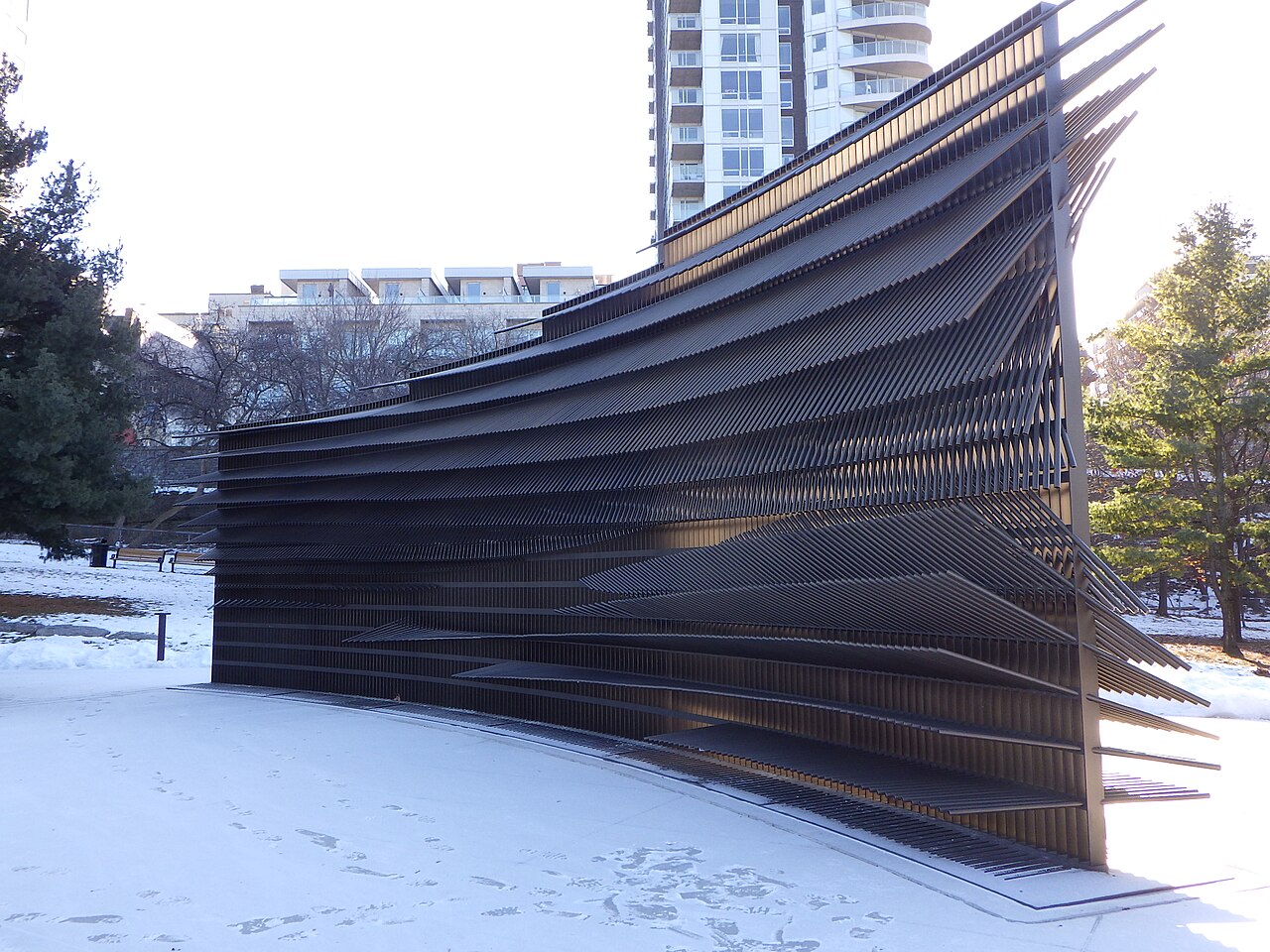
Canada’s Victims of Communism monument nearly commemorated Nazi collaborators. Internal government records show that the charity behind the fiasco is still at the center of the publicly funded project.
The Canadian government scuttled plans to display hundreds of names on Ottawa’s controversial “victims of communism” monument, after officials concluded that individuals listed for commemoration, in the bloodless vernacular of bureaucratese, did not “align with Canadian values.”
“After a thorough review, it has been determined that the names (both donor and commemorative) will not be displayed on the Wall,” the briefing, obtained through Access to Information, read in part.
“The Memorial to the Victims of Communism – Canada, a Land of Refuge” has faced considerable scrutiny since it was revealed that the names of Nazis and suspected war criminals had been proposed for commemoration. A list of names was provided to the Department of Canadian Heritage when it took over the project from a charitable organization, Tribute to Liberty (TTL).
Despite this, the same documents reveal Canadian Heritage plans to continue working with Tribute to Liberty to develop new, yet-to-be defined commemorative elements for the memorial’s Dedication Wall (also referred to as the Wall of Remembrance). The Wall of Remembrance was supposed to contain the names of hundreds of alleged victims of communism, though when the monument was unveiled to the public on December 12, 2024, no names had been affixed to it. The wall was instead covered up during the unveiling ceremony and remains unfinished.
As reported by the Ottawa Citizen in October 2024, an internal assessment of the names revealed more than half of the 553 names listed for commemoration should be dropped. According to a 2023 internal report, between fifty and sixty were directly linked to the Nazis, while hundreds more were either suspected of such links, lacked sufficient information to determine one way or the other, or had no connection to Canada whatsoever.
Tribute to the Waffen-SS
A February 2025 article published by Ricochet revealed that the name of a Nazi collaborator who participated in the massacre of Latvian Jews was found attached to the dedication wall by a Canadian Heritage official during a site visit in early November 2023. Ricochet further reported that, although Canadian Heritage had not completed its vetting of the names slated for commemoration, the National Capital Commission (which oversees monuments in Canada’s capital city of Ottawa and the surrounding region) had nonetheless gone ahead with engraving nameplates to be affixed to the memorial. The unredacted sections of the documents obtained by Jacobin specify that the nameplates are “approximately the size of a business card, and could be removed or replaced.”
The memorial’s planned public unveiling, originally scheduled for November of 2023, was canceled and postponed for over a year after the Yaroslav Hunka scandal. Hunka, then a ninety-eight-year-old veteran of World War II, was honored by Canada’s parliament during a state visit by Ukrainian president Volodymyr Zelensky in September of 2023. Hunka was praised as a “Ukrainian and Canadian hero” for fighting the Soviet Union in World War II.
Reporting soon revealed that Hunka had volunteered for the Waffen-SS, the combat arm of the Nazi Party. Veterans of the 14th Waffen Grenadier Division of the SS, such as Hunka, were among thousands of suspected and alleged war criminals who immigrated to Canada after the war. The government of Canada created the Deschênes Commission to investigate some of these cases in the mid-1980s. The commission’s two-part final report contained a list of those investigated in its second half, though this remains a state secret and is not available to the public.
In December 2025, Jacobin asked Canadian Heritage if they had been granted access to the Deschênes Commission’s final report to compare against the names slated for commemoration. Ines Akué, a Canadian Heritage spokesperson, said the final report’s second part was not made available to their staff. Canadian Heritage asked two historians — Michael Petrou and Roman Krakovsky — to review the names, whose reports were submitted in 2021 and 2023, respectively.
Among his recommendations, Krakovsky proposed changing the monument’s name to be more inclusive and reflective of the refugee experience in general. As the Ottawa Citizen reported, Canadian Heritage officials told him the recommendation was “not required,” even though it was consistent with a separate and earlier suggestion made by the National Capital Commission (NCC).
Michael Petrou’s recommendations offered Canadian Heritage three options: remove only the names of the individuals whose histories are conclusively known; establish criteria for assessing the submitted names and evaluate each individually; or only list the names of donors, rather than those submitted as “victims of communism.”
“No Banderites, No Nazis”
Why Steven Guilbeault, then heritage minister, ultimately rejected these options isn’t clear. The heavily censored documents submitted for Guilbeault’s decision on the matter appear to list three possible options, of which only the second is unredacted. It reads: “Replacing the rear face of the Dedication Wall with other thematic content or design elements.” This is preceded and followed by page-length redactions, presumably the two other options. Guilbeault signed the document on September 2, 2025.
“Canadian Heritage undertook a due diligence process to ensure the Memorial aligns with Canadian values and principles of democracy and human rights,” said Caroline Czajkowski, a Canadian Heritage spokesperson, in a statement to Jacobin. “To that end, the Wall of Remembrance will not feature any names. Instead, it will present thematic content that conveys the broader commemorative and educational intent of the Memorial.”
The documents somewhat contradict Czajkowski’s statement, which indicate that Guilbeault actually opted to nix including the names of specific individuals because their backgrounds couldn’t be conclusively verified. “Including names without complete verification would create a significant risk to the credibility and purpose of the Memorial. Not displaying any names is the only approach that ensures no controversial names are included or associated with the site” read, in part, the briefing notes prepared by Canadian Heritage in advance of a meeting with Paul Raff, the architect who designed the memorial.
Elsewhere in the released documents, Canadian Heritage notes that the monument was vandalized in April 2025, a fact not previously made public. Signs and fencing surrounding the memorial’s construction were vandalized in 2020 with the slogan “Communism will win.” At the memorial’s public unveiling in December of 2024 — an event that no federal politicians or members of the government attended — protesters shouted “No Banderites, no Nazis” during a speech by Tribute to Liberty Chairman Ludwik Klimkowski.
The uncensored sections of the documents also reveal that Klimkowski requested — and Guilbeault provided — a signed letter explaining his decision. Klimkowski had requested such a letter so that he could show it to the other members of Tribute to Liberty’s board.
“I understand that this outcome may be disappointing and would like to express my sincere appreciation for your valuable contributions throughout this process,” reads the letter. “Your input has played a key role in shaping the vision for the monument.”
“Buy a Brick” for Nazis
As chairman of Tribute to Liberty’s board, Klimkowski played an integral role in raising $1.5 million CAD to develop the monument. Donations were made initially as part of a virtual “buy a brick” campaign for a memorial element called “Pathways to Liberty,” wherein donors purchased bricks at a set price and could dedicate the bricks to commemorate alleged victims of communism. Ultimately, this component was shelved in favor of the Dedication Wall, which was to feature a list of donors who had contributed over $25,000 to the project (called the Donor Recognition Element), as well as a Wall of Remembrance featuring up to one thousand business-card-sized plaques, listing the names of alleged victims of communism. These nameplates represented donors who had provided between $1,000 and $24,999 to Tribute to Liberty.
According to a 2021 CBC News report, some of the donors include former Canadian Prime Minister Stephen Harper, and former Alberta Premier Jason Kenney. Kenney championed the project while he was a cabinet minister in Harper’s government. Senator Linda Frum, sister of Iraq War propagandist and Atlantic Senior Editor David Frum, is among the project’s legacy donors, having committed over $100,000 CAD.
The uncensored sections of the documents confirm Canadian Heritage knew hundreds of donors contributed with the understanding that their money would cover specific commemorative elements. Although Guilbeault decided to abandon the specific recognitions, there was no indication Canadian Heritage intended to refund the money to the project’s donors. When asked about this, Czajkowski told Jacobin that TTL transferred the money they collected to the NCC, not Canadian Heritage. She referred to all questions concerning refunds — including whether TTL had asked for one — back to the charity.
While hundreds of private donors may have contributed to the monument’s price tag, taxpayers nevertheless were on the hook for the lion’s share of the cost, covering about $6 million of the $7.5 million total.
As reported by CBC News in 2021, some of those listed as “victims of communism” were in fact suspected war criminals, Nazi collaborators, and other assorted fascists. Names listed for commemoration on TTL’s website included Roman Shukhevych, Ante Pavelić, and the Order of Vitéz. Shukhevych led the wartime Ukrainian Insurgent Army, which was responsible for the deaths of tens of thousands of Belarusians, Jews, Poles, and Ukrainians. Pavelić led the Ustaša, the fascist movement that ran the Independent State of Croatia, a Nazi puppet state chiefly responsible for the Holocaust in the Balkans. Vitéz members organized and benefited from the Holocaust in Hungary and then became leaders of the Hungarian Nazi puppet state late in the war.
Of Redactions and Evasions
Though some of these names were removed from TTL’s website shortly after being contacted by CBC News, the names of other collaborators, fascists, and Holocaust perpetrators remained. Asked at the time whether donations had been returned, Klimkowski told CBC News it would be “premature to comment.” He also said at the time that questions about the individuals listed for commemoration were “premature,” as Canadian Heritage and TTL were still reviewing the names, and that this would be completed by December of 2021.
By then, however, the list of names to be commemorated on the memorial had already been submitted to Canadian Heritage.
Jacobin sent Canadian Heritage detailed questions about its review of the names with TTL, including what aspects of the names submitted to Canadian Heritage “wasn’t aligned” with Canadian values. Further questions included whether TTL conducted their own independent review of the names prior to their submission, and whether they challenged the assessment of the names by historians hired by the government.
Canadian Heritage did not respond to these questions. Instead, David Larose, another spokesperson for the government department, replied: “As the review was an iterative process involving multiple parties, PCH [Canadian Heritage] cannot identify specific dates marking the completion of one party’s review and the start of another’s.”
Canadian Heritage also didn’t respond to questions concerning TTL’s continued involvement in the project. Per Guilbeault’s letter to Klimkowski, Canadian Heritage remains committed to working with the charitable organization to “collaboratively develop thematic content” and to explore “alternative design elements for the Wall of Remembrance that foster remembrance, commemoration, and reflection for all visitors.”
Questions about what this might entail were not answered, as Canadian Heritage insisted that any questions regarding TTL’s involvement were best handled by the charitable organization.
However, briefing notes that appear to date to November of 2025 indicate Canadian Heritage “will be responsible for developing the thematic content, which remains to be defined.”
Neither Tribute to Liberty nor Ludwik Klimkowski responded to Jacobin’s questions.
The Politics of Commemoration
A 2015 letter written by Klimkowski and published by the Ottawa Citizen indicated Klimkowski believes in the conspiracy theory that communism killed 100 million people. The figure comes from the 1997 book The Black Book of Communism, edited by Stéphane Courtois. Historians and other experts dispute both the figure and the book’s content; in order for it to be accurate, it would have to count all the Nazis killed during World War II, among others, as “victims of communism.”
Klimkowski reiterated this view last year during an interview on American Thought Leaders with host Jan Jekielek, a senior editor with the Epoch Times and a donor to the monument. During the interview, Jekielek stated that communism was responsible for the deaths of hundreds of millions, while Klimkowski stated that Ernesto “Che” Guevara was “personally responsible for the slaughter of thousands of innocents.”
When asked similar questions in 1997, investigative reporter and Guevara biographer Jon Lee Anderson told PBS News Hour there was no evidence Guevara had ever murdered an innocent, and that the people executed by his order were “condemned for the usual crimes punishable by death at times of war or in its aftermath: desertion, treason or crimes such as rape, torture or murder.”
In answering a question from Jekielek about why the monument came close to not being built, Klimkowski explained that this was because some members of Canada’s federal government inclined toward “Marxist-Leninist ideology.”
Canadian Heritage could not provide details about the thematic elements that would be incorporated into the memorial, or whether any academics or other experts would be involved in developing them. It also could not say when the project might be completed.