The BBC Has Appeased Its Enemies and Alienated Its Friends
The idea of public-service broadcasting is still worth defending in a media culture increasingly dominated by the superwealthy. Unfortunately, the BBC has failed to defend that idea while bending over backward to appease those who want to destroy it.
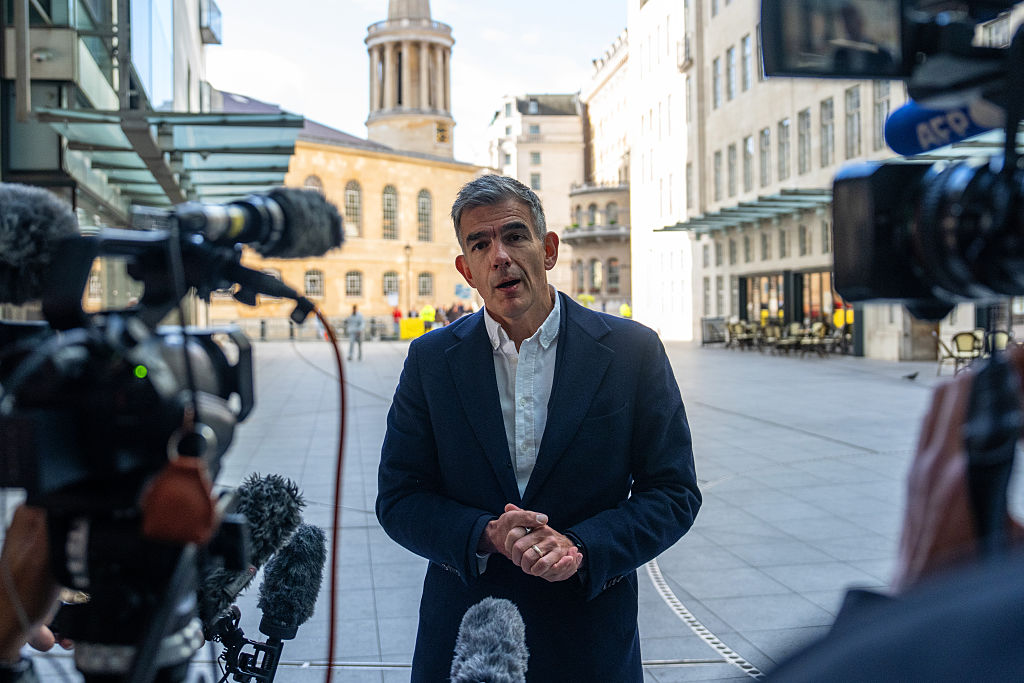
The BBC has acquiesced in the face of British political power with grim predictability. Many former allies of the public broadcaster now feel overt anger toward it rather than a sense of responsibility to speak up for its protection. (Carl Court / Getty Images)
It’s getting harder and harder to defend the British Broadcasting Corporation (BBC). Quite aside from the seemingly endless disclosures that management failed to act on sexual abuse allegations against some of its most high-profile presenters, the organization’s news output has long made things difficult for those who might otherwise champion it.
From the unforgivable equivocation around Israel’s genocide and the generally uncritical promotion of a NATO-aligned worldview to the nauseating obsession with the factionalism and court intrigues of Westminster, the BBC has acquiesced in the face of British political power with grim predictability. Many former allies of the public broadcaster now feel overt anger towards it rather than a sense of responsibility to speak up for its protection.
Swinging the Axe
On June 17, the BBC’s new director-general, Matt Brittin — a businessman, former McKinsey consultant, and Google executive — announced a fresh round of cuts. Few dissenting voices made themselves heard above the vaguely maudlin tone of reporting as another slice of Britain’s erstwhile national treasure was chewed up and spat out.
Brittin’s reported £565,000 salary is his reward for the performance of a role: that of grim-faced estate executor, a corporate axe-swinger tasked with inflicting more savage cost-cutting, a task in which he has previously excelled. Having once stood at the wicket for Big Tech, grilled by British MPs in 2012 as to why Google’s UK arm made many billions in profits yet paid nearly nothing in corporate taxes, today Brittin plays comprador presider in chief over the managed decline of the country’s most important cultural export.
Vastly flawed though it is, the BBC is still a stellar symbol of postwar Britain’s public sphere. Brittin insists that a long-mooted digital transformation is key to preserving the BBC for future generations:
We must be where audiences are, and experiment more bravely: test ideas, learn quickly and back what works. Audiences will value the fact we are listening, innovating and working hard to serve them better.
This nebulous formulation is a familiar feature of BBC belt-tightening: executives have been making similarly vague gestures toward the online space for an awfully long time. While the primary function of such vapid allusions to a coming digital revolution is to rationalize the self-immolation of large sections of the BBC, the fact that they are still taken even halfway seriously betrays the profound insecurity of the organization about its relationship to the modern news consumer and the durability of its own long-term model.
In the past few weeks, many thousands of staff on video calls and in cramped meeting rooms have seen managers delivering bad news with affected melancholy while claiming that the quality of BBC output will not be affected. Staff are well aware that management presents a different picture to its own superiors, where the order of the day is a hardheaded ability to make “tough choices” and carry out cuts with laudable speed. In the BBC as elsewhere in the corporate world, an aptitude for shape-shifting is the core criterion for climbing the ladder.
With up to two thousand job cuts planned over the next three years, the aim is to make £5 million in savings. Production teams are being trimmed and merged across a swath of different programs and platforms, and entire shows are being ended. The World Tonight, a Radio 4 staple that has run for more than fifty years, is among at least five programs on Radio 4 and four on the BBC World Service set to end in the next year. More such announcements are expected over the coming months.
Under New Management
Brittin took over from outgoing Director-General Tim Davie in May after the enforced resignations of Davie and BBC News CEO Deborah Turness. Davie and Turness fell victim to the fallout from the editing of a Panorama documentary about Donald Trump that attracted the ire of the White House.
Britain’s Tory newspapers also set great store by a memo from the journalist Michael Prescott accusing the BBC of liberal and left-wing bias. Prescott is a friend and ally of Robbie Gibb, the former BBC editor who received a knighthood after working as director of communications for the Conservative Prime Minister Theresa May. His memo reproached the BBC for not accepting Israeli claims that hospitals in Gaza were legitimate military targets.
What has followed from the new administration is not the robust defense of the BBC that the more naive among us might have imagined we would see. Instead, there has been more self-flagellation from the top brass and more demoralization for their underlings.
On Brittin’s first day in the job, he had to walk past striking workers as he entered New Broadcasting House. Did the pointed image force any change of course, any introspection; bring about any public outrage on behalf of the emaciated BBC, so tragically undermined by successive governments and their executive stooges? No, because the BBC has few backers left.
The Special Relationship
Another neglected symptom of the BBC’s rudderless state predates the Tim Davie era: the BBC’s contractual partnership with US broadcaster CBS, signed in 2017. James Harding, BBC director of news and current affairs, said at the time:
This new partnership between the BBC and CBS News is designed to bring our audiences — wherever you live, whatever your point of view — news that is reliable, original and illuminating. Our ambition is to deliver the best in international reporting on television.
You might be forgiven for thinking that a huge rethink was necessary when the Trump-supporting Ellison family (owners of tech behemoth Oracle and huge donors to the Israeli army) agreed to a deal in July 2025 for their Paramount company to merge with Skydance Media, bringing CBS News under their control. But there was no evidence of second thoughts from BBC management.
The Ellisons have overseen a rapid transformation of the network, installing Bari Weiss, an “anti-woke” blogger with no previous broadcast experience, as head of CBS’s news operation. Weiss appointed a brigade of her own right-wing cronies to senior on-screen analytical positions and fired the leadership of the organization’s flagship 60 Minutes show, along with other correspondents who accused her of editorial interference.
Ellison is now poised to complete a $111 billion purchase of CNN’s parent company too. As it happens, former BBC Director-General Mark Thompson now heads the CNN news division. During his time at both networks, Thompson has been accused of pro-Israel bias.
Over a Cliff
The oligarchic buying up of frontline US news organizations ought to be antithetical to the BBC’s operational remit and the pluralistic values it propounds. The coziness of the Ellisons with a sitting US president who is currently suing the BBC should provide further food for thought. However, there has been no discussion whatsoever of the partnership at the BBC — a sorry indictment of just how inward and navel-gazing its leadership has become.
The BBC is so focused on stripping itself for parts to appease abstemious governments, whether Tory or Labour, that the organization’s decline now appears terminal. Without a drastic reformulation of its funding model and overall relationship to the state, the sound of corporate platitudes will continue to abound as the BBC is marched over a cliff.