The Criticisms of Bernie’s AI Wealth Fund Idea Don’t Hold Up
Bernie Sanders has proposed making artificial intelligence providers hand over 50% of their stock to a US sovereign wealth fund. Criticisms of the idea, ranging from AI skepticism to arguments against public ownership, have not been compelling.
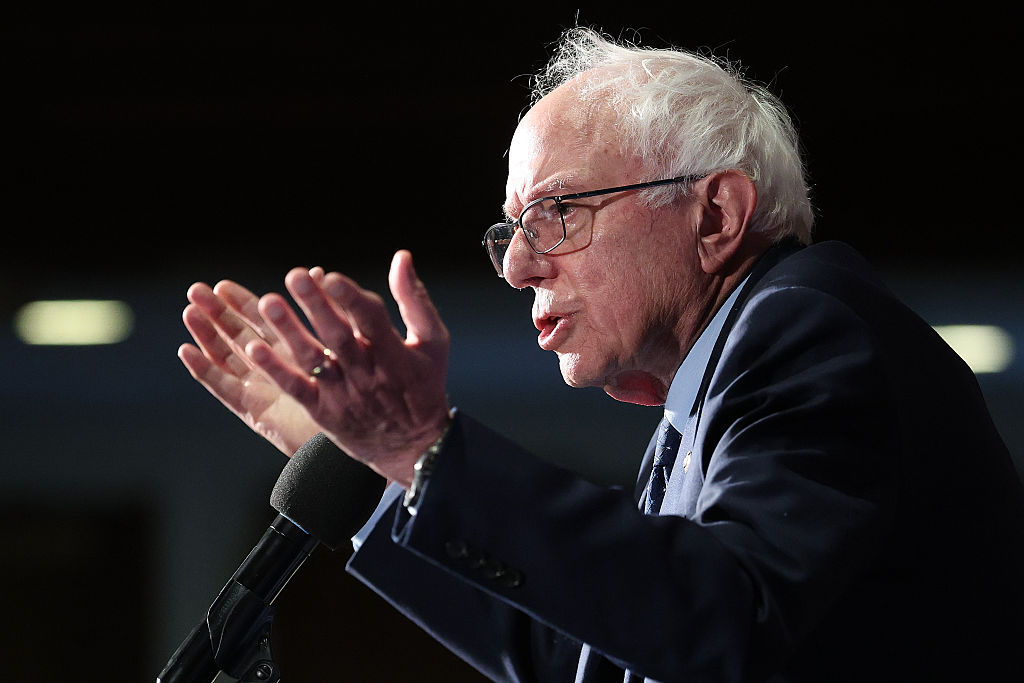
The objections to Bernie Sanders’s proposal for an AI sovereign wealth fund simply don’t hold up to scrutiny. (Win McNamee / Getty Images)
Earlier this month, the New York Times published a piece from Bernie Sanders about his proposal to require AI providers to hand over 50 percent of their stock to a sovereign wealth fund (SWF) administered by the government. In the piece, Sanders gives three main rationales for this policy:
AI models are trained on the entire corpus of human content creation. The AI companies did not produce this content. Everyone else did. This input should be compensated in some way so as to avoid windfall gains for AI companies.
Stock equity, with voting rights, would enable the government to more directly steer decision-making in a prosocial way.
The gains from this ownership would be available to the public in the form of dividends or revenue for the welfare state.
Sanders subsequently released legislation toward this end, which you can read here.
I have some pedantic quibbles with the way this is described. Within the usual taxonomies of public ownership, what’s really being proposed here is to turn Anthropic, OpenAI, and a Gemini spin-off into partial state-owned enterprises (SOEs). These are common throughout the world. In Norway, they have the telecommunications company Telenor (53.97 percent state owned), the energy company Equinor (67 percent state owned), and the bank DNB (34 percent state owned) to name a few. But Norway describes those companies as being in its SOE portfolio (concentrated holdings of selected companies for strategic reasons), not its SWF portfolio (diversified holdings seeking financial returns).
Of course, critics of the proposal did not tend to raise definitional problems. Instead, they offered more substantive complaints. I have tried over the last few weeks to collect these critiques so that I can respond to them here.
Confusion
As with any proposal, I saw a variety of criticisms that either misunderstood or deliberately misrepresented what the proposal was. The most common criticism of this sort was based on the premise that Sanders was proposing to purchase 50 percent stakes in these companies, which the critics said would be a bad way to spend public money. But the Sanders proposal is to gain a 50 percent ownership stake through a one-time tax on these companies that would have to be paid in stock rather than cash. Based on recent valuations, this would be akin to transferring over $1 trillion of stock equity from Anthropic, OpenAI, and the spun-off Gemini to the government, not by purchasing the stock but through taxation.
Against AI Inference Itself
Another set of criticisms was rooted in opposition to the production or consumption of AI inference in general. AI inference is produced with computers, and computers work by running electricity through transistors. Running electricity through transistors produces heat, which is typically dissipated with water cooling systems that are noisy. Computers take up space, which requires land. Computers are also scarce, and so using them for AI inference trades off with other sorts of computing like video games. For some, using these inputs — land, electricity, water, processors — is not worth the corresponding AI inference output.
At times, this second argument can sound like a categorical rejection of computers altogether, especially dense clusters of computers. But I assume that this is not the intent of those who raise these objections. After all, any digital service — including this website — relies on these same sorts of computer clusters, which we used to call server farms but now call data centers. Instead, it seems like the point here is that this particular use of computers is not a good one. So this argument really collapses into an argument about the utility of AI inference itself.
I suppose with any product, some people think it is useful and other people don’t. Often we try to assess these claims by seeing whether people actually are using the product. On that measure, it does appear to be useful: AI inference usage has grown at a rapid rate, whether measured by tokens or revenue.


But this does not necessarily settle the question. After all, people buy and drink a lot of alcohol, but that doesn’t mean it is a particularly useful product that we should be dedicating hundreds of thousands of workers and tens of millions of acres of land to producing. If your view is that AI inference is so useless or so harmful that it should be banned outright, then obviously the question of whether it should be owned publicly or privately is beside the point. But if, like me, this is not your view, and you do not want the whole thing banned, then the question remains, and expressing dislike of the technology does not resolve it.
Against Public Ownership Itself
Another argument is that public ownership is bad because it gives the government too much power, including when the government is controlled by politicians you oppose. Dean Baker put it this way:
First and foremost, Donald Trump is doing his best to show us why it is often a bad idea to have the federal government directly involved in running private businesses. He is using the power of the government to stuff his and his family’s pockets in every way imaginable.
He also is using the government to force private businesses to suppress criticism as you’ll see on the [Stephen] Colbert show tonight. Why on earth would any progressive want to give this demented jerk more power?
I have seen versions of this argument for a while now in a variety of contexts and I find it truly baffling. The example Baker gives here concerns a private sector business, CBS, that the government has no ownership stake in at all. If Trump has shown us anything, it’s that the prevailing wisdom about the private sector being insulated from the state is a fiction. As Baker points out, Trump has had no problem using regulatory power to force private companies to do what he wants. Virtually all of Trump’s corruption has occurred within the opaque private sector.
In fact, even without any public ownership of Anthropic, President Trump seemingly had no difficulty completely shutting down its state-of-the-art Fable model with the flick of a pen.
For the state-owned enterprises the United States already has — the United States Postal Service, the Tennessee Valley Authority, and Amtrak — Trump’s power over them has not amounted to much. In his first term, Trump used his power over the TVA to halt the outsourcing of some IT jobs. That’s the most momentous thing he’s done with the existing SOE portfolio.
More recently, Trump has quietly built a little SWF by acquiring debt and equity stakes in twenty-nine companies worth around $27 billion. The most significant thing he’s done with that ownership power has been to invoke the government’s “golden share” in U.S. Steel to prevent it from closing a steel plant in Illinois.
If Trump is the worst possible scenario for the kind of person who might be at the helm of an SWF or SOE portfolio, then it doesn’t seem like something to worry about.
Regulatory Conflicts
Another argument is that if the government owns 50 percent of Anthropic, OpenAI, and a Gemini spin-off, then that means it will struggle to properly regulate the firms, fearing that such regulation will reduce the value of the government’s equity stake.
Like the prior argument from Baker, this is basically an argument against state ownership itself. The difference is that while Baker believes state ownership gives the government too much power to control companies, this argument asserts that it introduces a conflict of interest that results in the government having too little power to control companies.
This is one of the classic contradictions in discourse about state-owned enterprises. If an argument about too little regulation is what you want, you argue that the state-as-owner will necessarily chase financial returns over prudent regulation. If an argument about too much regulation is what you want, you argue that the state-as-owner will foolishly impose rules and constraints on a business because government officials have no personal stake in the financial returns of these businesses. The state-as-owner is thus sometimes a rapacious capitalist and at other times a doddering central planner.
In reality, state ownership is not necessarily either one of these things. It depends on the goals and priorities of the relevant officials. Governments around the world, including in the United States, own all sorts of enterprises, including schools, hospitals, utilities, energy companies, mines, airlines, train companies, and so on. Some of these generate substantial profits, like the TVA in the United States or Equinor in Norway. Others break even or lose money in service of nonfinancial purposes like the Postal Service in the United States or Samhall in Sweden.
What state ownership gives you that normal regulatory power does not is more fine-tuned control, such as we saw with Trump halting the outsourcing of specific TVA IT jobs or the closure of a specific U.S. Steel plant, and a greater ability to exercise that control quickly and in real time as things develop, without having to wait years for a statute or administrative rulemaking. A fast-developing frontier sector like AI that presents some significant social risks is precisely the kind of sector where you might want that kind of control.