Stop Yapping and Pay New Parents
Is “girlboss feminism” responsible for declining birth rates? Are endocrine disruptors lowering teenage boys’ sperm counts? Stop asking ridiculous questions designed to stir up the culture wars, and start figuring out how to put cash in new parents’ pockets.
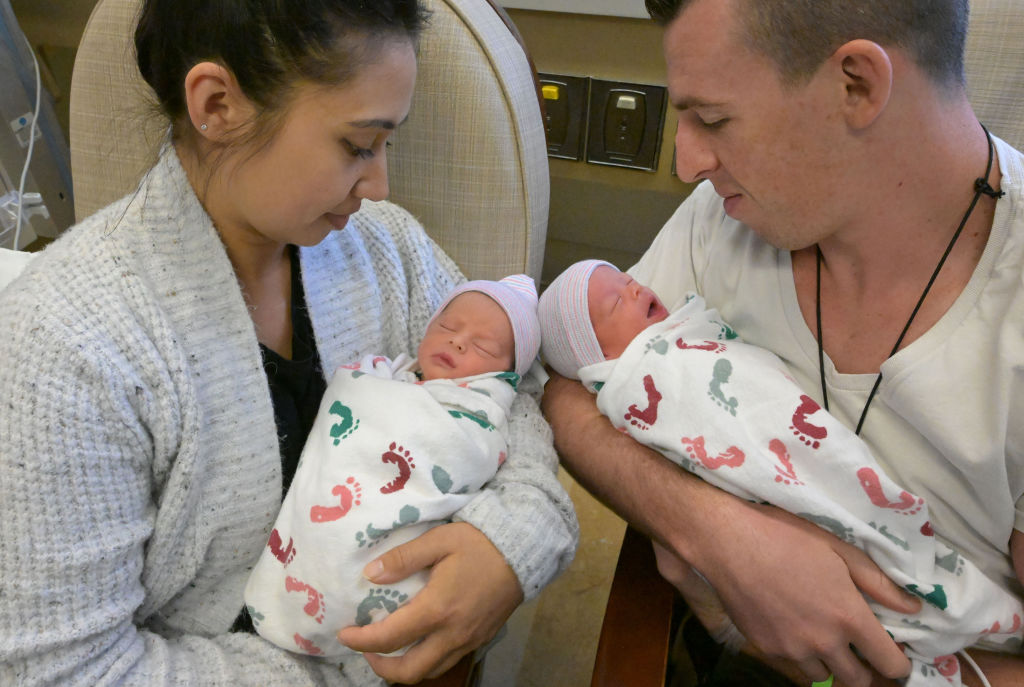
A $2,000 newborn tax credit and a cash-transfer program for pregnant mothers are gaining traction right now. Our divided nation agrees on very little, but we might reach consensus on the simple proposition that paying new parents is a good use of our money. (Brittany Murray / MediaNews Group / Long Beach Press-Telegram via Getty Images)
If you scan social media, the conversation about American families seems like a cesspool: arguments abound over whether podcaster Alex Cooper’s pregnancy is hypocritical, whether “girlbosses” are to blame for America’s declining birth rate, and whether environmental toxins are sending teenagers’ sperm count plummeting. Beyond the rage-bait, however, positive momentum is building around an idea that will actually help new parents and their children: just pay them.
A few weeks ago, Democratic Reps. Tom Suozzi and Debbie Dingell, and Republican Reps. David Valadao and Blake Moore introduced the Supporting Newborn Parents Act. The Act would create a new, fully refundable $2,000 tax credit that parents could get immediately upon having a child. It’s designed to be as seamless as government benefits can be: parents would apply for the credit in the hospital at the same time they’re filling out their newborn’s paperwork for getting a Social Security number. The Social Security Administration would then relay the relevant information to the Internal Revenue Service, which would promptly send a payment.
This approach helps parents right when they need it rather than making them wait until tax time or go through an onerous separate application process. As Leah Sargeant of the Niskanen Center think tank has written, “A newborn credit allows parents to receive a timely family benefit just as they hit the financial shock of a baby. In the months following the birth of a child, families see their household income drop by 10 percent on average. At the same time, their expenses surge.”
The proposal is also well-calibrated for a period of what is likely to be divided government for at least the next two years and seems designed to avoid any dead-on-arrival pitfalls. For instance, the price tag is arguably modest ($6.4 billion a year), especially stacked next to the cost of, say, Donald Trump’s Iran war ($16.5 billion per day). And by attaching the paperwork to newborn Social Security forms, there’s a built-in mechanism against fraudulent claims, which should neutralize an increasingly popular angle of attack from the Right. It also phases out for extremely high earners, starting with incomes of $200,000 for single filers and $400,000 for married couples, which isn’t ideal for a left that supports universal programs on principle, but also removes a common excuse for opposing it. Indeed, given the bill’s design and the obvious goodness of helping out new parents, it’s hard to see what objections either party could possibly muster.
And the Supporting Newborn Parents Act isn’t the only parent-support proposal with legs. Last October, Michigan’s divided government passed a budget that included $250 million over three years to expand a program known as Rx Kids. Started by Dr Mona Hanna in the wake of the Flint water crisis, Rx Kids offers all expectant mothers in participating communities $1,500 midway through their pregnancy, and then $500 a month through the first year of the child’s life. It will be in sixty-two Michigan communities by this summer, swift growth for a program that only launched in 2024.
A new study published in the Lancet found that in Flint, the Rx Kids cash led to a drop in preterm births of nearly 3 percentage points, along with significant reductions in low birth weight babies, maternal smoking, and an increase in mothers getting adequate prenatal care. As Hanna told the New York Times, “Moms told us, ‘Because of these dollars, I can take a day off work and pay for gas to go to my prenatal appointment.” Rx Kids is similarly defying traditional partisan line-drawing: in addition to purple Michigan, the legislature in ruby-red Mississippi has begun preliminary explorations of bringing the program there. (Support isn’t universal; Michigan’s Republican House Speaker Matt Hall has called Rx Kids, without evidence, “a complete scam.”)
We should be clear that a $2,000 refundable tax credit or even a $7,500 infusion during pregnancy and infancy is no substitute for transforming the conditions that currently hold back family flourishing. America’s lack of a national paid parental leave law remains a moral stain on the country. We shouldn’t talk about supporting parents without talking about a federal minimum wage that hasn’t budged since 2009, millions of parents and children who lack health insurance, decades of attacks on unionization, and weak labor laws that allow companies to exploit workers via inhumane working conditions and unpredictable “just-in-time” scheduling.
But if politics is the art of the possible, and since Donald Trump is going to be in the White House until January 2029, it’s worth putting some real muscle behind these proposals in hopes that one of them can get over the finish line. America’s families don’t have years to wait on the chance that Democrats may land a federal trifecta and manage to wield it effectively. This need not be an exercise in messaging bills, either: after all, in 2024, the House passed a bipartisan expansion of the Child Tax Credit before it died in the Senate. It’s important to understand that while liberals and conservatives may come to the family policy table from different angles, there is common ground here. Real action is feasible.
While it may be unlikely that the current Congress acts five months before the midterms, now is the time to soften the ground so that the 120th Congress — no matter who controls the House and Senate — can make family support a real priority. That means having some hard conversations about how to pay for these programs, which proposals can actually pass Congress and be signed into law, and how various interest groups can get behind ideas that may not be perfect but will have a meaningful impact for millions of parents and babies.
So let the hyperpartisans on X waste their precious days shouting themselves hoarse about idiotic ginned-up controversies. Those who are serious about helping America’s families start off with a strong, stable base of love and bonding would be much better off figuring out the best way to put money directly in parents’ pockets.