The Gas Station Attendant Is a Poetic Take on Love and Class

Karla Murthy’s new documentary film about her immigrant father’s tumultuous journey up and back down the class ladder turns the mythology of the American dream on its head. It’s a story many native-born Americans will find strikingly familiar.
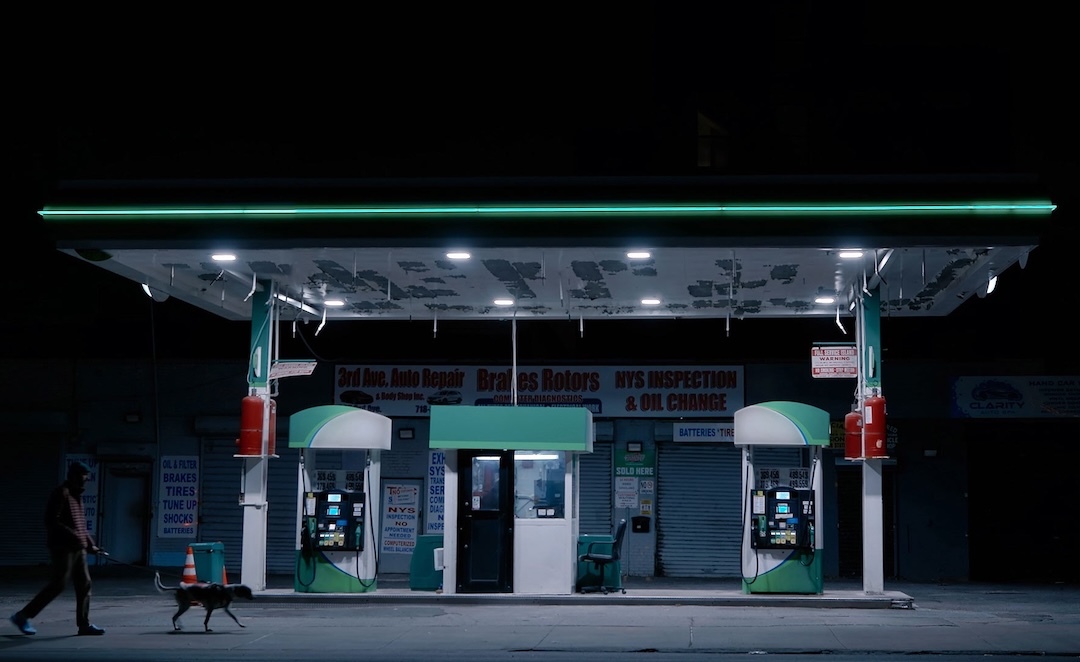
In The Gas Station Attendant, Karla Murthy traces her father’s journey from child runaway to immigrant engineer to overnight gas station attendant, asking a question American culture rarely permits: What does relentless optimism actually cost? (Greene Fort Productions / the Independent Television Service / Firelight Media / Center for Asian American Media)


Two years ago, the summer that he turned seventy, my father worked for his younger brother’s thriving contracting company. Week after sweltering week, Dad tore down ceiling tile, crushed ductwork, and carried heavy industrial air conditioners and other HVAC equipment out of an old school. The building itself was basically a brick oven, and the other laborers were less than half his age. After retiring early from the postal service, my father spent his sixties helping raise his grandkids and pursuing his dream of becoming a Catholic deacon. But that summer, tight finances and the lure of quick cash spoke louder to him than the strain on his joints.

By July, my sisters and I were scheming on how to compel him to quit. When confronted with any of our concerns, Dad responded with his usual refrain, the same thing he’d said when he worked construction in our childhood: “You forget, girls, I’m Superman.”

At a time when thousands of baby boomers are returning to work to make ends meet, Karla Murthy’s new documentary, The Gas Station Attendant, is bound to resonate. It is a powerful film that both honors a complicated patriarch and exposes the fallibility — and fallout — of his American dream. Murthy’s father, H. N. Shantha, would seem to be the poster child for the virtues of extreme bootstrapping: he escaped a life of indigence in India, earned a college degree in the United States, joined the professional-managerial class as an engineer, and provided for a boisterous brood in suburban Houston.

But Shantha’s upward mobility was the result of rare fortune just as much as hard work; and accordingly, when his luck turns bad, hard work isn’t enough. Shantha’s layoff from Boeing early in Murthy’s childhood prompted a series of wildly different occupations: running two Indian restaurants, selling children’s clothes and medical equipment, managing McDonald’s and Denny’s restaurants, opening a gift shop, and then, in his advanced years, becoming a gas station attendant.

American culture can think of little else to do with a story like Shantha’s than to exalt him for his discipline and self-sacrifice. But Murthy takes a different approach, examining her father’s trajectory from a vantage of tender concern and sustained critique. “I was worried, and I wish I didn’t have to worry,” Murthy shares, of her aging father’s overnight shifts. “I started seeing my dad in every gas station I’d pass.”

In The Gas Station Attendant, recordings of their adult phone conversations are played over static long shots of lonely petrol stops. Murthy juxtaposes archival footage from her happy, if financially precarious, childhood with footage of her own family flourishing in Fort Greene, Brooklyn. The film is enriched by the fact that so much of its footage comes from the tail end of the analog era, a time when recording one’s loved ones took patience and attention, not just a flick of a finger on a screen.

Shantha is a natural raconteur, and his affectionate pride in his daughter is palpable. But Murthy’s own success isn’t offered as evidence that her father’s labor was all worth it. Rather, the film consistently asks of Shantha’s relentless toil, “At what cost?” Not only for her father, but for every working-class immigrant family whose labors and troubles are eclipsed by the enduring myth of meritocracy.

While The Gas Station Attendant will likely strike a chord with the children of immigrants, perhaps especially those of South Asian descent, the film also speaks to the fundamental instability of middle-class American life and the psychological humiliations endured by those who once prided themselves on their ability to provide. As a ten-year-old runaway in Bangalore working for pennies and sleeping on the streets, Shantha’s early years looked radically different from those of most Americans. But he went on to live a story of American economic precarity and downward mobility that many of us will find astoundingly familiar.

By the end of the film, I saw my own father in Shantha, not because they share the same background but because they share a quiet, sometimes bewildering optimism — and a work ethic that can at once inspire and unsettle. “Here at least I have a hope,” Shantha tells his daughter, but it’s clearly a hope that often doesn’t come to fruition despite his best efforts. Upon learning that her parents put some of their debts in her name, Murthy admits to an indignation to which many an elder millennial or Gen Xer can relate, an anger laced with guilt at feeling ungrateful.

Few documentaries focus on class as much as identity, let alone acknowledge that a parent’s financial decisions can leave a fraught legacy. By the end of The Gas Station Attendant, Shantha’s life is a luminous testament to the depth of a father’s love but also a clear-eyed indictment of a system in which so many work themselves to the bone well past their prime.

For my father’s seventieth birthday, I planned a surprise party at an outdoor municipal theater playing his favorite musical, Fiddler on the Roof. One after another, loved ones living long distance filled the red plastic chairs on the mezzanine before the show. When asked later that night what he thought of the event, he replied, “It wasn’t just the perfect day. It was a miracle.” He finally quit the construction job later that week.

Share this article

Contributors

Eileen G’Sell is a poet and critic with recent contributions to the Baffler, Current Affairs, Hyperallergic, and the Hopkins Review, among other publications. She is a 2023 winner of the Rabkin Foundation Prize in arts journalism and teaches at Washington University in St. Louis. Her most recent book, Francofilaments, was published in late 2024.

Filed Under