How Döner Workers Skewered Their Bosses
Döner is one of Germany’s favorite fast-food meals, but workers processing the meat for the skewers are badly paid. Now they’ve won their first ever collective agreement, after a 12-day strike waged by a multinational workforce.
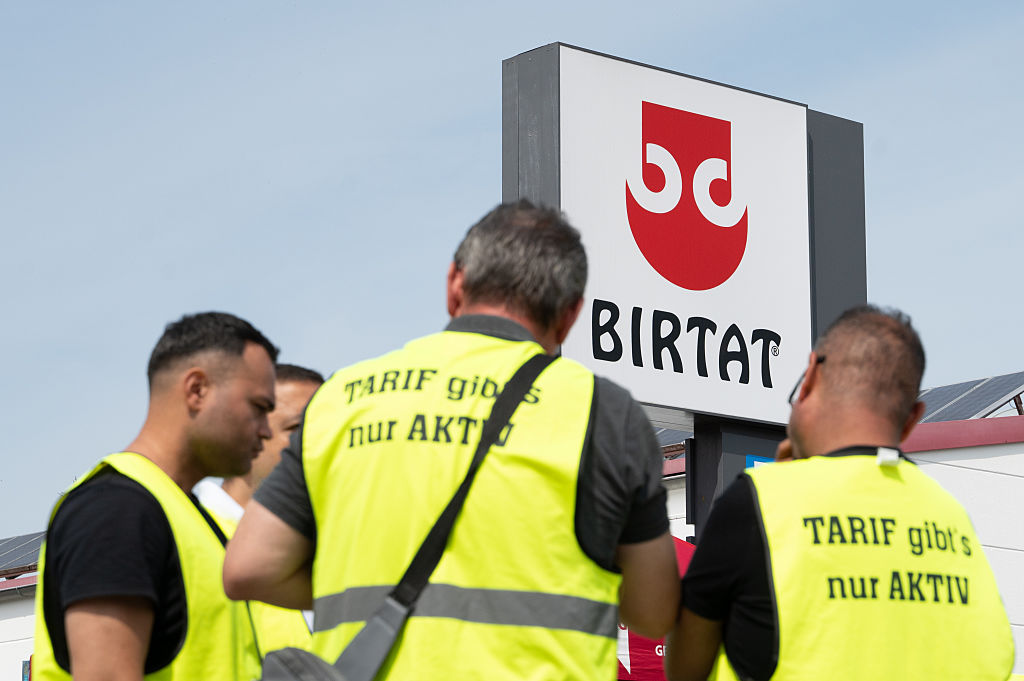
Strikers stand in front of the Birtat factory in Baden-Württemberg, Murr, Germany, on August 6, 2025. (Markus Lenhardt / Picture Alliance via Getty Images)
- Interview by
- Nicola Quondamatteo
Labor recruitment in postwar West Germany drew in millions of “guest workers” from Turkey, Italy, Greece, and elsewhere — and they also brought their culinary traditions with them. From Turkey, the döner, adapted to German tastes and marketed as an affordable street food, became a favorite in the 1970s. It was eventually enshrined as one of the country’s favorite fast-food meals.
To this day, the meat for the iconic döner skewers is often produced in migrant-dominated factories. One example is Birtat, a company that has manufactured these skewers for more than thirty years and claims to serve 13 million consumers every day. Yet unlike in Germany’s great metalworking industries, where migrant workers helped build strong union structures, this sector remained largely unorganized. Until 2023, no German döner meat producer had a works council or a collective bargaining agreement.
This changed at a factory in Murr, near Stuttgart, employing more than two hundred workers of Turkish, Kurdish, Romanian, Bulgarian, and Afghan backgrounds. The Food, Beverages and Catering Union (NGG) successfully organized the workforce and won the first works council election (representing employees in discussions with management). After an indefinite strike, lasting for twelve days, it secured the industry’s first collective agreement. In an interview for Jacobin, Nicola Quondamatteo spoke with Peter Schadt, an active supporter of the campaign, about how this success was achieved.
Nicola Quondamatteo
How did the struggle at the Birtat kebab factory begin? What were the reasons driving this, and what was the spark that caused everything to explode?
Peter Schadt
From the first conversation with NGG in December 2023 to the collective agreement in August 2025, not even two years passed. So overall, we are talking about a relatively short period. Before the winter break [in 2023], the first colleagues from Birtat approached my colleague Magdalena Krüger from NGG. The workers reported a lack of codetermination [Germany’s institutionalized system of elected worker representation on company boards] and unequal pay for workers doing the same work. Women were paid less than men, Romanians and Bulgarians less than other ethnic groups, and so on.
In addition, there was a culturally and linguistically diverse workforce. In a company with around 120 employees, Turkish, Kurdish, Romanian, Bulgarian, and Afghan colleagues work together. There is hardly a common language; many can only communicate within their respective communities. Accordingly, our initial assessment of the prospects for union organizing was rather sober. Magda made it clear to the workers that this would be a struggle with an uncertain outcome, and that they should think carefully about whether they really wanted this.
After the winter break, in early 2024, they came back to our union office. That laid the decisive foundation for turning an apparently impossible case into a possible one: active union members in the workplace who were willing to change things. And there was more than enough that needed changing.
Nicola Quondamatteo
How did the union manage to organize a strike among such an international, diverse workforce?
Peter Schadt
On the one hand, we had colleagues who wanted to establish a works council [company-level representation of workers] and who spoke little German but spoke Turkish and Kurdish. This allowed us to establish initial contact between the union and these communities. At workplace assemblies and especially during the strikes, colleagues with language skills became crucial and were approached by us in a targeted way. They passed on information and explained what was at stake.
One example: young female colleagues in particular took on responsibility, such as Andreea Olariu. We spoke with workers in German, this was then translated into Turkish and Kurdish, and Andreea translated it again into Romanian. These translators did not just overcome language barriers at union meetings; they also brought in the concerns and demands of their communities. For the Bulgarian colleagues, this role was taken on by Ivanka Ivanova, for example.
What initially appeared to us as a huge problem — how to organize a workplace where more than four languages are spoken — ultimately became an advantage, because many workers realized that they themselves could make an important contribution and accordingly took on responsibility.
Nicola Quondamatteo
How was the struggle handled in the media? Were alliances sought with organized civil society, or did it take an interest in the struggle of its own accord?
Peter Schadt
The longer the labor dispute lasted, the greater the public attention became. On social media, not only was the strike widely shared, but especially Hayrettin Bozkurt with his drum and all the colleagues dancing to it. This drum is usually played at Kurdish weddings; now it has also become a symbol of the strikers at Birtat in Murr.
Several videos from the strike were viewed more than half a million times.
By August, many major and smaller media outlets were reporting on the strike — from Tagesschau [the public broadcaster’s news program] to FAZ to TAZ [two major national newspapers]. The reporting often followed the narrative that the struggle for a collective agreement would “make döner more expensive.” This calculation is wrong. I had already written about this in the German Jacobin magazine, and even the employer emphasized this in a press statement at the end of the negotiations. However, none of this was taken up by the media.
Nevertheless, the extensive coverage strengthened the strikers. Alexander Münchow, a staffer for the NGG union, spent days issuing press statements to counter this narrative and used public attention to advance the union’s positions. This attention also generated a great deal of solidarity, regardless of how poor the press coverage was. Civil society had already provided significant support beforehand, for example, migrant organizations such as DIDF [Federation of Democratic Workers’ Associations, mainly Turkish and Kurdish], whose representative Ali Çarman was present at the strikes almost every day. His photographs were exhibited at the trade union building in Stuttgart in April and May.
At the peak of attention, we were also able to use it very concretely: within forty-eight hours, I raised €10,000 through a private donation campaign, which was crucial. When new workers were hired during the strike, the workforce spoke to them and successfully convinced them to join the strike action immediately — although they were not yet entitled to strike pay because they were not union members. In this way, we were even able to make use of negative media coverage.
Nicola Quondamatteo
What were the stages of this struggle, and what results were achieved?
Peter Schadt
There were several stages and some setbacks. Even the path to electing a works council was difficult. The election finally took place in September 2024 after several failed attempts. However, the union-backed list lost, and instead the list supported by management won. Interestingly, this was not the end of our struggle.
NGG offered training for the works council. Cihangir Dikme, a former works council chair and now an adviser and lecturer in works constitution and labor law, led these trainings and succeeded in bringing representatives of both lists closer together. Eventually all works council members joined the union. Thus, what initially seemed like a defeat was turned into a victory.
Although the union list had only won three of the seven seats, the works council now stood united after the seminars. It soon became clear that not all problems could be addressed through the works council. The next goal was a collective agreement. On this basis, a new unity developed among the workforce.
After forming a bargaining committee, the first negotiation took place in March 2025. The employer was not unwilling to negotiate but attempted to exclude NGG, preferring to negotiate only with the works council. Negotiations dragged on, partly because the employer changed legal representation between sessions. The divide between the bargaining committee and workforce on one side and the employer on the other deepened.
By this point, communication within the workforce worked very well, especially through trusted representatives in the different communities, and mutual trust had grown strong. The bargaining committee made its position clear: it had a mandate to negotiate a collective agreement, not a works agreement. All signs pointed to confrontation.
The first major warning strike lasting four hours took place on May 22, 2025, followed by further warning strikes in the following weeks. A major strike phase of six consecutive working days took place from July 18 to 25. By the end of July, there had already been ten strike days in total, while the employer also increased pressure.
The strikes usually took place in front of the factory gates. During heavy rain, the workplace chaplain Christian Gojowczyk quickly organized a nearby parish hall. The strike program also regularly included loud demonstrations in Murr and Ludwigsburg. In Ludwigsburg, the result of the ballot at the end of July was announced: NGG members voted unanimously for an indefinite strike.
Despite many obstacles, the strikers remained determined. After twelve strike days and a negotiation marathon lasting more than twelve hours, the time had finally come on August 7: the first collective agreement in the döner meat industry was concluded.
Nicola Quondamatteo
Beyond the issue of working conditions, did you as a union engage with the spheres outside work (such as housing issues or discrimination in public spaces) affecting these migrant workers?
Peter Schadt
Only indirectly. For example, housing conditions became an issue during the strike. In the first days, we discovered that many workers were not only employed by Birtat but that the owner was also their landlord, as he owned several properties in Murr. This naturally created additional dependency and fear.
Furthermore, during the strike, workers were picked up directly from their homes and driven to work. The next day, we placed pickets in front of their homes to prevent this.
We also found that Afghan colleagues who commuted by bus faced a similar issue: the company knew which bus stop they arrived at and attempted to intercept them before they could reach our strike meeting point, pressuring them to return to work. This only succeeded once: after that, we also placed pickets there.
Although we therefore “only” focused on organizing workers in the workplace, issues such as housing conditions and access to — or lack of — mobility clearly played an important role.
Nicola Quondamatteo
Is NGG organizing other disputes or campaigns related to migrant labor in this region or nationally?
Peter Schadt
Germany is a country of immigration; therefore, almost every labor struggle also involves migrant workers. Birtat is an exception in that hardly anyone in the workplace spoke German, but in disputes such as those at [app-based food delivery firm] Lieferando it is also common that many workers can only be organized in Arabic or other languages.
As a trade union secretary at the German Trade Union Confederation (DGB) [the umbrella organization to which NGG belongs], I would also point to other unions: last year, for example, I was in Nürtingen [a town near Stuttgart in southern Germany] on strawberry fields together with the unione IG Bauen-Agrar-Umwelt to check compliance with minimum labor standards. We knew that many workers came from Romania and brought colleagues with relevant language skills. However, on site we discovered that most strawberry pickers were from the Hungarian-speaking part of Romania. So, it never gets boring.
Nicola Quondamatteo
At the federal level, a few years ago a law was introduced to limit outsourcing in the meat industry. How would you assess its concrete effects in the workplace? What challenges are there still in ensuring the protection of workers’ rights?
Peter Schadt
At Birtat, we were not dealing with subcontracting. This is an industry that, until now, has largely operated without collective agreements and, to our knowledge, without works councils. Regular jobs were already so poorly paid that this particular form of wage dumping was not even necessary.