Toy Story 5 Takes On the Existential Dread of Big Tech
A kids’ movie about tech addiction and the terror of being obsolete? Of course Toy Story 5 is a hit — we’re all living through it.
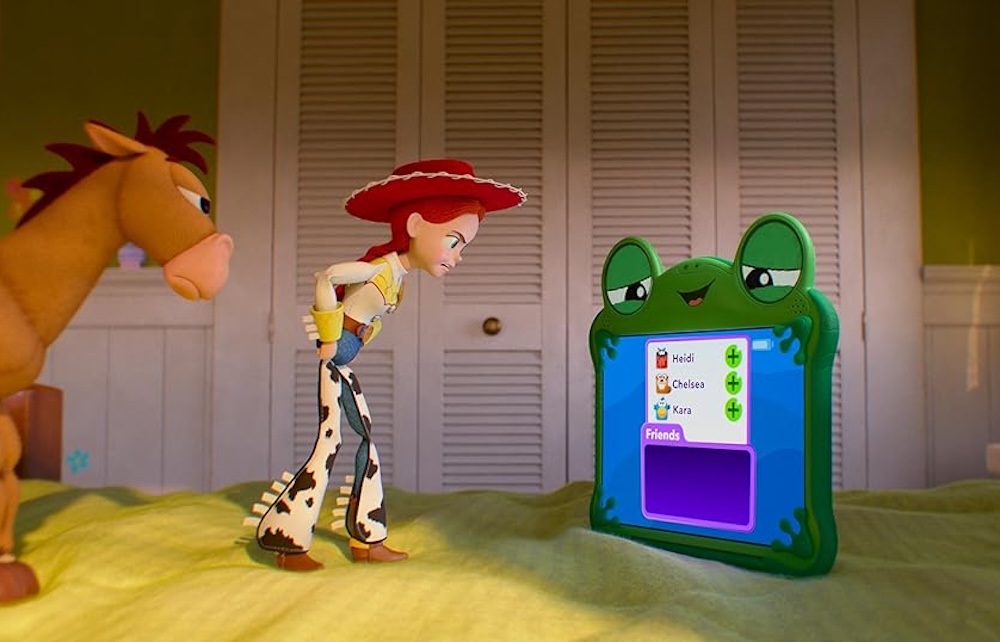
Toy Story 5 proves the two Hollywood genres still minting money are horror and kids’ movies — both coping mechanisms for a collapsing world. (Walt Disney / Pixar Animation Studios)
The biggest hit of 2026 so far, Toy Story 5 has made a whopping $160 million internationally, topping the opening weekend numbers of all previous super-popular Toy Story movies.
And for those of you wondering why a Toy Story 5 even exists, when there was so much speculation about Toy Story 4 as the unnecessary coda to the perfectly realized Toy Story trilogy — oh you adorable dreamer, you. As long as there’s a dollar yet to be made, there’ll be Toy Story movies. Disney doesn’t leave money on the table.
Directed by Andrew Stanton (Finding Nemo, Wall-E), who had a hand in writing but not directing all the previous Toy Story movies, Toy Story 5 brings cowgirl Jessie (Joan Cusack) to the fore as the main character suffering existential agonies as yet another kid gets ready to abandon her for a shinier new toy of some kind. That’s basically the plot of every Toy Story movie going back to the first one in 1995, when cowboy Woody (Tom Hanks) was Andy’s favorite toy until the boy’s birthday came around and he got the spiffy new astronaut Buzz Lightyear (Tim Allen).
The older toy always points back nostalgically to some faux-wholesome agrarian past of traditional American values, fed through self-deluding 1950s ideology, which is the hill Disney and Pixar intend to die on. Then, as the child grows up, that plaything gets replaced by a new toy pointing toward the high-tech future.
Toy Story 5 begins with a Buzz Lightyear doll waking up on a desert island where a whole shipment of Buzz Lightyear action figures has apparently fallen from a plane. As they all awaken, knowing only what “Mission Command” has programmed into them, they must once again determine for themselves what their purpose in life is, free of cultural contact. It’s a process all toys in the franchise go through, and it’s particularly horrible for the toys abandoned by children they’ve dedicated themselves to. They all question their own identities and get waylaid by anger and despair. Then they eventually recover their true purpose in the universe, which is to sacrifice themselves to the child’s happiness, no matter how short-lived their own time in the sun when the child actually cares for them or remembers their existence.
It’s actually a creepy vision when seen through the eyes of the slavishly devoted toys. Over the years we’ve seen them tortured, maimed, and subjected to monstrously sadistic experimentation — toys abandoned at barbaric daycare centers where hordes of rampaging kids pummel and destroy them; toys kept sealed in airless original packaging by weirdly obsessed collectors; toys tossed unceremoniously into dumpsters and garbage trucks; toys gathering dust in closets; toys forgotten outdoors for years on end, partially buried in dirt, their plastic colors faded by the sun, turned worn and gray by long exposure to the elements. In Toy Story 5, many of the favorite characters from the franchise — including Rex the Dinosaur (Wallace Shawn), Mr Potato Head (Jeff Bergman taking over for the late Don Rickles), Slinky Dog (Blake Clark, replacing Jim Varney who died shortly after the second film), and Hamm the piggy bank (John Ratzenberger) — spend almost the entire movie in a cardboard box in a dark garage awaiting disposal.
And the Pixar animators and storytellers, all very talented and inventive, find innumerable ways to explore the harrowing lives of toys before having to find some specious way to make it all heartwarming by the end. Toy Story 4, which definitely got more mixed reviews than the other fulsomely praised films, was a movie I loved for the way it plunged into black humor through one toy’s state of existential horror. It featured the character of Forky (Tony Hale), a plastic spork used to create a homemade toy by kindergartner Bonnie, who adorned him with skewed, tormented features and twisted pipe cleaner arms. “Forky shouldn’t be!” he’d moan before hurling himself suicidally into another garbage container, only to be rescued again by a duty-bound Woody.
Toy Story 5 is a less risky, more sentimental sequel, though by putting Jessie the cowgirl at the center of the story, it’s really pushing the masochistic devotion of toys to the utmost. Jessie has already been through the wars. We get the recap of her history that was laid out in earlier Toy Story movies. Back in the 1950s she belonged to Emily, an outdoorsy, cowboy-booted, horse-riding girl on a ranch. With the naivete of most new toys, Jessie believes that the child’s doting affection for her is a permanent state of bliss. After all, Emily’s written her name and address on the back of one of Jessie’s cowhide chaps, just to make sure she never loses her beloved doll.
The next thing Jessie knows, she’s dumped in a cardboard box and set out by the curb for the donations truck pickup, staring through the slot handle in disbelief as Emily, all indifference to her fate, walks away forever.
By the end of Toy Story 2, Jessie joins Andy’s toy gang, a female version of the Woody cowboy doll. She lives in the suburbs, and outgoing Andy has also written his name on the bottom of one of her boots in black marker. Many bruising adventures later, grown up and college-bound Andy gives Jessie and all his other favorite toys to a neighborhood kid, the shy Bonnie.
In Toy Story 5, when Bonnie (Scarlett Spears) becomes addicted to Lilypad aka Lily (Greta Lee), a frog-shaped kid’s-first-tablet computer, Jessie is left on the floor under the bed day after day. And Jessie has had it: “I just can’t do this again.”
So she sets out to fight this new favorite for the top spot in Bonnie’s heart, through both direct attack and sneaky plotting. And Woody — now going bald and developing a paunch — shows up to help her, along with his longtime love Bo Peep (Annie Potts) and the occasional assist from Duke Caboom (Keanu Reeves).
Jessie banks everything on her superior knowledge of Bonnie, which will enable her to help the shy girl make friends, even though Lilypad has access to vast numbers of potential friends through the internet. Blaze Manoukian (Mykal-Michelle Harris) is the new pal Jessie chooses for Bonnie, but it takes complicated schemes to get the two together. For one thing, Jessie needs help from Blaze’s old computer toys, unearthed from a drawer: Smarty Pants (Conan O’Brien), a toilet-training toy with a wealth of potty humor to offer; Snappy (Shelby Rabara), a ditzy camera; and Atlas (Craig Robinson), a friendly GPS in hippo-head form.
Hectic plotting, hijinks, and elaborate, fast-paced chase scenes ensue. If it seems just a bit tired, that’s because we’ve already seen four Toy Story variations. This one mainly differs in its more alarmist tone, because it’s impossible to downplay the impact of the digital world on children who get addicted to their screens at earlier and earlier ages. Long panning shots scanning Bonnie’s neighborhood show us a sea of children sitting inside their homes, each one alone, hypnotized by the lit-up screens on their personal devices.

“I don’t know, Jessie,” says Woody. “Toys are for play, but tech. . . . is for everything.”
However, like the other films in the franchise, Toy Story 5 has to find a way to reconcile the old with the new. After Bonnie gets mocked by the friends she chats with on the internet because of her love of old-school toys, Jessie and the digital gadgets guide her to Blaze, a playmate who also loves to use her imagination augmented by toys. Their multicharacter, hilariously melodramatic imaginary games are shown to us in sketchy 2D-animated style, looking like rough drawings colored with children’s crayons.
So the lesson is all about the value of play for children (and by implication, adults who would still like to enjoy life a bit), and the fear is that in a computer-crazed world, “playtime is over.”
Isn’t it interesting how the two most surefire genres still hauling in huge profits at the box office are horror films and family-friendly kids’ movies? One genre encourages us to wallow in our totally justifiable terror of everything happening in the world, while the other hints at troubles, instabilities, and patches of darkness, only to then flood the screen with reassurances.
The universe is actually quite stable! And darn cute if you look at it the right way! And we’re all gonna be just fiiiiiiiiiiiiine.