Class War on the Red Carpet
The Cannes Film Festival might seem like an elite event, but it has deep roots in anti-fascism and the labor movement. Its early history in the years after World War II tells us how cinema can truly belong to the working class.
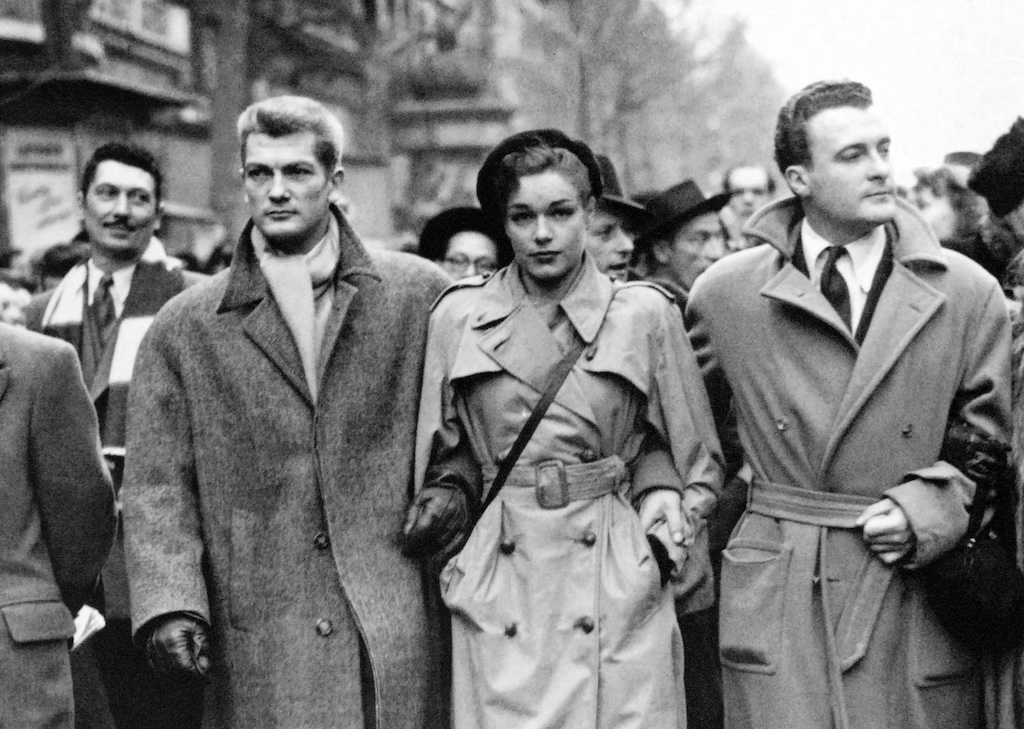
From left, French actors Jean Marais, Simone Signoret, and Roger Pigaut attend a demonstration to protest against the invasion of French screens by US films following the so-called Blum-Byrnes agreement in Paris on January 4, 1948. (AFP via Getty Images)
- Interview by
- Raphaël Martin-Dumazer
The Cannes Film Festival might sound a world away from socialist politics. Yet it has a far more radical past than the glitz and glamor of today’s red carpet might suggest.
Tangui Perron is a historian specializing in the connections between the labor movement, trade unionism, and film. In his latest book, whose French title reads Red Carpet and Class Struggles, Perron tells of how the General Confederation of Labor (CGT) union federation, the French Communist Party (PCF), and the Left emerging from liberation from Nazism in 1944–45 shaped the festival’s origins.
In an interview with Le Vent se Lève’s Raphaël Martin-Dumazer, historian Perron discusses the festival’s roots, French cinema’s battle to defend itself from Hollywood, and how the cultural values of the postwar years survive even into the present.
Raphaël Martin-Dumazer
How did the idea for this book, dedicated to the links between the labor movement, the CGT, the PCF, and the Cannes Film Festival, come about?
Tangui Perron
In the 1990s, I was working at the CGT Institute of Social History in Montreuil. I often heard this somewhat mythical story circulating there: “The CGT created the Cannes Film Festival.” Some believed it wholeheartedly; others had never heard of it. This legend intrigued me.
At the time, I had helped organize an exhibition on trade unionism and cinema, presented at the Seine-Saint-Denis department’s archives, then at the Cannes Film Festival. I took the opportunity to consult archives in Nice, particularly those of the CGT locally, where I discovered fascinating documents on Virgile Barel, a Communist MP from that city, and on the festival’s early days. I then wrote a first article on the subject, without intending to go any further.
A few years later, upon the publication of the multiauthor volume L’Écran rouge, I contributed an article on the Cannes festival, drawing on some of these archives. The unexpected success of this book revealed a genuine interest in the history of the relationship between cinema, trade unionism, and politics. Then the publisher suggested that I write a short book entirely devoted to the links between the CGT and the Cannes Film Festival. The idea was to produce a short, accessible work that would recover the memory of these historical links.
In writing this, I could make something coherent from my research, discover new figures, and, above all, address one key question. I wanted to understand how the defense of French cinema (through the battles around the Cannes Film Festival in 1947 and the Blum–Byrnes trade agreements between the United States and France in 1948) fitted into a broader, more continuous political and cultural story. I probably couldn’t have done that without going back into the archives.
Raphaël Martin-Dumazer
What was the postwar political and diplomatic context that allowed for the creation of the Cannes Film Festival?
Tangui Perron
The postwar climate was both unstable and steeped in historical legacies. There were strong commitments to anti-fascism and patriotism but also old tensions resurfacing. It’s impossible to understand the birth of the Cannes Film Festival without considering this political context.
We know, thanks to Olivier Loubes’s work Cannes 1939, that the first project, in 1939, was meant as an anti-fascist counterfestival, a response to the Venice Film Festival, which had become a showcase for Benito Mussolini’s regime and Nazism. That 1939 festival never took place because of the war, but everything was ready: the poster, the selection, the organization. Paradoxically, we know more today about the political history of this aborted festival than we do about the actual launch in 1946–47.
The 1939 project was based in the liberal anti-fascism championed by Western democracies. But by 1946–47, the political and symbolic landscape had changed markedly: this was the postwar era, the liberation from Nazi occupation, the Allied victory, and the rise of the labor movement and the Communist Party, which had a strong presence in southeastern France. In Nice, the Communist MP Virgile Barel played an important role, and, more surprisingly, a Communist MP, Henri Pourtalet, was also elected in Cannes (in 1936), faced with a divided right-wing camp. The region thus became a left-wing stronghold, while the local right remained dominated by the far right. Cannes’s mayor, Raymond Picaud, was not a PCF man, but he can be considered a fellow traveler. A doctor, patriot, and social philanthropist, after World War I he moved to the working-class neighborhood of Cannes-la-Bocca, where he became a respected figure. He embodied a humanist and progressive left, close to the PCF for his anti-fascism.
This local context is essential: in southeastern France, the fascist threat was very real, also given Mussolini’s expansionist ambitions regarding Nice and Corsica. The climate there remained tense, marked by far-right violence and the presence of an active political police force. After the liberation, this far right was weakened, and the Left believed it could sink lasting roots.
The 1946 festival was presented as a celebration of the Allies, an event that was both glamorous and popular, intended to revive the local economy and tourism while honoring the Resistance. The film La Bataille du rail (René Clément, 1946), produced by the General French Cinema Co-op — a cooperative launched in part by the CGT — received two major awards there. This sent a strong signal: the cinema of the people, the cinema of the Resistance, triumphed in Cannes. The context in 1946 was thus unusually favorable: a left-leaning city, a Communist-run department, a powerful CGT, and a national government that still had PCF ministers.
But this harmony would be short-lived. Already in 1947, the arrival of the Cold War upended this political balance and brought this interlude to a close.
Raphaël Martin-Dumazer
What was unique about the second edition, in 1947? How did the population get involved in building the Palais des Festivals?
Tangui Perron
In 1947, the working people of Cannes rallied behind their mayor, Picaud, and his PCF deputy mayor. Both were driven by a genuine collective momentum. For the state, this was a diplomatic question: regaining a foothold on the international stage. Locally, it was a reconstruction project: to revive tourism, to prove that the city was capable of rebirth and of shining once more. But this enthusiasm was not universally shared; a segment of the local bourgeoisie, with the exception of the hotel industry, viewed this festival — supported by the Left and the unions — with suspicion. In 1946, the festival was still an “Allies’ celebration,” a celebration of peace. But in 1947, the context changed radically: the Cold War had broken out, Communist ministers were ousted, and the festival became suspect in the eyes of the national government, seeing it as too left-wing.
Still, the mayor was determined to keep the festival going. Yet to do this, he had to fulfill a promise made to the government: to build a Palais des Festivals. The problem was that the Palais didn’t exist yet. It therefore had to be built urgently. Here an exceptional popular mobilization came into play. At the mayor’s urging, the residents, workers, and young people of Cannes-la-Bocca committed themselves to building the Palais. They worked during the day . . . then returned voluntarily at night. The deadlines were incredibly tight: only four months to build it. It was handed over at the last minute, barely finished but ready to host the screenings. This construction site became a real symbolic battle, of the people of Cannes fighting for their festival. The workers gave their time; materials were scarce, and some were even “borrowed” here and there (they fell off the back of a truck, it was said). The city’s seamstresses pitched in to decorate the hall and sew curtains.
Figures such as Fernand Grenier, vice president of the National Assembly and responsible for the film industry, lobbied the government to secure materials.
In short, the 1947 festival was a profoundly popular, activist event. It had no international status that year; American stars were absent, but French ones took center stage. Against the backdrop of the emerging Cold War, the festival became an act of cultural resistance against the hegemony of US cinema, foreshadowing the major battles to defend French cinema in 1948.
Raphaël Martin-Dumazer
The Blum–Byrnes agreements of 1948 were a turning point in the fight for French cinema’s independence. What they were about, and who mobilized?
Tangui Perron
The Blum–Byrnes agreements, originally signed in 1946, were an economic agreement between France and the United States, negotiated by Léon Blum and James Byrnes. Officially, the aim was to settle the war debt and organize US loans to France. However, hidden in an annex to these agreements was a clause with decisive consequences for French cinema: the near-total opening of French theaters to American films, with quotas heavily favoring Hollywood.
During the war, Hollywood had been operating at full capacity, while European countries had restricted imports of foreign films. Upon liberation, American studios thus had a colossal stockpile of films to sell on European markets. Conversely, French studios came out of the war hobbled, lacking both resources and energy. Coal, for example, was reserved for heavy industry or heating, not for film production. In this context, US producers pressured their government to ensure that the agreements would impose quotas on French films, not American ones.
In short: the French market opened up massively to Hollywood cinema. In 1946, the CGT’s Entertainment Federation warned of the danger of this clause, but the reaction was still muted. A major mobilization began a year later, in 1947, when the Cold War began and PCF ministers were excluded from the government.
At that point, the PCF changed its strategy. It made cinema a national cause: it was an economically, culturally, and politically vital good that had to be defended against US imperialism. The Communists had long had a fruitful, and strong, relationship with cinema: they saw it as an art “of the people,” a tool for emancipation, and had powerful allies within the CGT, particularly in entertainment and film. Conversely, Léon Blum, though a man of culture, never put cinema front and center: he regarded it as a minor art form, far beneath literature. He was thus prepared to make concessions to repay France’s debt. This prompted a spectacular mobilization, bringing together film professionals, trade unionists, and PCF activists.
It all began in Cannes in 1947, where the festival became the rallying point for this protest. Then in January 1948, the major demonstration by the French film industry took place in Paris: a procession bringing together artists, technicians, and activists, which won over a large segment of public opinion. The movement drew on film clubs and the tradition of the “spectator-citizen,” dear to the Communists: an active, critical, and politically engaged audience. Thanks to this campaign, the film industry managed to rally not only the public but also lawmakers and the government.
This all led, in September 1948, to two major victories: the revision of the Blum–Byrnes agreements, in a way more favorable to French cinema (quotas for US films were partly tightened) and, above all, the creation of the Cinema Support Act, which established a sustainable system of state support for national film production.
This law established the French model: a solidaristic, sustainable system of public financing born out of postwar reconstruction. Thanks to this model, even today, French cinema can hold its own against Hollywood.
Raphaël Martin-Dumazer
What was the Cinema Support Act about, and in what sense does this remain a unique model?
Tangui Perron
This law is based on a principle that free-marketeer liberals have always opposed: solidarity through taxation. In concrete terms, the law establishes a parafiscal tax levied on every movie ticket (originally about 7 percent, around 10 percent today). This tax applies to all films screened in France, including US ones. In other words: American films also contribute to the financing of French cinema.
This mechanism, managed by the National Cinema Center (CNC, founded in 1946), allows these funds to be redistributed to support the production, promotion, and showing of French films. It is not a tax in the traditional sense: by buying a ticket the viewer indirectly invests in national film production. This system also benefits European films and other foreign films through joint productions, despite recent and very worrying budget cuts.
The law belongs to the general postwar trend of social and cultural reconstruction, rather like Social Security or state employees’ employment status. The idea is that the state must give itself the means to pursue a sovereign cultural policy, capable of resisting market logic and US influence.
Over the decades, this model has been enriched and consolidated. In the 1950s–1960s, new mechanisms emerged, such as advance payments on projected revenue, which allowed writers and directors to get funding even before filming began. Then in the 1980s, as the audiovisual and performing arts sectors developed, the system for intermittent workers in the performing arts was expanded. This system, first outlined during the mid-1930s Popular Front era, originally covered a small number of film technicians working on a temporary basis. It gradually expanded, becoming one of the pillars of the social model for cultural workers. Thanks to this system, French cinema continues to exist and to renew itself. It is sometimes criticized, but it endures, which is no longer the case for many of Europe’s other national film industries.
But this legacy is now under threat. Certain political factions, notably Marine Le Pen’s Rassemblement National and part of the Right, have recently proposed dissolving the CNC or eliminating its subsidies. This is not merely a budgetary debate: it is an ideological project, a desire to do away with an anti-free-marketeer, solidarity-based model that breathes life into cinema and popular culture.
In short, the 1948 subsidy law, the creation of the CNC, and the system for intermittent workers form the pillars of a unique model, born of the liberation and still at the heart of French cultural resistance.
Raphaël Martin-Dumazer
Today, can we still find traces of this popular and political ideal at the Cannes Film Festival?
Tangui Perron
There are still some traces, and we absolutely must preserve them. For example, the CGT is still a member of the festival’s board, as is the International Federation of Actors. This represents only two out of thirty-odd seats; the state, local authorities, and producers hold most others. But this representation is important: it recalls the festival’s social origins and provides a foundation for drawing attention to certain excesses or abuses.
Still, we shouldn’t delude ourselves: money and US influence now hold overwhelming sway. The festival is increasingly overrun by marketing, brands, and major studios. The massive influx of Hollywood, its stars, and its economy has profoundly transformed the event. There is sometimes something obscene about this deluge of luxury. Cannes has become an extremely expensive city, marked by real estate speculation. For the working class, it is now very difficult to find housing there, even outside of festival time. Many year-round residents face enormous pressure. Access to the festival, which was once intended to be open to all, has become highly restricted, professionalized, and secured to the extreme. The right to protest has become impossible on the Croisette [shorefront boulevard] and very difficult in the rest of Cannes.
On the cinematic front, however, the selection remains demanding, the juries are independent, and there is still a real aesthetic and intellectual resistance. The parallel sections, such as the Directors’ Fortnight and Critics’ Week, often feature films that are more daring and more political than the official selection.
Raphaël Martin-Dumazer
The link between culture, cinema, and left-wing activism seems to have weakened. Do you think it can be reinvented today?
Tangui Perron
I’m not going to sugarcoat things: the situation is rather troubling. Political parties have lost much of their aura, their cultural roots, and their effectiveness. There are, of course, elected officials and activists (particularly in the Communist Party and France Insoumise) who continue to work seriously on these issues. But overall, we’re seeing a decline in public officials’ cultural and political awareness and a growing disinterest in culture.
For sure, they operate under constrained conditions: the state has tightened its control and reduced local governments’ financial leeway. Many local elected officials find themselves caught between an impoverished population and an increasingly technocratic and authoritarian state.
In the postwar years, the PCF put into practice real municipal-level cultural policies: the creation of movie theaters, theaters, libraries, swimming pools, and centers for popular education.
Today the focus is often on events rather than culture. But pockets of resistance remain, particularly in Seine-Saint-Denis, where public cinemas continue to screen challenging films at low prices, and where audiences turn out in force.
Still, something new is emerging today: a young, politicized cinephilia that we haven’t seen since the 1980s. In the Parisian suburbs and certain rural areas in particular, independent cinemas are doing remarkable work: cut-price screenings, discussions, meetings with directors. . . . Audiences gather, exchange ideas, and experience cinema collectively. This sharing of the screen and the conversation is something essential, and it is still going. France did not invent cinema, but it undoubtedly invented cinephilia: a way of watching films, debating them, and thinking about them politically without reducing them to militant discourse.
This tradition has not disappeared; it could even become the starting point for a new generation of engaged viewers.
On the union front, there are also encouraging signs. The CGT Entertainment Federation is doing well, and organizations like the Union of Professionals in the Audiovisual and Film Industries (SPIAC) are recruiting many young workers. This is rare in French labor overall, as most unions are losing members. Today journalism and intermittent workers in the performing arts are among the few sectors where trade unionism is making headway. So, there are still pockets of resistance, even if the overall power balance is still tilted against us. Perhaps civil society is regaining a central role, even if this has not yet translated to the political level.