The Long, Grueling Strike at Henry Ford Genesys Hospital

Nurses at Henry Ford Genesys Hospital in Grand Blanc, Michigan, have been on strike for more than eight months over staffing levels and return-to-work protections. The dispute is one of the longest nurse walkouts in recent US history.
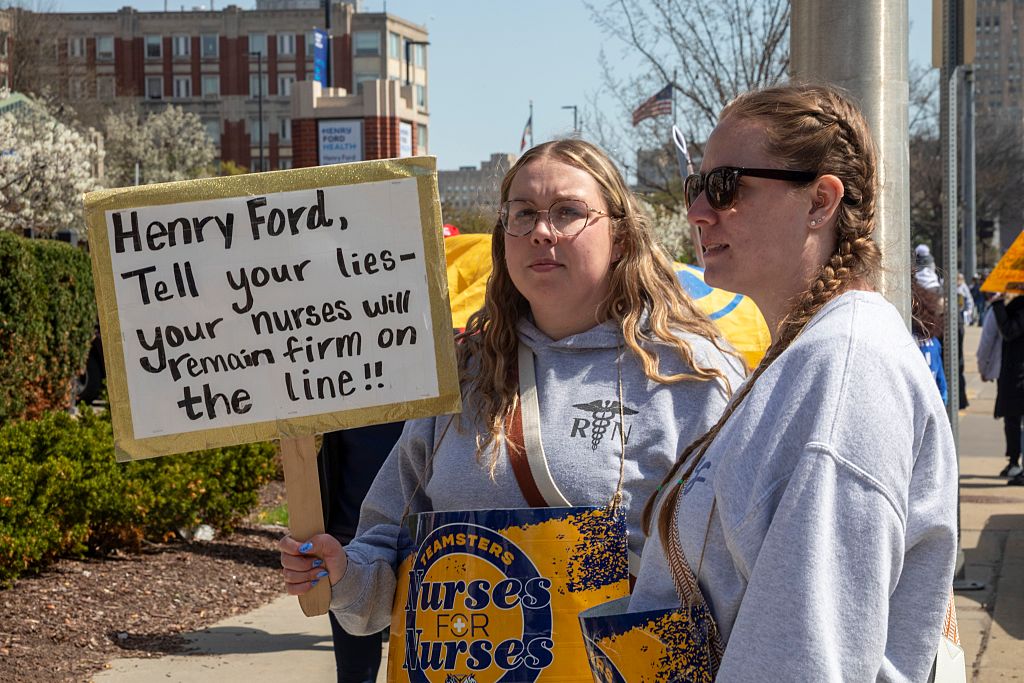
Two nurses on strike, one holds a sign that says, "Henry Ford, tell your lies—your nurses will remain firm on the line!"

Teamster nurses on strike at Henry Ford Genesys Hospital picket the health system’s main campus. (Jim West / UCG / Universal Images Group via Getty Images)


For twenty-nine years, Angela Spohn has worked at the same hospital in Grand Blanc, Michigan, a suburb south of Flint along the long stretch of exurban highway connecting Flint to metro Detroit. She started there in 1997, back when it was still just Genesys Hospital, before mergers and acquisitions folded the roughly four hundred–bed facility into the expanding Henry Ford Health system. She has spent nearly three decades in labor and delivery, helping deliver babies, running assignments, managing crises, and working alongside the same nurses long enough that they can anticipate each other’s movements before anyone speaks.

“We are a very well-oiled machine,” Spohn told me. “I’m doing one thing and my friend’s doing the other, and if I’m doing that thing, she knows what’s coming next.”

Now she sees many of those coworkers on a picket line instead. When roughly 750 nurses and case managers at Henry Ford Genesys Hospital walked off the job on Labor Day weekend last year, the strike centered on staffing levels, with nurses claiming the administration was requiring them to care for far more patients than they could while still providing state-of-the-art care. Intensive care nurses who should have had one patient were taking two, three, or sometimes four. Medical-surgical nurses assigned four or five patients sometimes had ten or twelve. There were nights, Spohn said, when three nurses were responsible for forty patients.

Labor and delivery functioned differently but no less dangerously. Patients who appeared stable could deteriorate suddenly, and nurses were responsible for both mother and baby at once. “You’re responsible for two people, even though one of them you can’t get to very easily,” Spohn said. More than eight months later, the strike has become one of the longest nurse walkouts in recent US history.

The nurses, represented by International Brotherhood of Teamsters Local 332, say the hospital has used the strike to permanently replace experienced nurses and undermine seniority protections. Henry Ford Health denies wrongdoing and says it has acted legally throughout the dispute, arguing that it has maintained safe staffing levels while continuing to negotiate with the union.

Outside the hospital, the strike dragged on through the Michigan winter. Burn barrels and tents became fixtures, much to the hospital administration’s displeasure. Some workers have taken on other jobs. Others remain on strike without health insurance, surviving on strike pay and savings.

“It’s a roller coaster,” Spohn said. “Some days I get up and I’m like, ‘Heck yeah, let’s go.’ Some days I get up, and I’m like, ‘Yeah, I’m not doing it.’”

A bird's eye view of a group of striking nurses.
Henry Ford Genesys nurses holding signs as the strike continues. (Teamsters Local 332)

For Spohn, the difficulties began long before Labor Day. Like many nurses, she traces the deterioration back to COVID, when staffing levels collapsed and hospital management discovered just how much workers could be forced to absorb.

“It was like they just realized what we could do,” she said. “You need ten nurses but you only have four, but hey, you made it! Look at you go!” Instead of staffing back up once the immediate crisis passed, she said, management simply normalized emergency conditions.

By the end, she said, entire shifts felt like exercises in improvisation: nurses registering patients because there were no administrative assistants, cleaning rooms between admissions because there was nobody else to do it, or scrambling to find monitors and equipment that should already have been available. “You just did it,” she said. “We got so used to just being abused. It was like a bad relationship.”

The stress accumulated. Spohn described nights toward the end of the summer before the strike when experienced nurses broke down crying during the end-of-shift report. One morning after an especially chaotic night, she was crying while giving the end-of-shift report; when she looked over at another longtime nurse — someone she described as a “hard ass” who never cried — she, too, was sobbing.

“I used to make it to my car and cry,” Spohn said. “But I never even made it out of the building most days.”

Dashed Hopes

When Henry Ford Health acquired Genesys through its newly combined organization with Ascension Michigan in late 2024, some nurses thought things might finally improve. “We were very excited,” Spohn said. “We thought it was going to be so great.” Henry Ford, unlike Ascension, was local. Nurses hoped that would matter.

“Ascension is a nationwide corporation,” she said. “We just truly felt like we were just a number.”

Henry Ford, by contrast, carried a particular weight in Michigan. The institution traces its roots back to Detroit’s industrial expansion in the early twentieth century. The hospital itself was founded in 1915 amid the rapid growth of the auto industry and grew out of an earlier effort to create what organizers described as “a hospital for the working man.”

The irony is hard to miss. Henry Ford became synonymous with a certain model of twentieth-century welfare capitalism — the five-dollar day for workers, the eight-hour workday, and the promise of stability tied to industrial employment — while Ford Motor simultaneously remained one of the country’s most aggressively anti-union corporations through the 1930s. During the 1937 “Battle of the Overpass,” Ford security men violently attacked United Auto Workers (UAW) organizers distributing leaflets outside the Rouge plant, future UAW president Walter Reuther included. The company became the last of the “Big Three” automakers to recognize the union, finally signing a contract with the UAW in 1941 after years of organizing drives and strike pressure.

A hospital system carrying the Ford name is now locked in a prolonged labor dispute with nurses who argue management is trying to use “flexibility” and operational efficiency to permanently weaken worker protections and reshape the workforce around management prerogatives.

Spohn said nurses quickly realized Henry Ford was not interested in addressing the staffing crisis they had hoped the acquisition might resolve. “They thought they could throw a little bit of money at us and we would forget the fact that we were short-staffed every day,” she said. Henry Ford has publicly maintained that its proposed contract preserved the staffing ratios contained in the previous agreement, while nurses argue those ratios had become effectively meaningless because the hospital routinely operated short-handed anyway.

Negotiations over a new contract dragged through the spring and summer of 2025. Nurses say management refused to seriously negotiate staffing protections and other core issues. The union eventually filed a series of unfair labor practice (ULP) charges with the National Labor Relations Board (NLRB), alleging that management ignored bargaining proposals, altered previous agreements, withheld staffing information, and threatened workers over strike activity. In April of this year, the NLRB dismissed one of those charges, centered on allegations involving health insurance information, while other charges, which led to the ULP strike, remain pending.

Under US labor law, employers are generally permitted to permanently replace workers during an economic strike but not during a strike over unfair labor practices. The unresolved status of the remaining NLRB charges has therefore become central to the dispute over whether nurses can return to their previous jobs, units, and shifts.

The conflict now largely centers on return-to-work rights. Earlier this year, the union and management reportedly reached the outlines of a tentative agreement before talks collapsed over language governing returning strikers. Spohn said management refused to guarantee that nurses would return to the same jobs, units, or shifts they held before the strike.

“The nurses can have a job, but not necessarily their job,” she said, describing the hospital’s position.

In public statements, Henry Ford Health has said it guaranteed jobs for returning workers while continuing to hire during the strike, and that many of the nurses currently working are employees who continued working, returned during the strike, or were hired afterward.

For nurses still on strike, though, the issue is not simply whether work exists somewhere inside the system. It is whether management can use a prolonged strike to permanently reorder working conditions inside the hospital and establish a precedent for future contracts across the health care sector. “If you don’t get it in the contract, we’re screwed from every contract from here on out,” Spohn said.

Striking nurses hold signs in front of a banner that reads,
Nurses gathering on the picket line. (Teamsters Local 332)

The strike has unfolded alongside rapid expansion at Henry Ford Health, whose joint venture with Ascension Michigan doubled its acute-care footprint from five to fourteen hospitals, while the system simultaneously pursues a multibillion-dollar redevelopment project in downtown Detroit. Across the health care industry, hospital systems increasingly frame flexibility and operational efficiency as necessities in an era of labor shortages and financial pressure.

Nurses tend to experience those same changes as the erosion of staffing protections, scheduling guarantees, and workplace autonomy. Spohn said many workers now feel permanently alienated from a profession they once loved. “I don’t want to even do health care anymore,” she said. “I’m freaking over it.”

At the same time, she remains fiercely proud of the people she walked out with. Some workers have crossed the picket line, but many others have simply taken different jobs because they could no longer survive without insurance or a regular paycheck. “If this was just a job to me, I would be gone already,” Spohn said. “This is not what this is.”

Staying Together on the Picket Line

Part of what has kept the strike together are the relationships that formed around it. Across from the hospital sits a small house belonging to Glenn and Shirley Fitzpatrick, an elderly couple who began supporting the nurses shortly after the strike began. When hospital management objected to tents and burn barrels on hospital property, the Fitzpatricks invited the nurses to move everything onto their lawn.

“We took over their yard,” Spohn said, laughing. “We looked like a homeless shelter.”

Then Glenn Fitzpatrick was diagnosed with cancer. Nurses checked on him daily, lined the driveway to cheer him on as he left for treatments, and later attended his funeral after he died last fall. “They were just salt-of-the-earth people,” Spohn said. “You were reminded why you’re doing this in the first place.”

The hospital, she said, matters to the community. Genesee County only has three hospitals, and nurses are not trying to destroy the institution where many of them have spent decades working.

“I want to be proud that I work there,” Spohn said. “I don’t want to feel ashamed.”

What finally pushed many nurses to strike, she said, was the sense that they were being asked to normalize a level of care that neither workers nor patients should accept. “Nobody signed up to give bare minimum care,” she said. “Patients should be mad if you’re the eleventh patient of a nurse who has ten patients.”

The strike has now stretched from Labor Day to Memorial Day. Nurses wait while ULP charges inch through a slow-moving and understaffed NLRB, and negotiations continue intermittently.

“I feel like white noise right now,” Spohn said. “Like nobody cares. It’s been too long.”

But she also described the strike as clarifying, a moment when nurses collectively stopped internalizing the failures of the system around them. “I am not the problem,” she said. “I work my butt off every day for these patients. I am this community.”

The strike has drawn support from some Michigan Democrats, including US Senate candidate Abdul El-Sayed, who appeared at a Lansing rally for the nurses in March alongside other Democratic candidates for statewide office. But despite the strike stretching well past the half-year mark, Governor Gretchen Whitmer has largely stayed silent on the dispute. Henry Ford Health, meanwhile, occupies an increasingly influential position in Michigan’s health care and political landscape as it expands across the state and partners with state and local officials on major redevelopment projects in Detroit.

Nurses and their supporters say patients are not receiving the same level of care while the strike remains unresolved. Luis Martinez, an independent labor journalist who has been reporting from the picket line, recalled recently helping a woman who appeared disoriented and injured outside the hospital after she had been discharged from the emergency room following a car accident.

Martinez said the woman told him she had repeatedly tried to explain to a nurse where an IV could safely be inserted because of damage to her veins from prior drug use, but that she was stuck “dozens and dozens of times” before another nurse finally listened to her and inserted it successfully. The woman, Martinez said, was wandering outside wearing a patient gown while still complaining of severe pain and waiting for a neck brace. Martinez eventually drove her back to the emergency room entrance.

“It just seems as if patients are falling through the cracks all the time,” he said.

“Nothing changes if nothing changes,” Spohn told me. Eight months into the strike, nurses at Henry Ford Genesys are still insisting that patients cannot receive adequate care when staffing levels are treated as a cost to be cut.