Congress Is Trying to Preempt State Robotruck Regulations
Despite mounting safety concerns, House lawmakers inserted a provision into a transportation funding bill this week that would block states from establishing safeguards for self-driving trucks and other commercial vehicles — after fierce industry lobbying.
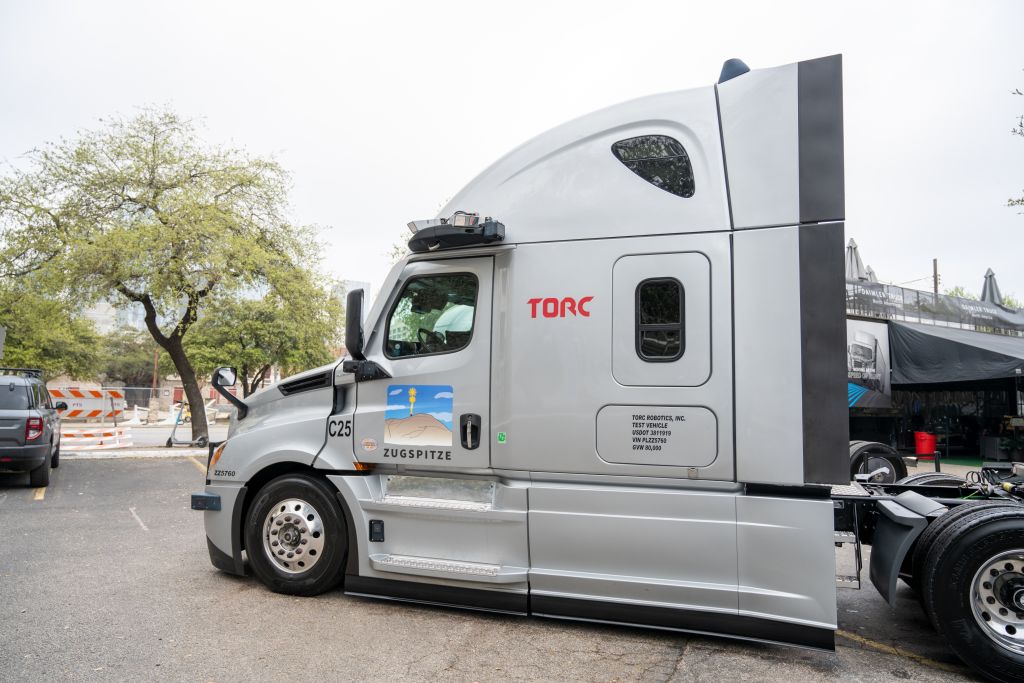
US House lawmakers have inserted a provision into a must-pass transportation funding bill that would block states’ from setting safety standards for self-driving trucks, buses, and other commercial vehicles. (Smith Collection / Gado / Getty Images)
After months of industry lobbying, House lawmakers inserted a provision into a must-pass transportation funding bill that would block states’ from setting safety standards for self-driving trucks, buses, and other commercial vehicles — despite mounting calls for tougher safeguards.
On Sunday, House lawmakers announced a deal on a congressional funding package for surface transportation and highways, which would determine policy and spending for the country’s roads, bridges, trains, and highways for the next five years.
Buried in the one-thousand-page legislation was a provision that would grant a longtime wish of the autonomous vehicle industry: override state autonomous commercial vehicle regulations and instead install a light-touch national framework allowing nearly unrestricted expansion of self-driving trucks across the nation’s highways and roads.
According to the Truck Safety Coalition, an advocacy group of trucking accident victims and survivors, the proposal sacrifices “commonsense safety measures to satisfy industry interests.”
This preemption clause comes after dozens of states have implemented or proposed their own rules for autonomous commercial vehicles. While two dozen states have fully approved autonomous vehicles on their roads, ten states, including New York and Massachusetts, have imposed more rigorous safety and reporting requirements restricting such technologies on their thoroughfares.
Pending legislation in New York and other states would furthermore require human operators to be present in every autonomous vehicle. California previously banned autonomous vehicles but revoked the law earlier this year following industry pressure.
Newly released National Highway Traffic Safety Administration data show that while large truck-related fatalities are on the decline, more than 5,300 people were killed and more than 160,000 were injured in 2024 in crashes involving big-rig trucks.
The House Committee on Transportation and Infrastructure plans to mark up the bill on Thursday. There is not yet a Senate version of the deal.
No Humans Necessary
The preemption clause is part of Congress’s effort to create a new federal safety standard for autonomous trucking and related commercial transportation, as Trucking Dive reported Wednesday.
The surface transportation bill provision directs the transportation secretary to develop basic federal regulations for autonomous commercial vehicles within two years, including rules allowing operators to self-report crash and accident information and mandating that remote operators of vehicles be located in the United States.
Per the preemption clause, the transportation secretary could override any state laws requiring otherwise.
The surface transportation bill would also grant other wish list items to the autonomous trucking industry. That includes eliminating a federal requirement that truckers place warning placards around their vehicles when they’re forced to stop due to a hazardous situation.
This rule effectively necessitated a human operator to be present in all trucks, save for those operated by autonomous vehicle companies that were granted federal waivers on the matter. According to the new bill language, the warning placards would be replaced by flashing warning beacons to accommodate autonomous vehicles’ specifications.
Aspects of the new autonomous vehicle provision appear to be lifted in part from previously introduced legislation that included a more expansive state preemption proposal along with several other provisions to encourage “innovation” and to speed up the deployment of self-driving commercial vehicles. The 2025 bill — dubbed the AMERICA DRIVES Act — was introduced with industry backing and would have explicitly prohibited state regulations mandating human operators for any commercial vehicles.
At the time, trucking safety advocates warned the bill “could lead to catastrophic consequences,” given that it included no safety standards beyond broad preemption of state laws.
Robolobbyists Behind The Wheel
Efforts to supplant state rules with lenient federal regulations have been championed by the autonomous trucking company Aurora Innovation, one of the fastest-growing self-driving freight companies. The company has received funding from major venture capital firms such as Sequoia Capital, Greylock Partners, and others. It has also received funding from Amazon, and LinkedIn cofounder Reid Hoffman sits on Aurora’s board of directors.
From July 2025 to April, Aurora and the Association for Uncrewed Vehicle Systems International, a lobbying group for the autonomous vehicle industry, together spent more than $700,000 lobbying Congress, the White House, the Transportation Department, and other agencies on the surface transportation reauthorization bill, the AMERICA DRIVES Act, and other matters.
During that same time, Aurora vocally opposed attempts by state governments to regulate autonomous vehicles and called for Congress to intervene. “You can’t have a patchwork of legislation, particularly when it comes to interstate trucking,” Gerardo Interiano, Aurora’s senior vice president of government affairs, told a reporter in March.
Aurora and other self-driving trucking firms aren’t the only companies pushing to eliminate state-level autonomous commercial vehicle laws. In September 2025, the Big Tech lobbying group Chamber of Progress, which is funded by giants including Google, Meta, and Amazon, argued in a letter to lawmakers that the AMERICA DRIVES Act would “serve as a foundation for further efforts to expand the safe deployment of autonomous vehicles.”
Unsurprisingly, given the tech sector’s advocacy for such a measure, the inclusion of the preemption language in the new surface transportation bill is already being met with industry support.
Don Burnette, the founder and CEO of Kodiak AI, an autonomous trucking company, released a statement applauding the new bill.
“By replacing today’s patchwork of state regulations with a single federal standard, the [surface transportation bill] would ensure Americans benefit from the safety and economic advantages that autonomous driving technology delivers,” noted Burnette.
But trucking accident victims and survivors with the Truck Safety Coalition have raised contentions with the approach outlined in the reauthorization bill text. In a May 19 letter to Congress, the group wrote that the bill’s autonomous trucking preemption language was just one of “many consequential provisions that will harm safety on our roads and highways.”
According to the organization, that included provisions allowing heavier trucking loads, lowering the qualifications of Commercial Driver License test administrators, and extending a ”boondoggle” apprenticeship program that allows nineteen-year-olds to operate big-rig trucks.
“We’re seeing over 5,000 truck crash fatalities every year, and I don’t think this bill goes nearly far enough to address that problem,” Truck Safety Coalition Executive Director Zach Cahalan told the Lever.