No, Bulgaria’s New Premier Isn’t Pro-Kremlin

New Bulgarian Premier Rumen Radev’s Progressive Bulgaria party is more conservative than it sounds. It’s also unfair to call it pro-Kremlin, despite alarmist claims in international media casting the party as stooges of Vladimir Putin.
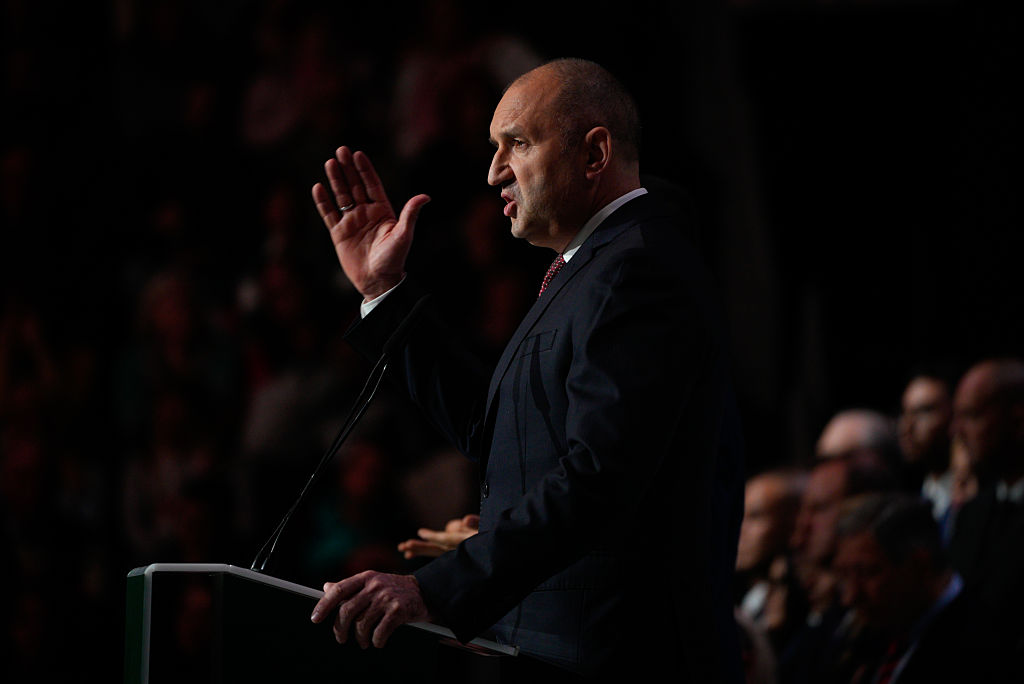
Bulgaria's newly elected premier Rumen Radev addresses a crowd at a campaign rally in Sofia.

International media cast April’s Bulgarian election as a grand struggle between East and West. The reality was more prosaic: on questions like the euro or the fundamentals of economic policy, the main parties hardly disagree with each other. (Jaap Arriens / NurPhoto via Getty Images)


In a news environment dominated by the most severe global energy crisis in history and ongoing war in the Middle East, it is unusual for an election in a small Balkan country to capture headlines in the United States and Western Europe. Yet this is what happened following Bulgaria’s parliamentary elections on April 19, which resulted in a landslide victory for former President Rumen Radev and his two-month-old party, Progressive Bulgaria (PB). Bulgaria — a country roughly the size of Ohio, with a population of about 6.5 million — rarely enters the global news cycle, and that is not necessarily a bad thing. This changed after Radev’s party secured 131 seats in the country’s 240-member parliament.

This sudden surge of interest in an election from the EU’s eastern periphery was largely driven by geopolitical concerns. With few exceptions, the vote was framed as a contest between pro-Russian and pro-Western orientations, and Radev’s victory was widely portrayed as a triumph for pro-Kremlin forces. Headlines reinforced this narrative. The Washington Post suggested the result “gives Moscow a new foothold in Europe,” and reasoned that, after Viktor Orbán’s loss in Hungary, Radev was the “Kremlin’s next best bet.” Similarly, NBC and CNN described Radev as “Kremlin-friendly,” while the Guardian labeled him “Moscow-friendly,” and the Financial Times characterized him as “pro-Russian.”

Radev, who has consistently maintained that Bulgaria (an EU and now euro member) should remain on a European path, has also emphasized the importance of dialogue with Russia and expressed skepticism toward military aid to Ukraine. Yet these positions alone hardly justify reducing Bulgaria’s recent election to a simple geopolitical contest. Uninformed readers abroad might get the misleading impression that Bulgarians live in relative affluence and are so detached from domestic concerns that they have become preoccupied with foreign policy, debating their country’s place in a grand clash between East and West.

To be sure, like many peripheral nations, Bulgarians are acutely aware of their position within the international order. However, the near-exclusive focus of US and European media on the Russia-versus-the-West framing obscures far more than it reveals about the underlying dynamics of Radev’s victory.

Why the “Russian Stooge” Narrative Falls Short

One obvious indication that more than geopolitics was at stake is the sheer scale of the victory for Radev’s PB. It won nearly 46 percent of the vote — over thirty percentage points ahead of the second-place Citizens for European Development of Bulgaria (GERB), who were narrowly trailed by the third-place, pro-Western coalition We Continue the Change — Democratic Bulgaria (PP-DB). For the first time since 1997, one party achieved an absolute majority in parliament.

Voter turnout, at 51 percent, was also high by Bulgarian standards: the last two elections had seen just 34 percent and 38 percent turn out. This decisive result complicates the familiar narrative that attributes electoral outcomes to Russian disinformation. While some “disinformation experts” had already begun to advance this claim ahead of the vote — and a close result would likely have amplified it — the magnitude of the victory rendered such arguments far less tenable. Even staunchly anti-Russian, center-right figures such as former Foreign Minister Nadezhda Neynsky were quick to describe the election as “the fairest and most transparent” in recent years.

Underscoring the scale of Radev’s victory, his new party outperformed its competitors across nearly all categories: it rallied both urban and rural voters and spanned demographic divides such as gender, education, and age. Particularly striking for the self-described pro-Western liberal parties was PB’s strong showing among Gen Z voters. This is especially notable given that Gen Z had been widely portrayed as the driving force behind the anti-government protests led by the PP-DB coalition that brought down the GERB-led government in December 2025.

Additionally, the association of Radev with Russia overlooks a key contradiction: the far-right Revival party — openly pro-Russian and anti-EU — attacked Radev from the opposite direction. It portrayed him as a pro-Western stooge, pointing to his training at the US Air War College at Maxwell Air Force Base in Alabama and his own description of himself as a “NATO general” as evidence of his alignment with the United States rather than Russia. Former fighter-jet pilot Radev has in fact remained silent on the now more than two-month-long use of Sofia’s civilian airport by US military aircraft, despite warnings from Iran against allowing such activity.

Two broader considerations highlight the weakness of framing Bulgaria’s election as an East-West clash. First, although Bulgarians maintain a different historical and cultural relationship with Russia than, say, the Central European or Baltic states, there is little grassroots support for abandoning Western institutions or pursuing a political realignment toward Moscow. Such claims also raise a deeper question of what exactly “the West” or being “pro-Western” means today. Given that the current US government has threatened to take over Greenland, belittled NATO on multiple occasions, and is seeking to push Spain out of the alliance, this does not seem like such a cohesive force.

Post-Socialist Context

The massive support for Radev reflects a complex set of factors that extend beyond Bulgarian attitudes toward Russia and the West. Central among these are the long-term consequences of Bulgaria’s post-socialist transition, which has been particularly challenging. Bulgaria has consistently ranked as the poorest member of the EU and among the countries with the highest levels of income inequality. It has also experienced a severe demographic crisis, with its population declining from nine million in 1989 to approximately 6.5 million today. More recent political developments have further shaped the context of his electoral success.

In 2009, GERB came to power as a center-right party aligned with the conservative European People’s Party in the EU’s Parliament. Built around the leadership of Boyko Borissov — a former minister of the interior and mayor of Sofia — the party dominated Bulgarian politics for over a decade. Although it never secured an absolute majority, it governed through coalitions with smaller parties, allowing Borissov to become the longest-serving prime minister in Bulgaria’s post-socialist history. His rise coincided with the growing prominence of Delyan Peevski, a media mogul and leading figure in the Movement for Rights and Freedoms (DPS), who was sanctioned in 2021 by the United States under the Magnitsky Act for corruption. Over time, this governing arrangement came to be widely perceived as increasingly corrupt, with entrenched clientelist networks resembling a “mafia-style” or even feudal system.

Rising public dissatisfaction with this political order ushered in a prolonged period of instability, driven by repeated but unsuccessful efforts to dislodge GERB and DPS from power. Since April 2021, Bulgaria has held eight parliamentary elections, yet until Radev’s victory, no party had secured a stable majority. A succession of fragile coalitions followed, reflecting a fragmented electorate.

Bulgarians experimented with a range of political alternatives, including backing the media personality, Slavi Trifonov. Much like other entertainment figures who transitioned into politics, such as Ukraine’s Volodymyr Zelensky or Donald Trump, Trifonov rose to prominence as the host of a popular late night talk show before founding the populist, center-right party There Is Such a People (ITN). In July 2021, ITN narrowly edged out GERB in the parliamentary elections, but the party failed to assemble a governing coalition and gradually lost its appeal, with less than 1 percent of voters supporting it in last month’s elections. In another paradox, in 2023 the anti-corruption, liberal PP-DB coalition joined a governing alliance with GERB — an arrangement derisively labeled the sglobka, or “patched-together” coalition. This unnatural combination undermined the credibility of the liberal opposition, which had previously positioned itself as the main challenger to the Borissov–Peevski model.

Against this backdrop, Radev’s overwhelming victory can be understood as a response to five years of political gridlock: a clear demand for stability and for a government capable of serving a full term.

An Attempt to Find Political Differences

There are understandable reasons why Western media frame Bulgaria’s elections along a Russia-versus-the-West axis. Linking Radev’s victory to a familiar Cold War–era geopolitical narrative provides an accessible — if oversimplified — frame of reference for audiences unfamiliar with the Bulgarian context. In an environment where news organizations are increasingly stretched thin, as the Washington Post’s recent trajectory illustrates, such outlets are unlikely to invest heavily in coverage of Bulgaria. Moreover, major wire services like Reuters and the Associated Press, from which many media organizations draw their reporting, also framed the election as a contest between Russia and the West. At the same time, Bulgarian domestic actors — particularly the center-right liberal parties — also reinforced this narrative by labeling Radev a “Putinist” and portraying the election result as a Russian threat. In fact, much of the Western reporting relied heavily on Bulgarian figures affiliated with liberal parties, media outlets, and NGO circles, reinforcing this interpretive framework rather than challenging it.

One reason this narrative gains traction is the relative lack of substantive differences across much of the political spectrum. To be precise, and much to the ire of liberals, Radev had argued that Bulgaria is not yet ready to adopt the euro and supported holding a referendum on the issue. Yet although euro adoption remains controversial, especially amid soaring prices, the broader fundamentals of Bulgaria’s economic policy remain largely uncontested.

Despite its name, Progressive Bulgaria offers little that could be described as distinctly progressive. Its platform largely reproduces the familiar neoliberal policy framework that has defined Bulgaria’s post-socialist trajectory, supplemented by promises to integrate AI across public administration to streamline staffing. In fact, the party has been quite explicit that, despite its name, it has no intention of replacing the country’s highly regressive flat income and corporate taxes with progressive taxation. In an interview, Ivo Hristov — Radev’s former chief of staff and a close ally who currently serves as deputy prime minister — stated that while the party aims to address inequality, it does not plan to repeal the flat tax. Critics across the spectrum have highlighted this gap: left-wing trade unionist and politician Vanya Grigorova warned before the election that the program would disappoint left-leaning voters, while liberal analyst Ruzha Smilova argued afterward that PB cannot be considered a left-leaning force. The emphasis on the “Russian threat” thus also serves to obscure the limited substantive differences between the economic programs of Radev’s party and those of its staunch critics in PP-DB.

Indeed, one of the most significant outcomes of this election — largely overlooked in Western coverage — is that, for the first time in Bulgaria’s post-1989 period, the Bulgarian Socialist Party (BSP) has been left outside parliament. This marks a striking reversal of an earlier trajectory: unlike much of the region, Bulgaria’s first free elections in 1990 were won in a landslide by the reformed former communists of the BSP, which remained the dominant force on the left for years thereafter.

Its decline began in the 2000s, perhaps even earlier, as a result of both external and internal factors. A hegemonic anti-communist media and intellectual environment, along with the dominance of conservative interpretations of Bulgaria’s socialist past, played a role. But so did the party’s own ideological shift to the right. Notably, it was under BSP leadership that Bulgaria adopted a flat income tax in 2007. In the past decade, the party further alienated voters by embracing socially conservative and nationalistic positions and by participating in coalition governments with the widely unpopular center-right parties GERB and DPS.

Only two months before the election did BSP attempt a course correction, electing Krum Zarkov, a Sorbonne-educated reformist committed to restoring the party’s socialist ideals, as its leader. Zarkov — whose mother, a prominent investigative journalist, survived an acid attack in the 1990s — articulated a modern vision of social justice and campaigned on progressive social and economic policies. However, the shift came too late to reverse the party’s decline. BSP secured just 3 percent of the vote, one point below the threshold required to enter parliament. Given that public subsidies are tied to parliamentary representation, the party’s future viability is now in question.

Viewed from this perspective, Bulgaria does share a similarity with Hungary — but not because it has produced a new “Balkan Orbán.” Rather, the similarity lies in the absence of institutional left, leaving political competition largely confined to the center-right and the far-right. In the mid-1990s, the anthropologist Katherine Verdery posed a prescient question in her book What Was Socialism, and What Comes Next? Recent developments in Bulgaria, and in large parts of the region, suggest a stark answer: what came next was the disappearance of the socialist left from institutional politics. This “achievement” is one that both the far right and the liberal center-right can claim, insofar as both remain united by anti-communism as a central ideological framework. Whether the disappearance of the institutional socialist left benefits democracy or the working class in one of Europe’s poorest regions, however, is an entirely different question.

Barring major upheavals, Bulgaria is unlikely to remain in the international spotlight. This is not only because it is unlikely to leave NATO or the EU or generate other geopolitically salient developments. It’s also because there’s little prospect of substantive political or economic change that might attract more sustained attention.