Mexico Is Going All In for Universal Health Care
Mexico’s new national health system aims to provide universal care. At a moment when US taxpayer dollars are being harnessed to destroy health care infrastructure abroad, Mexico is attempting to make a constitutional right to care into a lived reality.
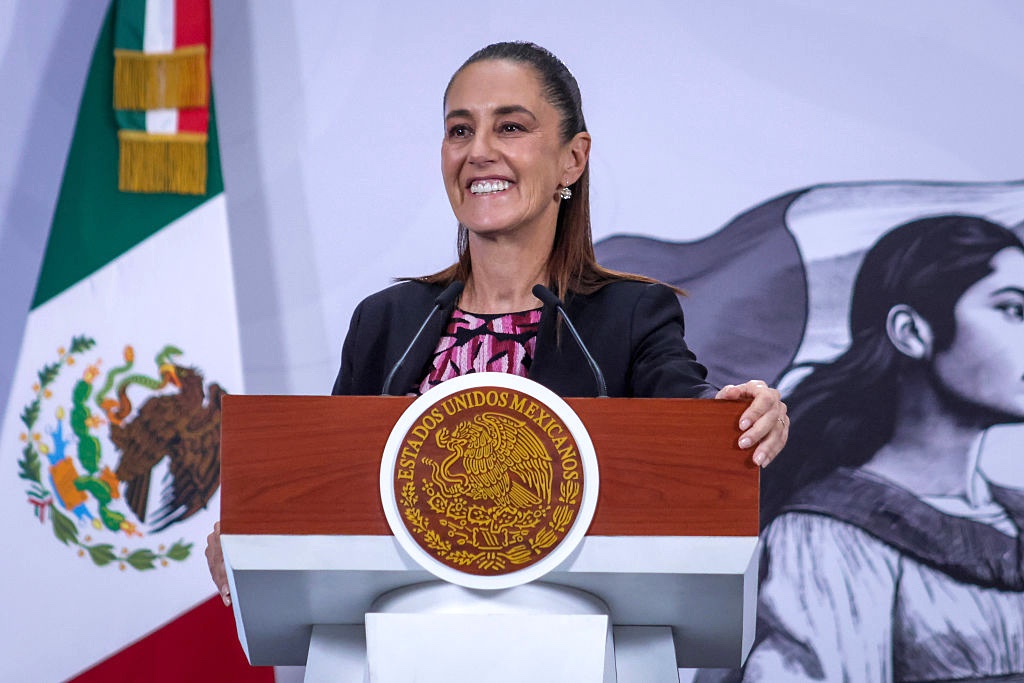
Claudia Sheinbaum is making the current disparate health care service in Mexico open and portable. (Mariana Maytorena / ObturadorMX / Getty Images)
At her morning press conference on April 7, President Claudia Sheinbaum announced that the credencialización process, or enrollment, for Mexico’s new universal health care service was set to begin. The goal, she explained, was unambiguous: “By the time we leave office, any Mexican will be able to go to any public health institution and receive care for any condition.”
To be phased in over the next four years, the reforms represent, in her words, “a historic step.” And if successful, indeed they will be. But in a fragmented health landscape where the Holy Grail of genuinely universal coverage has proved elusive, how will Sheinbaum’s ambitious rollout work?
A Service, Not a System
The key to the answer lies in the name itself: it will be a national health service, not a system. Broadly speaking, Mexico’s current public system is divided into four main areas: The Mexican Social Security Institute (or IMSS, for its Spanish acronym) is for salaried, private sector workers; the Institute for Social Security and Services for State Workers (or ISSSTE) is for their counterparts in the public sector; workers at the state oil company PEMEX have their own system; and the IMSS-Bienestar (Spanish for “well-being”), established by Andrés Manuel López Obrador’s (AMLO) administration, for those who do not qualify for the others, namely contract workers and the 33 million or so laboring in the informal sector. (An effort somewhat hampered by the fact that, in a dynamic roughly equivalent to the Obama-era expansion of Medicaid, a minority of states with right-wing governors have refused to opt in.)
IMSS was founded in 1943 and ISSSTE in 1959. And although the concept of a fully contained public-health institute is reminiscent of European systems, these institutes are actually financed not through general taxation but US-style: by means of employer-employee payroll contributions. This means, in practice, dueling bureaucracies with decades of tradition, protocols, and infrastructure behind them. Instead of trying to storm these castles with a risky, all-out assault — merging everything into a new model that shifts the burden onto the general budget — Sheinbaum has instead opted for a next-best option: making the current one open and portable. In other words, allowing anyone from any of these public networks to use any of the others, with a behind-the-scenes reimbursement process so that it all flows smoothly.
Here’s how it will work. In 2026, all citizens will be given their credencial, or health ID card, which will also serve as an official means of identification. The card, which will gradually replace the health booklets currently in use, will be linked to an app containing each individual’s medical records, appointments, and available services. In 2027, portability will begin for an initial set of services: universal emergency care (currently patients are stabilized at the hospital of arrival before being transferred to a hospital in their system); high-risk pregnancies and other obstetric emergencies; heart attacks and strokes; breast cancer; universal vaccination; and basic consultations such as flu, diarrhea, and preventive care.
Patients will not only receive care at any health center but will also have the option of remaining there for the duration of care, eliminating situations where forced transferals lead to truncated treatments. Then, in 2028, portability of care will be extended to chronic conditions such as diabetes and hypertension; cross-institution specialist consultations and hospitalizations; and the ability to fill prescriptions at any institution.
In addition to extending coverage to those who lack it, thus expanding its reach, an obvious goal of the service is to make use of existing resources more efficient. As things currently stand, an IMSS hospital in a certain area may possess specialized equipment that is underused, while an ISSSTE hospital down the street could be experiencing backlogs. In the same way, a PEMEX hospital may have beds to spare while the nearest IMSS-Bienestar institution will have patients on gurneys in the corridor.
That leads us to the political aspect in play: as portability will eventually allow anyone to attend any public institution instead of being shunted into certain health ghettos, it will, ideally, require the harmonization of quality across the system — if nothing else, to avoid the “best” centers from being overrun. As people will be voting with their feet, underperforming or underserved areas will, in theory, be exposed sooner rather than later, leading to more timely interventions.
The Long and Winding Road
The road to universal coverage has been a long one for Mexico’s Fourth Transformation, or 4T. When he came into office in December 2018, AMLO inherited a denuded system in which some 300 hospital projects had been left unfinished, a handful of distributors had cornered the medications market, the IMSS and ISSSTE were being subjected to death by a thousand cuts due to privatizations, and governors such as Michoacan’s Silvano Aureoles were diverting state health resources to finance right-wing media outlets such as Latinus.
Determined to move forward quickly, AMLO canceled the ill-named People’s Health Care (Seguro Popular) program, which cannibalized public infrastructure while funneling resources into the private sector, replacing it with a proto-universal proposal called INSABI. While aspiring to universality was the right impulse, INSABI proved to be so open-ended that people didn’t know whether they were covered or not, and if so, where and how they could make good on said coverage. Where the Seguro Popular, however deficient, had clear enrollment procedures and ID cards, the INSABI had none. That, in addition to a parallel set of confusions in the rollout and the onset of the 2020 pandemic, was enough to sink the initiative.
The AMLO administration regrouped and, learning from its mistakes, launched IMSS-Bienestar. But the ghost of INSABI was to haunt it for years to come. When, toward the end of his term, a series of national and international studies — from Mexico’s CONEVAL to the World Bank — documented its remarkable success in lifting some 13.4 million out of multidimensional poverty, these findings nearly always included an asterisk with the caveat that access to health care had declined significantly.
Although untrue and in many cases made in bad faith, the assertions did point to a clear, underlying problem. Namely, that the attempt to clear away impediments to care without a clear structure or communications strategy led many people, when asked on a survey if they were covered, to answer “no.”
From Constitutional Promise to Concrete Reality
This is a lesson that the Sheinbaum administration has clearly taken to heart, as reflected in the front-and-center prominence of the new health ID card, together with a clear, calendarized rollout of services. Dangers, however, remain. As the IMSS and ISSSTE continue to be financed by payroll contributions, a drop in formal-sector employment, driven by the persistence of the informal economy or a war-induced global recession, would directly impact the system (general tax revenues would fall as well, of course, but the payroll-financing system is that much more direct).
The reimbursement mechanism among institutions will need to be carefully worked out to weather these ups and downs. As the INSABI experience shows, a consistent, effective communications strategy will be necessary to overcome the decades-long habit of patients believing they can only receive care within their own system — or none, leading them to resort to “medical orientation” consultations at private pharmacies or simply forgo care altogether.
As a percentage of GDP, Mexico’s health care spending remains well below the Organisation for Economic Co-operation and Development (OECD) average. And finally, the service will need to prove that it can put an end to the stratified provision of care by class, state, and region, replacing it with a truly universal experience, and to do so while working within existing bureaucratic divisions.
No small order, in short. But at a time when the dollars of US taxpayers are being harnessed to destroy health care infrastructure in Iran, Gaza, and elsewhere, it is heartening to see Mexico take up the challenge of turning Article 4 of its Constitution, which provides for health care as a right, from promise to reality.