Yakov Kronrod’s Plan for Economic Democracy in the USSR
Yakov Kronrod played a major role in debates about how to reform the Soviet economy during the 1960s. His vision of a genuinely democratic economic system was too radical for Soviet leaders to accept because it threatened their authority.
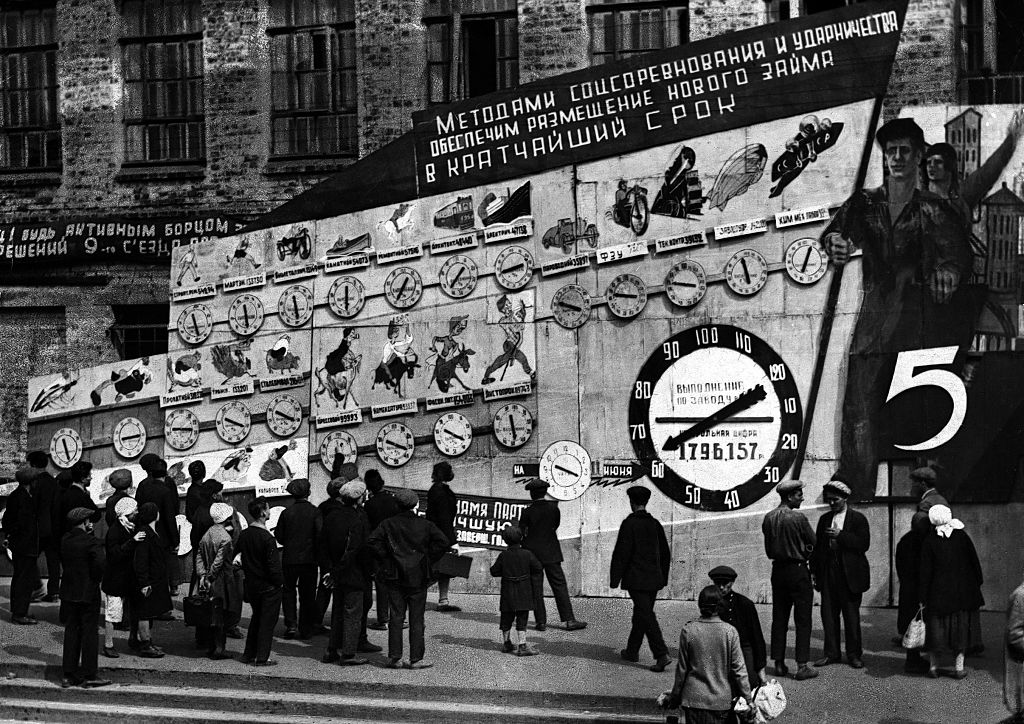
During the 1960s, Soviet economists engaged in wide-ranging debates about how to reform the planned economic system. Yakov Kronrod was one of the key participants, but Soviet leaders couldn’t accept his vision of a truly democratic socialist economy. (Ullstein Bild via Getty Images)
Yakov Kronrod was a leading figure of the Soviet economic school of so-called marketeers (tovarniki) and a major participant in the debates about economic reform in the 1960s, as Soviet planners discussed whether to accord a greater role to market relations within the framework of the planned, nationalized economy.
Kronrod was born in 1912 and attended university during the 1930s. After completing his studies, he began working in the state planning and statistics agencies. When Germany invaded the USSR in June 1941, he immediately volunteered and fought in the battle of Moscow, ending the war in East Prussia with the rank of major.
After the war, he headed the theoretical section of the prestigious Institute of Economics of the USSR Academy of Sciences, a position he occupied until his punitive demotion in the late 1960s. Revisiting Kronrod’s life and ideas can give us a fresh perspective on the rise and fall of the Soviet economic system, the most ambitious attempt to build an alternative to Western-style capitalism.
Plan and Market Under Socialism
Going against Marxist orthodoxy, Kronrod argued that socialism is a separate mode of production, not merely communism in a still immature state. Under socialism, market relations necessarily retain an important role, because socialism inherits from capitalism an unequal society in which resources are limited: while citizens are equal as co-owners of the economy, their practical roles in the economy place them in unequal situations. This society is a long way from genuine social equality, the overall goal of socialism, when scarcity will have been overcome and work will have become its own incentive.
At the same time, Kronrod insisted on the primacy of planning under socialism and of the direct, nonequivalent allocation of resources. He was a fierce opponent of the Yugoslav model, in which enterprises enjoyed almost complete autonomy, with the state’s role limited to mimicking the market or to correcting market failures. For Kronrod, the plan’s role under socialism is to maintain the necessary proportions among the major economic sectors, corresponding to the longer-term goals decided by society, the main one being necessarily ever-growing social equality.
The plan is thus the sphere of direct, nonequivalent economic relations. Competition operates among enterprises that are established by the plan and whose activity is restricted to their major economic sector; their autonomy is, thus, only relative. It does so without commercial secrets and within the parameters of the national plan. This competition — the sphere of market relations — promotes technological progress and sends signals to the planners, through the appearance of local disequilibria, about the need to correct economic proportions among the sectors.
Kronrod argued that the state’s attempt to manage the enterprises by direct, administrative command — in effect, to run the economy as if it were a single giant enterprise — had the ironic consequence of undermining its ability to plan, to establish correctly the necessary proportions among major sectors, and to adjust them continually as disequilibria manifest themselves.
For the Desk Drawer
In the second half of the 1950s and for much of the ’60s, Kronrod’s ideas were not only tolerated but also shared by other economists and published quite widely. They found practical expression, albeit in a much watered-down and partial form, in the so-called Kosygin reform of 1965. Named after Alexei Kosygin, the chairman of the Council of Ministers, this reform had been discussed and elaborated under Nikita Khrushchev, the Soviet leader deposed in October 1964.
While Kronrod challenged the Marxist classics, the content of his arguments cannot in itself explain why he and his ideas were subsequently repressed. In December 1971, a party meeting in Kronrod’s institute condemned him for “ideological errors of theoretical significance.” It was conducted in the presence of a member of the ruling Politburo; the institute’s own party secretary courageously dissented from the decision. After this blow, he was relegated to a minor position, and his work became unpublishable.
In 1972, Kronrod penned a brilliant essay “for the desk drawer” (it was first published in 1992) entitled “Socio-Oligarchism — the Pseudo-Socialism of the Twentieth Century.” He characterized the Soviet system as “a combination of socialization of the principal means of production at the national level with the totalitarian dictatorial power of the social stratum that controls the state.” The combination of the two “transforms this ruling stratum into a distinct privileged group of political and economic oligarchs.”
This system, he wrote, was a historical dead end, with socialism being only one of its possible successors, depending on the correlation of class forces. The other possible outcomes were capitalist restoration and a technocratic-militaristic regime. Although Kronrod recognized the serious obstacles to the emergence of an adequate political consciousness among workers, he remained fundamentally optimistic about the future of socialism.
Kronrod’s fate poses the question as to why he was not only tolerated but much respected within the Soviet system until the late 1960s, only then to be repressed and silenced. This, in turn, poses the question of the role of ideology in the Soviet Union. When the USSR still existed, most Western academic “Sovietologists” portrayed the system as an “ideocracy” — an ideology in power. According to their analysis, the elite’s vast concentration of power was explained by its desire to form the “new Soviet man” in accordance with that ideology.
“Respect for Cadres”
Kronrod’s own analysis was very different. For him, the “Marxist-Leninist” ideology was a mere cover, a fig leaf, to legitimate the bureaucracy’s usurpation of power. The usurpation had first occurred under Joseph Stalin’s leadership in the 1920s, allowing the functionaries to wield absolute power and lead a privileged life, though one that had to be concealed behind a socialist facade. In that system, merely to speak the truth about the regime out loud was a serious act of sedition.
After Stalin died in 1953, the Soviet leadership undertook various attempts at reform, which began seriously with Khrushchev’s denunciation of Stalin’s crimes at the twentieth congress of the Soviet Communist Party in 1956. While Stalin was denounced, the bureaucratic regime he had built was left more or less intact. That suited most of the functionaries, who were longing for stability, since their power and material privileges depended on their tenure in office. Under Stalin, the political police had been the dominant apparatus, and no functionary could feel secure.
The problem for the bureaucrats arose, however, when Khrushchev tried to reform the economic system, which was wasteful and resistant to technological progress. This was a time when the abundant and cheap human and natural resources of preceding decades were drying up. While it is true that Khrushchev’s reforms were often ill-conceived, they also came up against the intrinsic conservatism of the bureaucracy.
Khrushchev looked for ways to neutralize that resistance, even dusting off the long-forgotten Marxist idea of the withering away of the state, as he devolved various minor state functions to civil organizations (which remained, however, under the supervision of the party apparatus). But his big push came in September 1961, at the twenty-second party congress, when he pronounced a new, expanded denunciation of Stalin’s crimes. This time, it was addressed to the public instead of being presented as a secret speech for top functionaries alone.
Even more worrisome to the bureaucrats, the congress adopted changes to the party’s constitution that made the regular renewal of administrative cadres mandatory. This was a direct assault on the all-important structures of bureaucratic tenure. In most cases, cadres would be limited to six years in any role, with compulsory retirement at the age of sixty.
Khrushchev was ousted at a Central Committee meeting in October 1964 and replaced by Leonid Brezhnev, whose criticism of Khrushchev at that meeting centered around his “lack of respect for cadres.” For his part, Brezhnev pledged his respect for cadres and subsequently followed through on that pledge. This sealed the fate of the Soviet Union by effectively ruling out serious reform for the next two decades. Brezhnev’s tenure in office subsequently became known officially as the “period of stagnation.”
The Prague Spring of 1968 in Czechoslovakia, a movement to democratize the state in which the Czechoslovakian Communist Party participated fully, gave a new and powerful impulse to the bureaucratic reaction already in progress in the USSR. Progressive intellectuals, who had colonized the party’s ideological apparatus and the editorial boards of publications under Khrushchev, were replaced by conservatives, and censorship was tightened. At the same time, the previous limited attempts at economic reform were wound up.
Economic Democracy
This was the political context of the attack on Kronrod and his school of political economy. What role, then, did Kronrod’s published ideas on socialist planning play in his downfall? The content of the ideas themselves might seem secondary, since in the later 1960s and from that point onward, until Mikhail Gorbachev’s perestroika, any significant theoretical-ideological diversity was found threatening by the elite. However, the subsequent abandonment of serious attempts at economic reform and the repressive measures taken against Kronrod and his school — criticism of the school became mandatory for any academic thesis defense — indicate that there was something more at work.
The reform that Kronrod advocated would have given enterprises significant operational and commercial autonomy, though their activity would have been restricted to their major economic sector, as determined by the plan, and there would have been no commercial secrets. In such a system, enterprises would be economic subjects with power to make economically significant decisions. This, in its turn, would have reduced the pivotal economic role that the party apparatus, the most powerful faction of the Soviet bureaucracy, had come to play.
At the same time, the relative autonomy of enterprises, the role played by competition and profitability in determining a part of workers’ remuneration, would logically have led workers to demand a say in management of their enterprise, all the more so as workers’ control had always been an integral part of the Marxist view of socialism. The activation and independent organization of workers, as occurred in Czechoslovakia in response to its economic reform, could not have been a pleasing prospect for the nomenklatura.
In his published work, Kronrod could not have called openly for democracy, since the regime insistently claimed it was already democratic. To deny that claim was to invite certain repression. But democracy and its suppression by the bureaucracy were central elements in his 1972 essay on socio-oligarchism.
For Kronrod, in a socialist society inherited from capitalism, the plan had to be the result of a democratic process, politics being concentrated economics. The most important economic questions, such as the relation between accumulation and consumption, the balance between industry and agriculture, between the capital-construction fund and the wage fund, the wages of various categories of workers, and much else besides were all political questions that could not be decided a priori by bureaucrats but only through a genuinely democratic political process. That was even more the case, of course, for the ultimate goals of socioeconomic development, which for Kronrod had to lead to ever-increasing equality.
A Road Not Taken
The late Boris Rakitskii, who was a senior researcher in Kronrod’s theoretical sector in the 1960s, offers us the following picture of Kronrod the man:
He was vibrant, alive. It was a pleasure to listen to him. The intellectual atmosphere of the time was stale, grey, covered in a layer of dust. And suddenly, amidst all that — Kronrod, brilliant, vital. To the Central Committee bureaucrats, who looked upon him as a serf, he was an unpleasantly intelligent man. He bothered them. They tolerated his ideas until the latter 1960s but did not want those ideas to conflict with their decisions. He served as an example for us. The breadth of his intelligence and the depth of his humanism opened up new horizons. It made us ashamed to remain small.
Rakitskii sees Kronrod’s school of thought as a road not taken:
Kronrod’s work, and that of the other members of his school, really systematized what socialism should be. The work of his school was the most productive of what was written in the Soviet Union on the political economy of socialism, if socialism is ever to be realized. We, in fact, prepared a programme for taking our society out of totalitarianism and into socialism. It would have been of great value in 1989, had the country then turned to socialism.