Stop Asking If Israel Has a Right to Exist
The question “Does Israel have a right to exist?” isn’t a real inquiry about the rights of nations. It’s a manipulation of discourse, a litmus test that forces Palestinians to offer theoretical assurances before their real political grievances can even be heard.
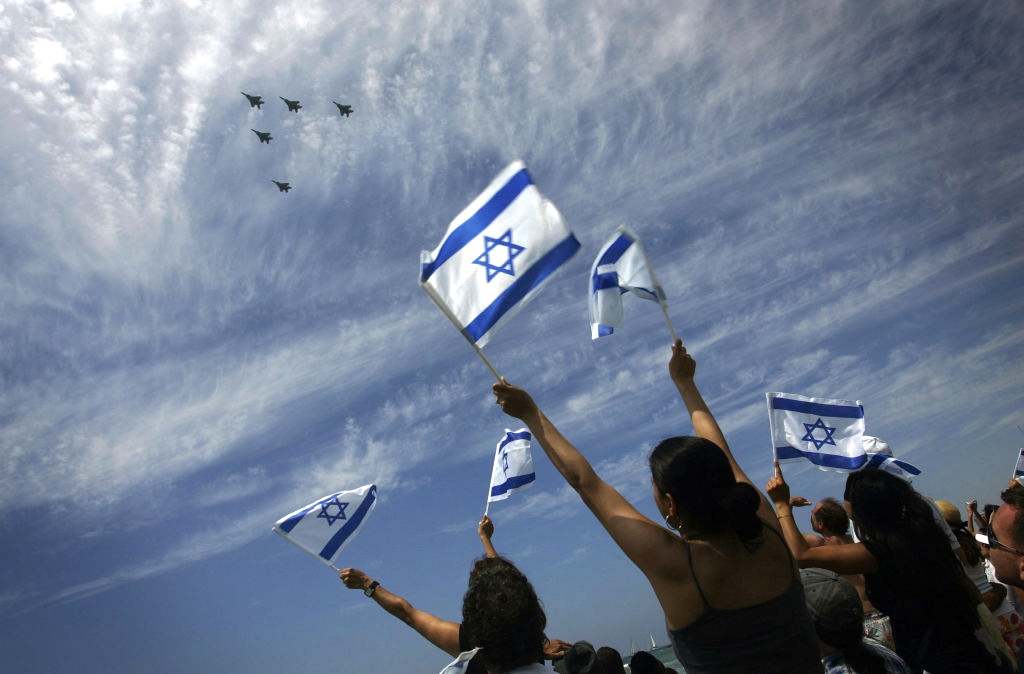
The post-WWII international order claimed universal principles while producing and protecting political arrangements that violated them from the start. The creation of Israel is its foundational contradiction. (David Furst / AFP via Getty Images)
As Donald Trump’s second term unfolds, his administration has adopted an increasingly forceful approach to foreign policy — from threatening allies and pursuing territorial expansion to unlawful military actions stretching from the western hemisphere and the Caribbean to the Middle East, culminating in an escalating and illegal war against Iran waged alongside Israel. In response, mainstream foreign policy debates have increasingly revolved around two existential questions.
The first question is: What is next for the rules-based international order? Those asking it are mostly members of the neoliberal political leadership class, who argue that Trump’s actions have shattered the pretense that the postwar order still functions as it once did — a recognition that Prime Minister Mark Carney captured in a widely discussed speech at the World Economic Forum in Davos, in which he declared that the world is experiencing “a rupture, not a transition.” Others on the Left note that this is always how the order was meant to function and has functioned, underscoring continuity rather than a sharp rupture.
As the 2028 presidential contest begins to beckon, and Democratic Party leading lights test messages on book tours and media appearances, the second question that keeps getting asked is: Does Israel have a right to exist? The discourse is sharpened not only by the current war but also by shifting sentiment within the party’s base, where polling and public rhetoric show growing awareness of and support for Palestinian self-determination.
Presidential hopeful Gavin Newsom proved responsive to this climate when he recently called Israel an apartheid state — though he swiftly backtracked and expressed regret. Josh Shapiro, on his recent book tour and in various media and podcast appearances, has been much more consistent. To paraphrase his argument, Shapiro’s position is that if you don’t believe Israel has a right to exist, you are in favor of forever war, while he is for peace because he supports a two-state solution.
On the other side of the aisle, the Right is toeing the line between a newfound suspicion and critique of Israel and rising anti-Jewish sentiment, espoused by figures like far-right influencer Nick Fuentes, who continues to receive a partial warm embrace by the radicalizing GOP.
Tucker Carlson, for example, has cogently criticized Israel’s role in influencing the United States to attack Iran but also controversially platformed Fuentes. Carlson grew visibly frustrated in a recent interview when Economist Editor in Chief Zanny Minton Beddoes repeatedly asked whether he believed Israel has a “right to exist.” Carlson kept pressing for clarification: “What does that mean? Where does that right come from? Do other countries have a right to exist?”
To answer the two pressing questions of our moment, we must recognize that the post–World War II order claimed universal principles while simultaneously producing and protecting political arrangements that violated them from the start. As legal scholar Aslı Ü. Bâli notes, the creation of the State of Israel and the development of international law as we know it today are interwoven. “Palestine remains the one instance that goes right back to the founding of the United Nations, an example that a majority of states at the U.N. continue to interpret through the lens of incomplete decolonization.”
She adds, “So Israel has created a state that is an expression of the recognized right of self-determination of the Jewish people but is continually behaving in ways that essentially deny Palestinians the ability to achieve the same.”
The United Nations Partition Plan for Palestine allocated the majority of the land to a Jewish state, even though Jews were a minority of the population and owned only a small fraction of the land. The war that followed, the 1948 Arab-Israeli War, produced the mass displacement and killing of Palestinians. In that sense, the creation of Israel represents a foundational contradiction — an original sin within the supposedly rules-based international order.
Yet the political conversation rarely confronts that contradiction. Instead, it fixates on the ritual question of whether Israel has a “right to exist.” In reality, international law does not recognize such a right for states; it recognizes the right of peoples to self-determination and prohibits territorial conquest. The question functions less as a legal inquiry than as a political litmus test.
As Mohammed El-Kurd has argued, this framing forces Palestinians and others into a rhetorical trap. Rather than addressing dispossession, occupation, or unequal rights, they are first required to perform a moral certification assuring the world they do not seek violence before their political grievances can even be heard. The result is a debate that substitutes abstract pledges for the material realities of military rule, displacement, and statelessness.
The answer to those two fundamental questions should start with the fact that the very order itself was founded on an initial contradiction that set it up for hypocrisy — and hypocrisy is the ultimate vulnerability. The system at once created this contradiction and is weakened by it. What comes next need not rely on false promises but on actions rooted in reality.
Former Secretary of State John Kerry famously framed Israel’s dilemma: it can be either a democratic state or a Jewish state but not both. Any new international order must confront a similarly stark choice: the self-determination of all peoples or the entrenchment of Zionism.