The US Government Has the Power to Lower Drug Costs

The American people are now paying the highest prices for medicines that they paid to help develop. Congress and the president have the power to change this — but in the past few decades, thanks to intense drug industry lobbying, they have refused to.
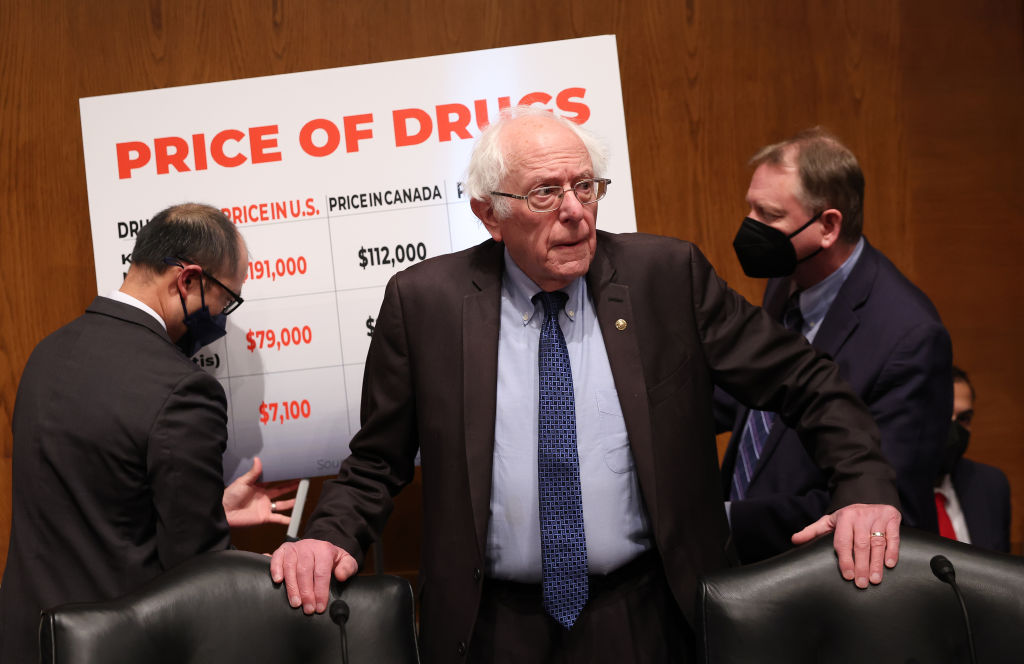
Sen. Bernie Sanders (I-VT), then chairman of the Senate Health, Education, Labor, and Pensions Committee, presides over a hearing on prescription drug costs at the Dirksen Senate Office Building on February 8, 2024, in Washington, DC.

Sen. Bernie Sanders (I-VT), then chairman of the Senate Health, Education, Labor, and Pensions Committee, presides over a hearing on prescription drug costs at the Dirksen Senate Office Building on February 8, 2024, in Washington, DC. (Kevin Dietsch / Getty Images)


Democratic senator (and possible 2028 presidential candidate) Jon Ossoff has a solid video out explaining the link between legalized political corruption and high drug prices — and touting his work to end the ban on Medicare negotiating lower rates on a handful of medicines. That was long-overdue legislation, and now it’s time to go much further and do something that’s also long overdue: reinstate the drug pricing rule imposed by Republican President George H. W. Bush’s administration.

In 1989, Bush’s National Institutes of Health asserted the power to require that medicines developed at taxpayer expense be offered to American taxpayers at a “reasonable” price. The idea was common sense: if the public spent money to help develop a drug, the public’s return on such investment should be affordable prices for that drug.

Six years later, however, the Clinton administration bowed to pharmaceutical industry lobbying and rescinded the rule.

“The National Institutes of Health relinquished its right to require ‘reasonable pricing’ on drugs and other products developed in cooperation between the government and industry,” reported the New York Times in 1995. “The pricing policy had been opposed by business interests.”

Five years later, Sen. Paul Wellstone introduced legislation to reinstate the rule, but amid the usual lobbying onslaught and flood of pharmaceutical industry campaign cash, the amendment was voted down by Republicans and a handful of Democrats.

In the quarter-century since, there have been calls for presidents to use related “march-in rights” to license generic drug companies to produce lower-priced versions of medicines originally developed at government expense. The Obama administration rejected congressional Democrats’ calls to do this.

A few years later, President Joe Biden appointed one of those congressional Democratic proponents of march-in rights — Xavier Becerra — to be secretary of Health and Human Services (HHS), which is the specific official who is empowered under federal law to use those march-in rights. But as HHS secretary, Becerra refused to use the march-in power that he had demanded other HHS secretaries use.

The end result: the American people are paying the highest prices for medicines that they paid to help develop.

If you think reasonable pricing rules for drugs developed at taxpayer expense is just some niche issue affecting only a small subset of medicines, see this data and think again: between 2010 and 2019, almost every new FDA-approved medicine was developed with government funding.

Examples of Americans being fleeced on the prices of medicines we paid to develop are everywhere — from COVID-19 treatments to GLP-1 weight loss drugs.

Those examples are a reminder that any member of Congress could — right now — reintroduce Wellstone’s legislation to reimpose the reasonable pricing rule.

It is also a reminder that if there is a Democratic president in 2029, the new administration could start using march-in rights that are already on the books.

The only thing stopping any of this from happening is the system of legalized corruption that Ossoff mentions and that the Lever details in the first season of Master Plan. The pharmaceutical industry has used the lobbying and campaign finance system to block these commonsense measures.

That’s why they can probably only happen if proponents are disciplined and link the substantive policy argument to the kind of anti-corruption message that could resonate in this era of endemic graft.