MAGA’s War on Teaching Goes Full Conspiracy Theory
What were once considered the ravings of tinfoil-hat conspiracy junkies are now par for the course for the Trumpian right and its analysis of the state of public education.
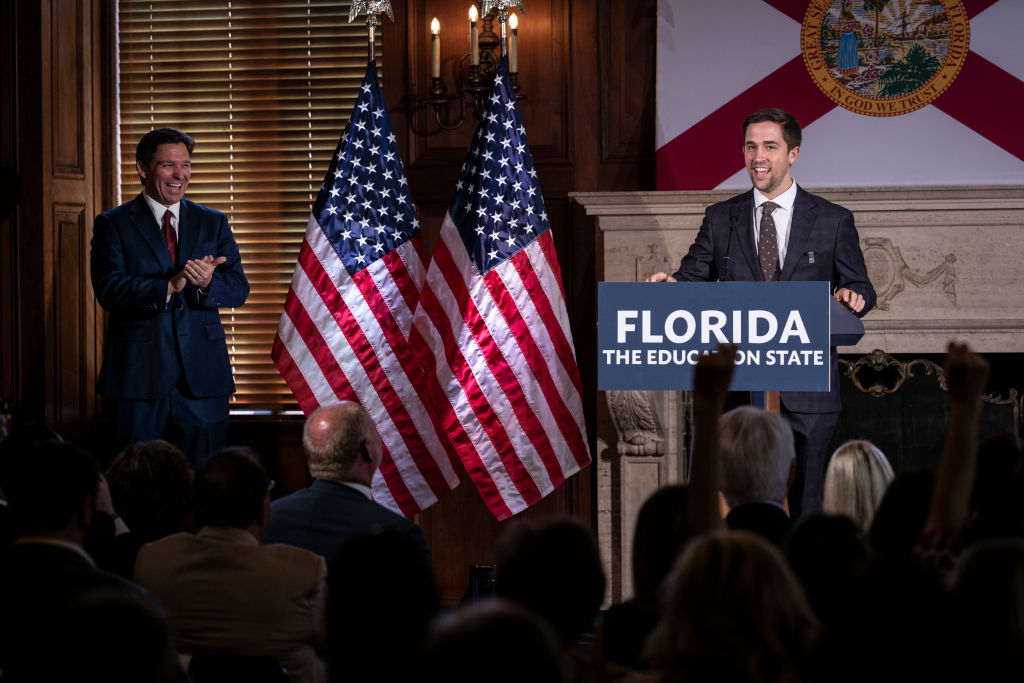
The cultural Marxist conspiracy theory that has bounced around the far right for decades is clearly now comfortably embraced by the GOP mainstream — and is central to the party’s current attacks on public education. (Thomas Simonetti for the Washington Post via Getty Images)
This week. the House of Representatives of New Hampshire, one of the states that pioneered public education, passed on a party-line vote yet another bill limiting what teachers can teach. Many such bills have passed in dozens of states, but this is the first to be debated after a year of Trump 2.0. It bears close examination as a bellwether of what a movement rapidly embracing open authoritarianism plans to do with public education.
Named the CHARLIE Act, an acronym for “Countering Hate and Revolutionary Leftist Indoctrination in Education Act,” the bill’s contradictions are glaring. But as George Orwell observed, a state gathers power from inconsistency by demonstrating that no one is willing to point out the nakedness of the king.
Clause 2:2 declares, “Education should cultivate a neutral or patriotic disposition,” as if these approaches were synonymous. Later it nervously repeats itself: “This act prohibits such indoctrination while preserving academic freedom for neutral, factual discussions” — but then mentions what it calls “prohibited world-views.” Immediately after reiterating for a third time that teaching “factual, neutral instruction on historical events or figures” was not prohibited, it adds a caveat: “Instruction on critical race theory or intersectionality is permitted only if presented factually and objectively as Marxian theories contrary to American tradition, law, and ethics.”
While specifically permitting discussion of the Civil Rights Act of 1964 (but not the Voting Rights Act of 1965), it must be described “as a historical achievement and objectively describing critical race theory as a Marxian-derived framework contrary to American legal principles.”
But the CHARLIE Act’s odd understanding of “neutrality” goes on to require educators to teach “respect for the U.S. Constitution, American history, civic responsibilities, and national symbols, without compelling total ideological allegiance,” implying that some form of inculcation short of “total” was permissible. By the end of this subsection, the idea of neutrality is abandoned, and teachers are warned to “never cultivate a hostile or revolutionary disposition against the founding of America or the constitution.”
Guarantees that “neutral and factual” discussions were protected in practice mean little against the litany of specific mandates and banned ideas it details, especially when the CHARLIE Act empowers any parent or citizen to privately sue a teacher who steps over this line to collect $10,000 plus costs in damages. Just so there is no misunderstanding about what education is for, the bill declares, “Employment in public education is a privilege funded by taxpayers, not a right,” and violators will not only be disciplined or fired but can lose their teaching license, rendering them unemployable.
The CHARLIE Act’s long list of “prohibited world-views” is in many ways a road map of how we got to the point where we currently find ourselves in America. When the bill bans “using dialectical analysis to frame history or current events primarily as class, racial, or identity-based conflicts intended to foster division rather than resolution” or “compelling students to adopt “critical consciousness” by requiring them to identify personal or societal “oppressors” and “oppressed” through lenses derived from Marxist analysis,” it is reaching back to conspiracy theories forged in the the 1970s by cult leader Lyndon LaRouche, echoing a fringe crusade against “cultural Marxism.” Tracing its genealogy reveals the deep ties between what MAGA has become and what were once considered the ravings of tinfoil-hat conspiracy junkies.
The Cultural Marxism Conspiracy Theory
For example, subsection three of the CHARLIE Act is a reiteration of what coalesced by the 1990s as the cultural Marxism conspiracy theory:
Certain pedagogical practices and praxis, derived from Hegelian or Marxist dialectical analysis, Paulo Freire’s critical pedagogy emphasizing “critical consciousness” or conscientização, Gloria Ladson-Billings’ culturally relevant pedagogy, Kimberlé Crenshaw’s intersectionality framework, critical race theory (CRT), critical legal theory, LGBTQ+ ideology as a prescriptive world-view, and similar approaches, often promote purposeful division by framing society through lenses of inherent oppression, liberation narratives of overthrowing systems and hierarchies, systemic inequity based on identity groups, or anti-constitutional narratives.
The CHARLIE Act is here channeling a conspiracy theory that scholars have traced back to the neofascist LaRouche cult of the 1990s. Michael J. Minnicino, a LaRouche hireling, introduced the far right to continental cultural studies in his 1992 article, “The New Dark Age: The Frankfurt School and Political Correctness.” While the LaRoucheys were primarily interested in cultural theorists like Theodor Adorno and Herbert Marcuse, because they believed they were British intelligence and CIA operatives and proved their conspiracy theory that the modern left was (take your pick) a government covert op or an international Jewish plot, those who read and imitated Mannicino were more intrigued by the ammunition it gave to their culture war. Within a decade, others had connected more dubious dots to link the Frankfurt School to Walter Lippmann, the Rothschilds, Nelson Rockefeller, and the Beatles.
In this comic book version of critical theory, all European philosophers who thought deeply about the relationship of culture to power and class struggle were members of the “Frankfurt School,” and all of them were “Marxists.” Georg Lukács, Antonio Gramsci, Erich Fromm, and Walter Benjamin are, in their eyes, all coinstigators of a singular “cultural Marxism” targeting “Western civilization.” As historian Martin Jay presciently wrote in 2010, the far right’s conspiracy fantasies had accomplished “the transformation of ‘the Frankfurt School’ into a kind of vulgar meme, a charged unit of cultural meaning that reduces all the complexities of its intellectual history into a sound-bite sized package.”
By the time George W. Bush took office, these themes had begun to move from the fringes into the mainstream of American conservatism. Perennial presidential candidate and popular conservative commentator Patrick Buchanan included a chapter linking the Frankfurt School to a plot to destroy America in his book The Death of the West, which nudged into the best-seller lists of 2002 for six weeks. Buchanan tutored his broad readership to understand that the cultural issues that raised their blood pressure, from abortion to homosexuality to welfare, were all part of a plot to destroy Western civilization hatched by Marxist professors: “Among the new weapons of cultural conflict the Frankfurt School developed was Critical Theory. The name sounds benign enough, but it stands for a practice that is anything but benign.”

One of the key insights of Horkheimer and Adorno, Buchanan argued, was that “the road to cultural hegemony was through psychological conditioning, not philosophical argument. America’s children could be conditioned at school to reject their parents’ social and moral beliefs as racist, sexist, and homophobic and conditioned to embrace a new morality.” These ideas were spread around America by radical professors and became “well-known at the teachers’ colleges back in the 1940s and 1950s.”
Unlike the Bolsheviks, the critical theorists did not “storm a Winter Palace” and “did not impose their ideas by force and terror.” But their stealthy takeover of the nation’s intellectual class was, in the end, more successful: “Their ideas have triumphed“, Buchanan wrote, and “America’s elites, who may not even know today who the Frankfurt thinkers were, have taken to their ideas like catnip.”
Culture Is the Battlefield
Buchanan was the most successful early popularizer of cultural Marxist conspiracy theories, but he was not the promoter who carried them into mainstream conservative institutions. This credit goes to a pioneering DC conservative operative named Paul Weyrich, who successfully convinced right-wing funders to invest in the culture war. In 1999, Weyrich circulated a letter pointing out that the Right had been successful in taking over the Republican Party but this achievement “did not result in the adoption of our agenda.” The reason for this failure was that politics was no longer the most strategic battlefield. Culture was:
The ideology of Political Correctness, which openly calls for the destruction of our traditional culture, has so gripped the body politic, has so gripped our institutions, that it is even affecting the Church. It has completely taken over the academic community. It is now pervasive in the entertainment industry, and it threatens to control literally every aspect of our lives.
Those who came up with Political Correctness, which we more accurately call “Cultural Marxism,” did so in a deliberate fashion. I’m not going to go into the whole history of the Frankfurt School and Herbert Marcuse and the other people responsible for this. Suffice it to say that the United States is very close to becoming a state totally dominated by an alien ideology, an ideology bitterly hostile to Western culture.
Through his network of funders and the think tanks he founded, such as the Heritage Foundation, the Council for National Policy, the Free Congress Foundation, and the American Legislative Exchange Council, Weyrich bankrolled a number of films and books popularizing the cultural Marxism conspiracy.
Most influential in solidifying the idea that cultural Marxists had quietly engineered the takeover of the American mind was the work of William S. Lind, whose 2004 book “Political Correctness:” A Short History of an Ideology was bankrolled by Weyrich’s Free Congress Foundation. Lind spoke directly to the emotions of right-wingers who felt themselves ostracized from public life by their beliefs.
America itself never had an official, state ideology — up until now. But what happens today to Americans who suggest that there are differences among ethnic groups, or that the traditional social roles of men and women reflect their different natures, or that homosexuality is morally wrong? If they are public figures, they must grovel in the dirt in endless, canting apologies. If they are university students, they face star chamber courts and possible expulsion. If they are employees of private corporations, they may face loss of their jobs. What was their crime? Contradicting America’s new state ideology of “Political Correctness.”
Lind opens by imagining the plight of a time-traveling 1950s man transported into 2004:
If a man from America of the 1950s were suddenly introduced into America in the 2000s, he would hardly recognize it as the same country. He would be in immediate danger of getting mugged, carjacked or worse, because he would not have learned to live in constant fear. He would not know that he shouldn’t go into certain parts of the city. . . . In the office, the man might light up a cigarette, drop a reference to the “little lady,” and say he was happy to see the firm employing some Negroes in important positions. Any of those acts would earn a swift reprimand, and together they might get him fired.
As Lind put it, the horror was that their “nation that had decayed and degenerated at a fantastic pace, moving in less than a half a century from the greatest country on earth to a Third World nation, overrun by crime, noise, drugs and dirt.”
Lind’s pining for the good old days of smoking, patriarchy, and white supremacy was only a set up to then show that political correctness was not just the consequence of cultural change but the triumph of an eighty-year conspiracy to overthrow Western civilization. “‘Political Correctness’ is in fact cultural Marxism — Marxism translated from economic into cultural terms.”
Lind’s strategy for rock-ribbed conservatives to fight back was different from what MAGA has arrived at today. Twenty years ago, Lind called for cultural defiance, urging others to “use words it forbids,” to “refuse to use the words it mandates,” and to “shout from the housetops” that “sex is better than gender . . . [and] violent crime is disproportionately committed by blacks and that most cases of AIDS are voluntary, i.e., acquired from immoral sexual acts.” Right-wingers should scrupulously follow “the old rules of our culture,” and
ladies should be wives and homemakers, not cops or soldiers, and men should still hold doors open for ladies. Children should not be born out of wedlock. Open homosexuals should be shunned. Jurors should not accept race as an excuse for murder.
Since the early 2000s, most right-wingers have realized Lind’s proscriptions are too personally hard and inconvenient, and they have eagerly sought a tool by which they can police others’ morality and not their own, namely the awesome powers of the state. But this is a hard sell to the rest of the conservative movement. which still had elements that believed in small government and personal liberties. Their opportunity to wield that hammer came with the rise of Donald Trump and MAGA.
This moment was seized by a partnership of a right-wing documentary filmmaker and a mathematician turned conservative philosopher. They had little in common besides their opposition to what they called “woke” culture and their common method. Each mashed a bookshelf of obtuse cultural theory into a woodchipper and glued the pieces together into a ransom-note version of how scholars discuss racism.
Making “Critical Race Theory” the Enemy
James Lindsay earned his PhD in mathematics from the University of Tennessee in 2010 but devoted his time to advocating for atheism. With his coauthor, Peter Boghossian, a former assistant professor of philosophy at Portland State University, Lindsay became famous for submitting prank research papers to obscure gender and ethnic studies journals, a few of which were embarrassingly accepted for publication. After one of these hoax articles, “The Conceptual Penis as a Social Construct,” aped the sometimes overly dense language of poststructuralist theory to reach absurd conclusions and was published in a sketchy journal, Lindsay and Boghossian became conservative media celebrities.

By 2020, like many cultural conservatives, Lindsay was struggling to formulate a vocabulary with which to attack the anti-racist movement. As late as February of 2020, Lindsay admitted that he did not quite know what to call the “far left” “ideological movement” for “social justice” that he opposed. “Attempts to name this ideological enemy — for enemy it is — are therefore necessary so that we might frame our arguments against it with the requisite precision and clarity needed to challenge it, but they are also fraught,” he wrote at the time. Lindsay was quite clear about the rhetorical paradox he faced:
One might be tempted to call it the Social Justice Movement or Social Justice ideology or just Social Justice made into a proper noun, as many have, including myself and my colleagues. This clearly has its problems. It feeds into exactly the nearly perfect branding that the movement wants, it risks the genuinely positive valence of that which genuinely deserves the name “social justice,” and it places people who understand, thus resist, this parasitic ideology on a back foot of having to explain why on Earth they’d be against social justice in the first place. It’s quite the pickle.
Lindsay and his circle of conservative thinkers pondered names like “Postmodern Neo-Marxism,” “critical constructivist epistemology,” and for a time settled on “Grievance Studies.” But none of these gained traction. Lindsay complained that because of the popularity of “woke” ideology, it was getting “more difficult to get anything Marxist, Marxian, or even Marxish to stick to the effort to create social justice.” Lindsay finally settled on the descriptor “critical social justice,” a term he lifted from Robin DiAngelo and Özlem Sensoy’s 2012 book, Is Everyone Really Equal?
Then in the summer of 2020, Lindsay abandoned banging on “critical social justice” and began honing his rhetoric against “critical race theory” (CRT). At first, Lindsay struck a tone of reasonableness, even granting that CRT made some good points: “I’m also not going to tell you everything about Critical Race Theory is wrong. . . . [It] says something that needs saying.” But no matter what insights CRT affords, it must be combated, because it is politically dangerous. “We need to reject Critical Race Theory not for its observations but for its analysis and its prescriptions. . . . Making group identity inherently political, and dividing us up by group identity is the wrong way.”
At the same time Lindsay was formulating the vocabulary with which to attack anti-racism, harping on the terms “woke,” “wokeness,” and labeling everything having to do with fighting racism “critical race theory,” another young right-wing activist, Christopher Rufo, a documentarian who unsuccessfully ran for a seat on the Seattle City Council, fished around for an issue that would resonate. In 2018 and 2019, Rufo wrote stories about Seattle’s failure to address homelessness, a problem Rufo identified as being largely the fault of those living on the streets and not some systemic failure. Actually, in Rufo’s view, state and local attempts to not lock up homeless people for petty crimes were “permissive policies” for “favored identity groups.”
Rufo explained that homelessness was the fault of socialists:
Using homelessness as a symbol of “capitalism’s moral failure,” the socialists hope to build support for their agenda of rent control, public housing, minimum-wage hikes, and punitive corporate taxation. . . . The homeless mythology is not merely anti-factual; it’s also a textbook example of what sociologists call pathological altruism.
Rufo’s crusade against those attempting to advocate for homeless people didn’t catch fire as he had hoped (though it won him the attention of right-wing foundations, and he was awarded a fellowship with the Heritage Foundation that summer). In July 2020, he shifted to focus on Seattle’s anti-racist employee training programs that he called a “racial-justice shakedown.” Rufo warned that similar efforts were spreading around the country:
The new racial orthodoxy has seen exponential growth in the past few years and has proved extremely difficult for local governments and elite institutions to resist. The movement’s key rhetorical premise is designed as a trap: if you are not an “antiracist,” then you are a “racist” — and must be held to account. Skeptics might dismiss Seattle’s “interrupting whiteness” training as a West Coast oddity, but it is part of a nationwide movement to make this kind of identity politics the foundation of our public discourse. It may be coming soon to a city or town near you.
In that article, Rufo drew on and quoted James Lindsay’s article “The Cult Dynamics of Wokeness,” published on his blog site a few weeks before, that had begun using the term “critical race theory.”
Rufo’s star began to shine. On September 1, 2020, he appeared on Tucker Carlson’s Fox network primetime show. Rufo called critical race theory “cult indoctrination” and “black lives matter and neo-Marxist rhetoric” that wreaks “danger and destruction.” Echoing LaRouche, Buchanan, Weyrich, and Lind, Rufo charged that “critical race theory has pervaded every institution in the federal government. . . . Critical race theory has become the default ideology of the federal bureaucracy and is now being weaponized against the American people.”
Rufo’s conclusion needed no underlining: “Conservatives need to wake up that this is an existential threat to the United States.” He called for the president to immediately issue an executive order abolishing critical race theory trainings from the federal government and “stamp out this destructive, divisive, pseudoscientific ideology at its root.” The next day, Trump called Rufo to the White House, where he advised on drafting Trump’s “Executive Order on Combating Race and Sex Stereotyping.”

At that meeting that included, besides Rufo, a gaggle of right-wing historians, Trump declared that universities were “inundated with critical race theory” and explained, “This is a Marxist doctrine holding that America is a wicked and racist nation, that even young children are complicit in oppression, and that our entire society must be radically transformed.” The “Left” was trying to “divide Americans by race.” Critical theory was “being deployed to rip apart friends, neighbors, and families” by viewing “every issue through the lens of race” to “impose a new segregation.” Quoting Dr Martin Luther King Jr as though he was also a fighter against this radical theory, Trump reached his punch line: “Teaching this horrible doctrine to our children is a form of child abuse in the truest sense of those words.”
A Successful Campaign
While few right-wing politicians could or would accurately describe the tenets of critical race theory, they rushed to their teleprompters to warn parents of the “woke” “Marxist” and “un-American” indoctrination their children were being subjected to. Critical race theory, they charged, was being pushed at all levels of education and was harming young white children by teaching them to hate themselves, feel guilty about the past, and to despise their own country. By the fall of 2020, a sprinkling of bills aimed at outlawing the teaching of critical race theory appeared in a few state legislatures. This trickle of legislation became a flood after polls following the gubernatorial election in Virginia showed that the issue of critical race theory appeared to have swung masses of voters into the GOP column.
By adapting a conspiracy theory spun by shadowy figures entangled with actual neo-Nazis and white supremacists to a more obscure language that rings of Ivory Tower elitism, figures like Rufo have successfully convinced a large swath of the American public that their children and their society are endangered by tenured radicals who want to turn their world upside down.
New Hampshire Bill 1792 is just the latest and most detailed homage to its grandparent, the cultural Marxist conspiracy theory that has bounced around the far right for decades. It is clearly now comfortably embraced by the GOP mainstream.