Thousands of Colorado Meatpacking Workers Are on Strike

A strike in Colorado shows what happens when thousands of workers confront one of the most concentrated industries in the American economy.
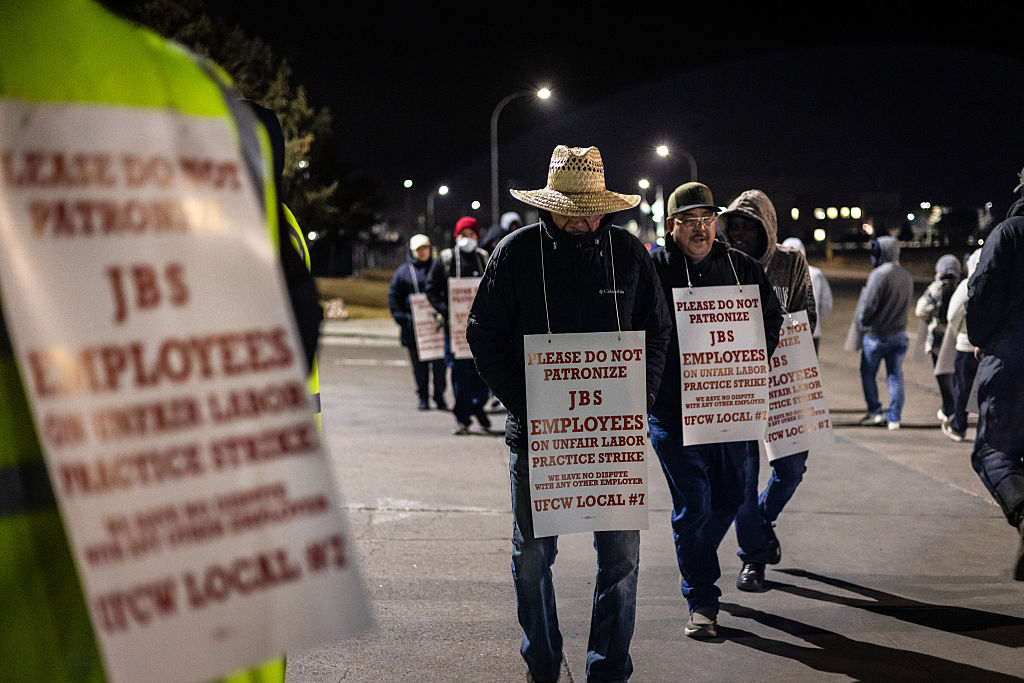
Roughly 3,800 members of United Food and Commercial Workers Local 7 are now on strike at one of the country’s largest meatpacking plants in Greeley, Colorado, after months of negotiations over wages, health insurance costs, and working conditions. (Chet Strange / Bloomberg via Getty Images)

When Deborah Rodarte arrives for her shift at the Swift Beef Co. plant outside Greeley, Colorado, owned by JBS USA, the first thing she does is gear up. Donning a hard hat and protective equipment, including a layer of metal mesh meant to keep knives from cutting through to the skin, she heads to the line and waits for the cattle to start coming down the chain.

Rodarte spends her shift trimming fat from cuts of beef as they move past her station. “It’s quick motion all day, every day,” she said. “One after another after another.” The job, she added, is hard on the body. “You’re trimming a piece of meat, taking all the fat, and when you’re done you throw it on top, and the next one is already there.”

Now Rodarte and roughly 3,800 of her coworkers — members of United Food and Commercial Workers (UFCW) Local 7 — are on strike after months of negotiations over wages, health insurance costs, and working conditions. It’s the largest strike in the meatpacking industry in decades, and the first ever at the Greeley plant, which accounts for around 5 percent of the US beef-processing capacity. JBS is the world’s largest meatpacking company.

The dispute at one of the largest meatpacking plants in the United States has been brewing since last summer, when the plant’s contract expired. Workers stayed on the job under a temporary extension while negotiations continued, but the union ended that extension earlier this month, clearing the way for a strike that could begin March 16. Union officials say the company has offered wage increases averaging less than 2 percent a year while shifting rising health insurance costs onto workers and continuing to charge employees as much as $1,100 for replacement protective equipment used on the job.

“Let’s say you’re been working for a year, and the PPE [personal protective equipment] has normal wear and tear,” explained Rodarte. “We have had them charge other employees for a brand new set of PPE when it should just be a trade-in.”

“While customers are paying more than they ever have, none of that is trickling down to the frontline worker that’s actually doing all the heavy work,” UFCW Local 7 president Kim Cordova told Reuters.

The strike comes just months after a major national contract covering roughly 26,000 JBS workers at fourteen US facilities, negotiated by the UFCW in 2025. The agreement included wage increases, paid sick leave, and a pension plan — the first new pension offered by a major meatpacking employer in nearly forty years — and was described by union leaders as a historic contract for workers in the industry. JBS officials say their current offer in Greeley reflects that agreement, but Local 7 says that workers at the Colorado plant already had some of those provisions and are being asked to accept less. The union also alleges the company has committed unfair labor practices (ULPs), including retaliating against workers by pressuring them to quit the union in one-on-one meetings. According to UFCW Local 7, workers voted 99 percent in favor of authorizing the ULP strike.

The dispute at the Greeley plant is a local fight. But it’s unfolding inside one of the most concentrated industries in the American economy. The modern American beef industry is extraordinarily concentrated: by 2019, the four largest meatpacking companies controlled about 85 percent of US steer and heifer slaughter. When production runs through a relatively small number of enormous plants owned by a handful of corporations, disruptions at one facility can ripple through the system.

As workers walk out in Greeley, production may halt at the largest meatpacking plant by volume in the United States. The company has already begun shifting cattle deliveries and production to other plants in anticipation of the possible work stoppage, which is likely to reverberate through an industry that was already at a seventy-five-year low in cattle inventory and has not seen a strike of this magnitude since the 1985 Hormel strike, which lasted more than a year and saw the National Guard deployed to protect scabs.

The Industry That Built Industrial Unionism

The industry didn’t always look like this. At the turn of the twentieth century, the slaughterhouses clustered around Chicago’s Union Stock Yards were among the most notoriously brutal workplaces in the country. At their peak in the early twentieth century, millions of cattle and hogs passed through the yards every year, moving through a dense network of pens, chutes, and slaughterhouses that supplied meat to much of the country.

Inside the plants, workers spent long shifts cutting, hauling, and processing animals at relentless speed, often on floors slick with blood and fat. Upton Sinclair’s 1906 novel The Jungle made those conditions famous, though Sinclair later joked he had aimed for readers’ hearts and instead “hit them in the stomach.” The book helped spark outrage over food safety, but it also captured defining characteristics of the labor itself: the pace, the danger, and the sense that workers were being used up as quickly as the animals moving down the line. The early struggles to build interracial solidarity in those plants were later dramatized in The Killing Floor, Bill Duke’s 1984 film depicting organizing drives among black migrants and immigrant workers in Chicago’s stockyards during World War I.

Those same workplaces later became a major site of industrial unionism. In the late 1930s and early ’40s, packinghouse workers across the Midwest organized under the Congress of Industrial Organizations (CIO). The effort culminated in the creation of the United Packinghouse Workers of America in 1943, which won higher wages and safer conditions — and pushed unusually hard, for the time, on racial equality inside the labor movement.

For a few decades, that organizing reshaped the industry. Meatpacking jobs were still dangerous, but union contracts made them comparatively stable industrial work that could support a family without a college degree. Decades later, the industry still revolved around enormous plants. What changed was where those plants were built and which corporations owned them.

How the Industry Was Remade

Beginning in the 1970s and accelerating in the 1980s, companies moved meatpacking plants away from union strongholds like Chicago and into smaller towns across the Great Plains and Mountain West. Today many of the country’s largest plants sit in places most Americans will never visit: towns in Colorado, Nebraska, Kansas, or Iowa where the plant dominates the local economy.

The shift helped companies weaken unions by relocating production to rural areas where labor markets were smaller and by increasingly recruiting immigrant workers who often had fewer protections and less job security. The Colorado Sun notes that as many as fifty-seven languages are spoken among workers at the Greeley plant, which has long recruited immigrants from countries including Somalia and Eritrea.

“We have people from all over the world,” Rodarte said. “Even when we don’t understand each other’s language, we try.”

Union officials say that diversity shapes the organizing at the plant too: many workers arrived in the United States through refugee or asylum programs and support families both in Colorado and in their home countries. UFCW Local 7’s Cordova said that companies in the industry have long counted on a workforce vulnerable enough to accept conditions other workers might refuse.

“We have never had a labor dispute at this plant,” Cordova, who was a union organizer when the plant workers first unionized in the early 1990s, told the Guardian. “The industry hasn’t had a labor dispute for a very long time, and it’s because they hire a very vulnerable workforce and the expectations are they keep their head down. They’re doing the work no one in this country wants to do.”

“Some people are scared, because we’ve never been through this before,” Rodarte said. “The emotions are everywhere, but people are ready.”

What those workers are confronting is not just a single employer but an entire industry organized around a handful of enormous companies. The industry that emerged from that restructuring is far more centralized. A handful of corporations — including JBS, Tyson Foods, Cargill, and National Beef — now dominate American beef processing, together controlling most US cattle slaughter.

The Work Is Still Brutal

Inside those plants, the work has changed little. Meatpacking jobs remain among the most dangerous in American manufacturing. One Government Accountability Office report found that injury and illness rates in meat and poultry plants consistently exceed the average for US manufacturing, with repetitive motion and fast line speeds driving high rates of musculoskeletal injuries. Workers spend hours repeating the same cutting motions, lifting heavy pieces of meat, and trying to keep up with production lines that move at a punishing pace.

In Life and Death of the American Worker: The Immigrants Taking on America’s Largest Meatpacking Company, journalist Alice Driver describes how the repetition of the labor can follow workers home. In her reporting on poultry plants, she recounts workers whose hands continued making the same cutting motions even in their sleep — the body replaying the labor long after the shift had ended.

The COVID-19 pandemic only added to the hazards. In April 2020, the Trump administration invoked the Defense Production Act to keep meatpacking plants operating even as outbreaks spread through facilities. Thousands of meatpacking workers were infected in the early months of the pandemic, and the sector recorded one of the highest workplace COVID death tolls in the country.

Rodarte said that faulty equipment contributes to hazards on the line. She recently injured her arm after being required to keep working with a dull knife for weeks.

“I was asking and asking for it to be replaced,” she claims. “They told us there were no knives.” After continuing to work with the dull blade, she says her arm became badly swollen, requiring repeated treatment from the plant’s in-house medical staff.

“When you go buy meat, think about who processed it and who cut it,” Rodarte said. “Our safety is on the line.”

The companies that run these plants wield enormous economic power — and increasingly political power as well. JBS subsidiary Pilgrim’s Pride, for example, made the largest single donation to the Trump–Vance inaugural committee. But the same system that concentrates that power in a handful of corporations also concentrates thousands of workers in the same place. In Greeley, roughly 3,800 of them are now preparing to test whether they can use that concentration to their advantage.