What the Conviction of Marielle Franco’s Killers Reveals
Socialist Rio de Janeiro city councilor Marielle Franco’s killers were recently convicted, exposing deep ties between Brazil’s right and violent militias. The case shows democratic institutions can still hold perpetrators of far-right violence to account.
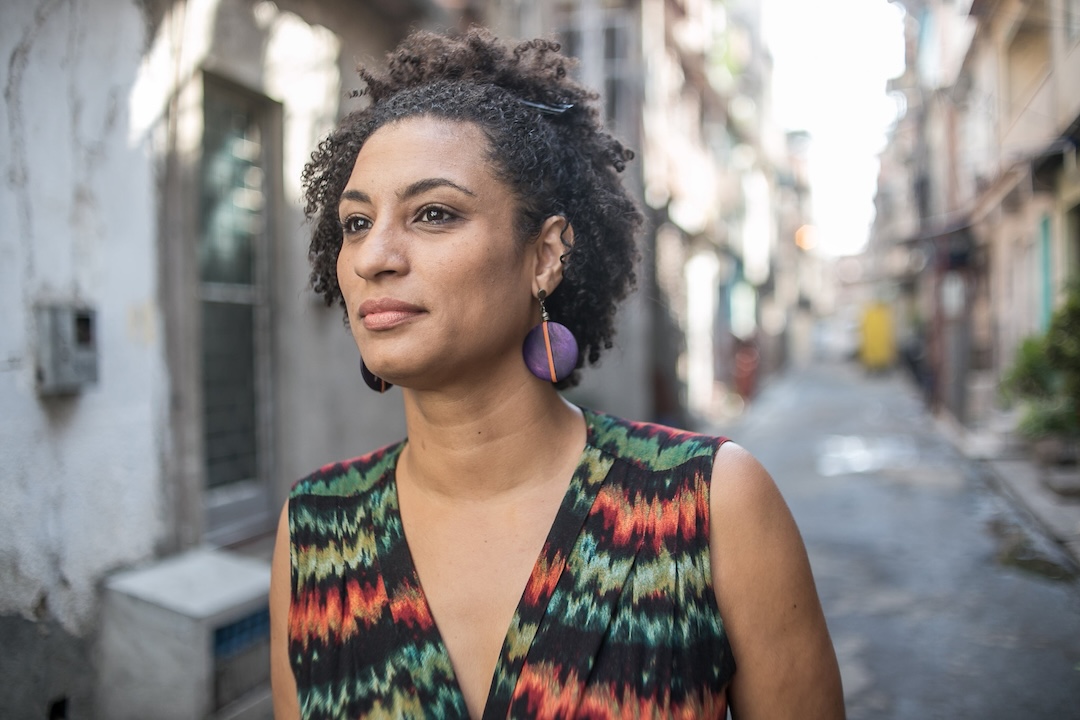
The 2018 assassination of socialist councilor Marielle Franco exposed the deep connections between Brazil’s far right and the criminal networks embedded in the state. (Mídia NINJA)
At around 9:30 p.m. on March 14, 2018, in central Rio de Janeiro, a silver Chevrolet Cobalt pulled up alongside a car carrying the city councilor Marielle Franco, her driver Anderson Gomes, and her press officer. Franco had just finished moderating a roundtable on black women and structural change and was heading home when the vehicle drew level and an assassin brandishing a submachine gun fired a precise burst of thirteen shots, striking Franco and Gomes multiple times and killing them before speeding away.
In a city accustomed to public bloodshed, the nature of the crime was, for many, immediately clear: this was not a robbery or a gang hit gone wrong but a political assassination. Franco, thirty-eight at the time of her death, had become one of the most prominent figures on the city council, representing the Socialism and Liberty Party (PSOL). An outspoken leftist and advocate for black, LGBTQ, and favela residents, she chaired the city’s Women’s Defense Commission and played an important role in monitoring and denouncing violent police raids, many of them ordered by the right-wing state government. She had grown up in the impoverished Maré favela, the daughter of parents who had arrived in the city with little and urged her to work hard. She took a job at age eleven to help support her family and later won a scholarship to attend university, where she wrote about the state’s policing policies.
Just as Franco’s rise embodied the promise of Brazil’s democracy, her death exposed its limits. She was killed because she had become one of the most visible opponents of Rio’s militias and one of the most forceful advocates for disenfranchised favela residents. More than arms smuggling, contract killings, or even drug trafficking, the militias — right-wing paramilitary mafias made up largely of former military men and police officers who claimed to fight crime — reaped enormous profits from illegal land-grabbing and property development in Rio’s favelas. Before her election, Franco had worked with state representative Marcelo Freixo on a parliamentary commission of inquiry into the militias, which led to the indictment of militiamen and militia-aligned politicians. Franco represented everything the right wing detested: a relentless socialist willing to expose corrupt officials, she posed a genuine material threat.