What Universal Childcare Should Look Like

Josh Wallack

A universal childcare policy that ensures adequate care for all families will not means test or rely only on vouchers to subsidize private providers. It should be free for all, with government taking direct responsibility for providing childcare seats.
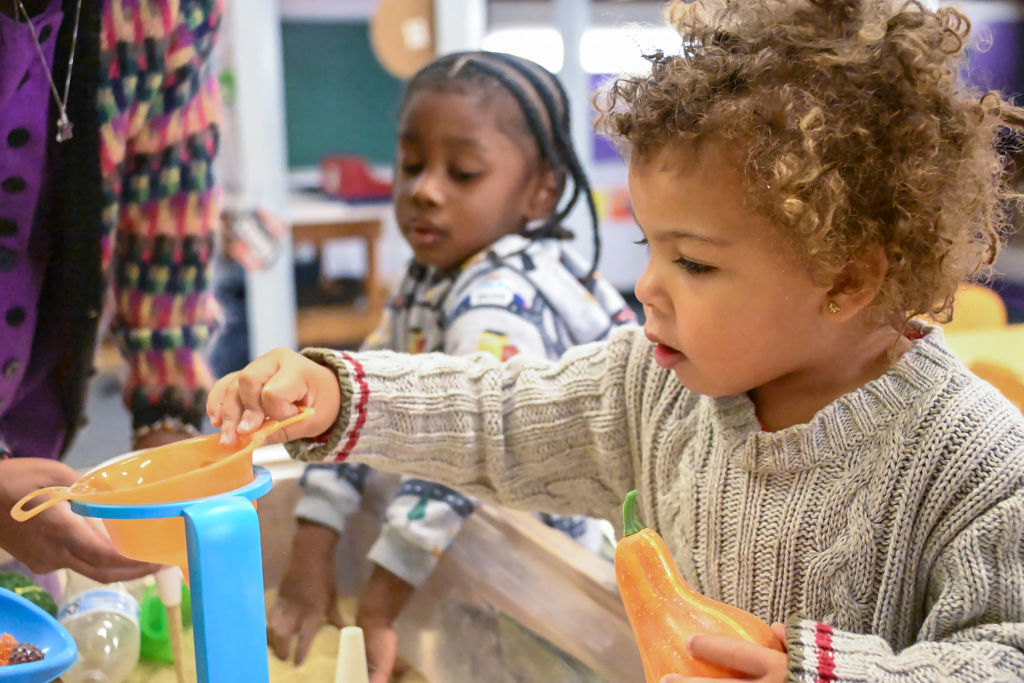
Community-based and home-based providers currently provide most of the care for infants and toddlers in New York City. (Kevin Richardson / the Baltimore Sun / Tribune News Service via Getty Images)

Interview by
Nathan Gusdorf

Earlier this month, Mayor Zohran Mamdani and Governor Kathy Hochul unveiled the initial stages of a plan for universal childcare. To discuss the recent history of childcare policy in New York City, and the lessons it may hold for the Mamdani administration, Nathan Gusdorf spoke with Josh Wallack, an early childhood policy expert who served as legislative director to then New York City Council member Bill de Blasio from 2002 to 2006 and later as the city’s deputy chancellor for early childhood, where he helped implement de Blasio’s signature “Pre-K for All” program.

In the following interview, edited for length and clarity, Gusdorf and Wallack discuss the meaning of “universal childcare,” why merely providing vouchers is insufficient to ensure that every family has access to high quality childcare, the importance of home-based providers, and the significance of the Hochul-Mamdani childcare agenda.


Nathan Gusdorf

Thank you for doing this. When you were de Blasio’s legislative director in the City Council in the mid-2000s, were people thinking about universal childcare?

Josh Wallack

Universal childcare was considered to be the longest of long shots and maybe beyond the horizon. Instead, the discussion focused on improving access for the lowest-income New Yorkers. At the federal level, we were still in the throes of the discussions about welfare reform, so childcare was seen mostly as a support for low-income working people to help them stay in the labor force. We tried to shift that discussion in the City Council toward universal childcare, but that was very much a new way of talking about it.

Nathan Gusdorf

Fast forward a decade to de Blasio’s time as mayor. How did the universal pre-K initiative become a priority and a successful project of his administration?

Josh Wallack

He settled on it as a major priority of his campaign early on in 2013. The premise of his campaign was that New York was a “tale of two cities,” and free prekindergarten was critical for the education and development of our youngest learners but also key to addressing the profound inequalities of our city, where some families could afford high-quality prekindergarten and others were left out.

Nathan Gusdorf

Considering that the policy was motivated by concerns about inequality, was there a debate about doing it more as a welfare program rather than as a universal program? How did de Blasio settle on the strong commitment to universality?

Josh Wallack

As far as I know, he never entertained making this a targeted program. He always framed it as a universal program. And I think part of that was Bill de Blasio’s orientation. Substantively, he felt that one program and a unified set of services sent the signal that we were all in it together. And practically, he felt it would prove more politically sustainable if it served everybody and brought together a unified constituency, which I think turned out to be right.

Nathan Gusdorf

Was it always clear that Universal Pre-K would go through the schools? Or was there a decision that had to be made about whether to subsidize private providers instead?

Josh Wallack

Well, he believed that it should be a mix. And he committed pretty quickly to providing about half of the program through the school system and half through the amazing network of community-based organizations that were already providing high-quality prekindergarten to many families. Now, he could have chosen a different agency to implement it, but he saw prekindergarten as part of a school system. The public schools were already universal; he felt that they were a part of the city government that everyone identified as being a common enterprise.

Nathan Gusdorf

Does it make sense to continue using the school system for extending childcare to younger children, down to infancy?

Josh Wallack

If you’re thinking about care for infants and toddlers, you could ask the question: Is this properly thought of as part of our educational system? I would say that since learning begins at birth, if you have an agency that’s devoted to education and learning, there’s no reason why it couldn’t be doing that for the youngest kids.

That said, community-based and home-based providers currently provide most of the care for infants and toddlers in New York City, and there is no reason that needs to change — the school system can partner with them as it does for 3-K.

A second answer to your question has more to do with the political economy of an administration and where a program can get financial resources and management attention. In that light, I would argue that care for infants and toddlers belongs in a new agency. There are specific needs and concerns that families with the youngest children have and it makes sense to have a management team that wakes up every day concerned with delivering the best services to our youngest learners.

It’s challenging for either of the agencies that currently take this on to sustain it. You have an education agency that has a lot to do to serve kids from kindergarten through high school, and a child welfare agency that runs one of the most complicated child welfare operations in the country. That’s why you’ve seen so many states put childcare into a new agency, and more cities are doing that as well.

Nathan Gusdorf

Today everybody seems to be talking about “universal childcare.” But it seems like people mean different things by that term. How would you describe the range of possibilities that are currently imagined by people who talk about universal childcare?

Josh Wallack

I think when people talk about universal childcare, what they mean can vary on a few different dimensions.
First, how is it provided? Is it provided through a market-based intervention like a tax credit or voucher that enables families to go out into the market, so to speak, to purchase childcare on their own — or is it a supply-side intervention where government takes an active role in creating new childcare seats and provides those either directly or through contracts with third parties to families?

Second, who is providing it? In some cases, public schools do; in other cases, not-for-profit community-based organizations. We also have private businesses providing childcare as well as home-based providers, which can be either not-for-profit or for-profit.

The third dimension is: Who is helped? Some people believe that we should just provide subsidies for the lowest-income families, on the theory that people who have enough money to purchase childcare themselves will — and so by giving some help to lower-income families you’ll get to universality. Some people mean what Mayor Mamdani means: provision for all, like public schools, as a way to achieve universal coverage.

Within that issue of “who is helped,” there is the question of how much help is actually provided — is it free or just subsidized? We’ve seen some federal plans for universal childcare that say things like, “No one will pay more than X percent of their income.” So it will be public, everyone will receive some assistance, but it will be different amounts for different families and not completely free.

Finally, within a program that’s universal, is there targeting for students with disabilities and those who require different services or are you providing exactly the same thing for every child no matter what?

Nathan Gusdorf

Do you think it’s important for childcare to be free in the way that public schools are free? Would it make sense to charge a small fee, or, as some federal proposals have done, cap it as a certain share of your income?

Josh Wallack

Watching the way the issue resonated for New Yorkers twice now should instruct the way we approach it. We saw two mayoral campaigns succeed on a message of free care for all in a city with a politically diverse set of constituencies. When we start to talk about policies in less clear ways — when we talk about percentages of income and qualifications, any sort of means-testing, where we’re dividing one group from another or asking people to calculate whether they’ll qualify — we lose an enormous amount of support. We need to be very clear that we want to provide this the way we provide public school, and that means that it’s free for all.

The opposing view would like to adopt as small of a market intervention as possible, seemingly in an effort to win support from political moderates. I think that’s the wrong way to look at it — and it has not succeeded in winning over enough moderates to support making childcare affordable for everyone.

So I think we need to view childcare as a right and as part of the public realm that is shared by everybody. This goes back to the history of public schools themselves, which were fought for during Reconstruction. It’s part of the fight to make sure that this country offers what everybody needs to live a dignified life. That’s the way the mayor’s talked about it, and that’s exactly the right way to look at this issue.

Nathan Gusdorf

Given that we have a landscape that includes private providers, what are the policy stakes of giving people vouchers versus directly contracting and providing seats through the city?

Josh Wallack

When we rely on vouchers mainly to solve the problem, we’re not able to ensure that every family will be able to find a high-quality program close to them that works for their child. The theory that if we just subsidize the income of families, the market will sort out the rest has not proven true. That’s why you continue to see huge waiting lists for vouchers, childcare “deserts” where there are not enough seats for kids that need them, and high-quality providers with empty seats. If this mechanism was going to work, it would have worked by now.

Instead, this policy area requires direct support, where the municipal government steps in and takes responsibility for making sure that every family has a seat that meets their needs. Local government must communicate with families and have the ability to adjust the location of seats. This is the system that finally worked for Pre-K for All. And that’s the approach that we need to replicate.

Nathan Gusdorf

Is there a difference in the level of government influence or regulation that comes along with the city directly providing seats as opposed to providing vouchers?

Josh Wallack

As we were implementing the Pre-K for All, we wanted to ensure that every family would get a free, full-day, high-quality seat. So we were in constant communication with families to make sure that we were living up to our promise. “High quality” meant that we did a lot to ensure that all providers had the support that they needed to create excellent developmental experiences for kids; it meant we developed curriculum support in collaboration with educators in our system.

Coaches visited every program and met program leaders and teachers to offer them professional learning. Excellent social workers worked with families and kids to make sure children were developing socially and emotionally. We knew that because this was a publicly provided service, the city was responsible for assuring the quality level.

I think that when you take a demand-based approach and you issue the vouchers, you’re buying into the logic that the market will “punish those that don’t provide high-quality service” and that “people will vote with their feet.” That approach was never consistent with our values, but I also think that it does not bear out. We were only able to provide that assurance of quality when the public sector showed its willingness to step in.

Nathan Gusdorf

Given what the governor and the mayor have announced, where are we? What do you think has been accomplished? What remains to be done?

Josh Wallack

It’s hard to overstate what a significant step forward this was, with the governor and mayor announcing that the state would expand pre-K throughout New York State, begin the process of implementing 3-K throughout New York State, support the city’s efforts to fix 3-K, begin the implementation of what we call “2-Care,” and also support the mayor’s vision of universal childcare.

We should keep in mind that the New York State legislature made a commitment in 1997 to universal prekindergarten, but we never saw that fully implemented because nobody attended to the politics of implementation. So far, this administration is attending to that, and that’s so hopeful.

By the politics of implementation, I mean that the mayor and his team recognize the need for continued work to advance the goal. You need to design the implementation so that at each stage it shows people what is possible. For example, as they roll out 2-Care, rather than starting with means-testing people and echoing some of the failed approaches of the past, they will target areas of the city where the need is greatest and give it to everybody, so that everyone can see what care with a public universal approach looks and feels like.

Nathan Gusdorf

How does this differ from de Blasio’s roll out of universal pre-K? Are there certain lessons learned about what to do or what not to do?

Josh Wallack

It’s going to look different in a few really important ways. The first and most important is that home-based providers will be at the very center of this implementation. We know that there is a tremendous opportunity to partner with home-based providers on this, and they are, in many cases, already providing really high-quality services to our youngest kids. Under the de Blasio administration, we made the mistake of leaving home-based providers out of the implementation of pre-K.

The second difference is that we did not pay enough attention to the needs of students facing delays and disabilities. The system for what we call prekindergarten special education was largely run by the state. Rather than trying to take on more of it, we left it alone. I think that this administration intends to address the entire continuum of services for students with disabilities and delays from birth to age five, under the rubric of universal care.

Nathan Gusdorf

Why were home-base providers left out of the implementation of Universal Pre-K?

Josh Wallack

There are a couple reasons, some more legitimate than others. There was a bias against believing that home-based care could be really high quality. That was a mistake. The field has evolved in the past fifteen years to update views on that, largely because of the hard work and advocacy of talented home-based providers.

There are also administrative difficulties with a system that features home-based providers, because they serve fewer kids per site than a childcare center does. A center may have four classrooms with pre-K serving eighty kids. A home-based provider will typically have six to twelve kids, depending on their size, who are a mix of ages. So you wind up with many, many more sites in a system that incorporates home-based providers, making it more difficult to administer all of the services that you want to provide. I think that that can be tackled. But it was daunting, as we were rolling out Pre-K for All, to figure out how to incorporate this set of providers.

Nathan Gusdorf

One final question: When de Blasio initially proposed universal pre-K, he wanted to fund it with a tax on the rich. Ultimately, however, he wound up with Universal Pre-K but without the tax on the rich. Do you think that can happen again?

Josh Wallack

The simple answer is that, ultimately, we need a permanent, sustainable progressive revenue source for universal childcare. It was possible to get Pre-K for All, and most of 3-K for All, up and running through a commitment from the city and state and federal support to fund it. But under the [Eric] Adams administration, those programs, despite their popularity, were vulnerable to cuts. We need a specific, sustainable revenue source to support these programs if they’re going to be sustainable. Otherwise, they will stay vulnerable.