Jesse Jackson Paved the Way for a New US Left
With his two unabashedly left-populist campaigns for president in 1984 and 1988, Jesse Jackson opened the door to Bernie Sanders’s presidential runs — and a reborn American socialist movement.
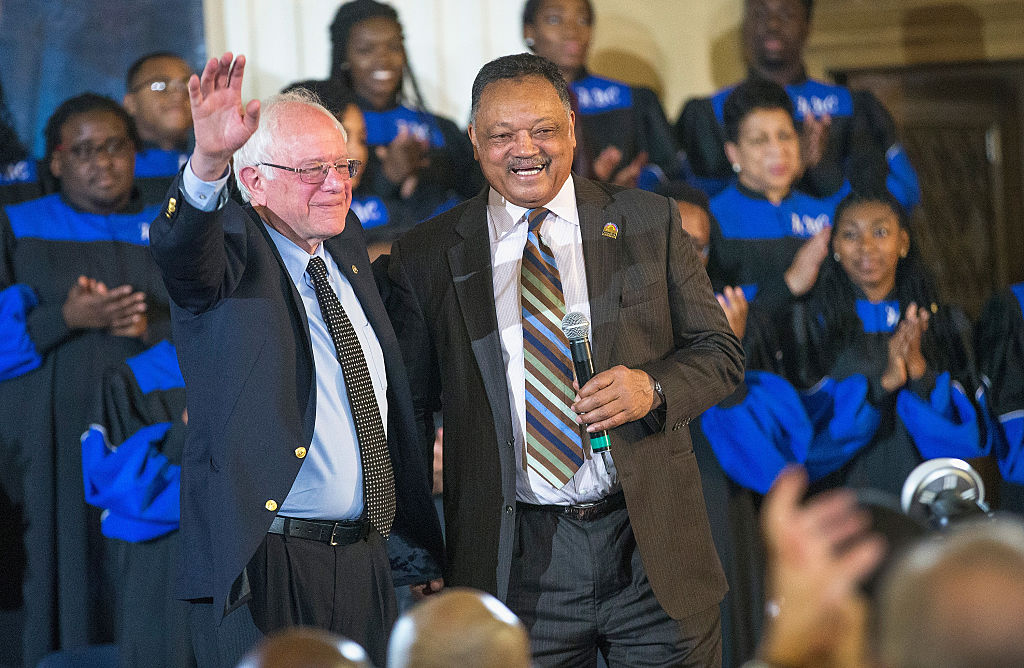
A renewed American left grew in the wake of Bernie Sanders’s two presidential campaign. And those two Sanders presidential campaigns owed a great deal to Jesse Jackson. (Scott Olson / Getty Images)
The Reverend Jesse Jackson passed away this week at the age of eighty-four years old. A national figure and leader in civil rights, international diplomacy, and the Democratic Party, he occupied a space few could in US politics.
While much less prominent in his final years as illness took him away from the spotlight, Jackson’s influence is felt today in many ways. One major impact is how left-wing challenges in Democratic Party presidential primaries with a socialist influence or character have grown over the past four decades.
Jackson was a major presidential candidate in the Democratic primaries in 1984 and 1988, winning over 1,200 delegates in his final race — over triple what he had in the first campaign. But his legacy was defined less in quantifiable delegate counts than in qualitative success, in showing how multiracial politics could advance economic justice.
Jackson’s left-wing economic views attracted supporters, especially among socialists, including a range of anti-capitalists like current and former Maoists, members of the Democratic Socialists of America (DSA), and the then-independent-mayor of Burlington, Vermont, Bernie Sanders.
While even the most progressive Democratic presidential candidates do not typically receive significant socialist backing, DSA’s shift on Jackson was a harbinger for broader political movements. DSA declined to back any candidate in the Democratic primary in 1984 — which was notable after one of its predecessors, the Democratic Socialist Organizing Committee, had gone all in for US senator Ted Kennedy’s primary challenge to President Jimmy Carter.
DSA went from neutral on Jackson in 1984 to enthusiasts in 1988. This transformation went noticed in the New York Times, which highlighted Jackson’s embrace of the socialist group’s endorsement and his collaborations with its then-cochair Michael Harrington.
DSA’s move reflected how both it and Jackson adapted over the two campaigns, which had broader implications. Jackson was able to build a wider coalition by his second campaign, transforming himself beyond being viewed as a leader in black America into someone who could bring together labor, rural white farmers, leftists, peace activists, organizations of color, and more — a mosaic of US peoples and their collectives.
This grouping, according to Jacobin founding editor Bhaskar Sunkara, “looked, more than anything else in US political life, like a genuine social democratic bloc.” The “Rainbow Coalition” represented some of the best progressive politics in the last quarter of the twentieth century. This framework was able to elect David Dinkins, then a DSA member, as New York City’s first black mayor.
None of this is to say this strategy was without flaws. Jackson’s Rainbow/PUSH Coalition did not become a mass and democratic organization. Dinkins’s mayoralty only lasted one-term. But they did show that a multiracial working-class movement was possible and could lead to real victories in high office.
As Sanders noted in a 2024 commemoration of Jackson’s legacy, during his presidential runs Jackson alone as a White House hopeful then was articulating in places like Iowa that “corporate forces that were destroying family-based agriculture for white farmers in Iowa were the exact same people exploiting black and Latino workers.”
This anti-corporate agenda, years before NAFTA and other free-trade agreements would further destroy working-class communities and small farmers, helped pave a way for candidates like Sanders by 2016, who could clearly run on policy failures that Jackson tried to prevent. Jackson also returned Bernie’s endorsements over two decades later when the former mayor, now US senator, ran for president in 2020.
In times of a rising populist far right, Jackson’s legacy serves as a reminder to the Left here and abroad that socialists and left-populists should work together, to build a society where hope is not just kept alive, as Jackson was wont to say, but embedded into the fabric of its laws and practices.