When Protesters Shut Down the World Trade Organization
The new documentary WTO/99 reconstructs the 1999 protests against a global neoliberal trade order, the violent police repression, and the hope for a different world that found vibrant expression on the streets of Seattle.
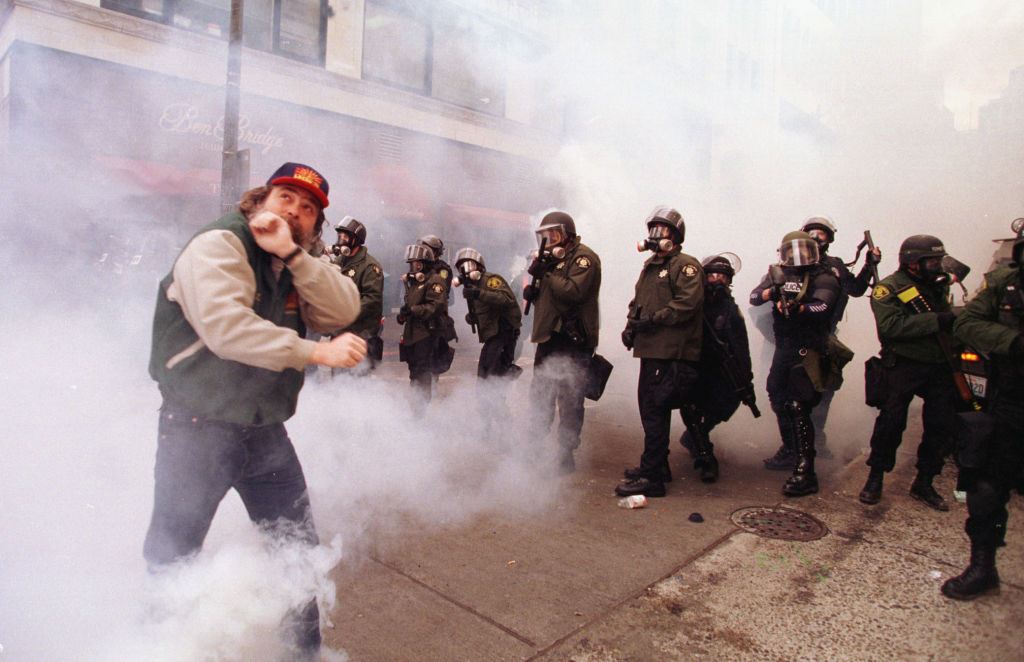
Tear gas is thrown at a demonstrator who had come to march with the unions against the WTO in Seattle, WA. (Sion Touhig / Sygma via Getty Images)
WTO/99 opens not with chaos but with assurances. Protesters against the World Trade Organization (WTO) — the body countries turned to when they wanted to challenge another nation’s labor or environmental protections as “barriers to trade” and the institutional muscle behind the era of plant closures, offshoring, and supply chains that could leap borders, leaving workers behind and pollution, deforestation, and deregulation in their wake — travel to Seattle in late November 1999, discussing their plans for the week ahead and their hope that, despite the scale of what’s coming, the police will not overreact. Seattle police officials, interviewed on local news channels, echo that confidence. They say they are prepared and stress their support for people’s right to express their views for the first time the WTO has met on US soil.
The calm will not last. And the film makes clear from the beginning that what follows is not simply a story of a city losing control of its streets. It’s a story about the enforcement mechanisms that backstop the “inevitable” order of capitalist globalization that protesters are in Seattle to oppose — and how quickly those mechanisms appear once that order is disrupted.
What distinguishes WTO/99 from the long tail of “Battle in Seattle” retrospectives is its refusal to turn Seattle 1999 into a founding myth or a morality play. The film isn’t especially interested in deciding whether the protests “worked.” Instead, it reconstructs what happened — in rooms populated by activists, political leaders, and police, and on Seattle’s streets, allowing meaning to emerge as events unfold.
The documentary is composed entirely of archival footage, letting those images do the editorializing. This was a pre-smartphone era, before the constant circulation of protest footage made images of police escalation familiar. Today, on city streets patrolled by Immigration and Customs Enforcement and elsewhere, chemical agents and indiscriminate arrests can feel like a grim genre convention. In WTO/99, they still register as escalation — not because state violence is new, but because the public documentation of it is less routine, and the insistence on law enforcement restraint is still spoken by authorities with a straight face to local broadcasters.
Early interviews establish the political terrain. Bernie Sanders appears near the beginning, warning that “the American people are increasingly alienated” and framing the WTO as a question of sovereignty — who decides the rules governing work, trade, and the environment. Moments later, the film cuts to cable news footage of right-wing gadfly Roger Stone, identified by chyron as a member of Donald Trump’s presidential exploratory committee. Even in 1999, the critique of globalization was already breaking through, and the political fight over who would capture that anger — and to what end — was underway.
Then the camera leaves the pundits and drops into the street. Protesters lock themselves down with concrete containers, steel pipes linking their arms, slowing police attempts to clear the obstruction. A reporter crouches beside a demonstrator lying prone on the pavement and asks whether the contraption hurts. “Not really,” the protester replies calmly. It’s a moment of faint absurdity before the city’s response arrives — police advancing with pepper spray and tear gas — making clear how seriously the authorities take the interruption.
By midmorning on November 30, the WTO’s opening ceremony is postponed. At 10 a.m. an AFL-CIO rally is underway. Edward Fire of the International Union of Electrical Workers notes that General Electric has eliminated a hundred thousand jobs in the United States as it moved operations abroad. Another labor leader, Neil Kearney of the International Textile, Garment and Leather Workers’ Federation, describes children hammering rivets into jeans for export and others making toys for Western markets as “the real face of globalization.” A speaker from the Barbados Workers’ Union Federation emphasizes that these trade regimes bind workers across borders, whether they consent or not.

The crowds swell as some fifty thousand people converge in Seattle. The “Teamsters and Turtles” — shorthand for the unlikely sight of unionized truck drivers marching alongside environmentalists in papier-mâché sea turtle shells — are all in the streets. In a brief stretch of downtown Seattle, dockworkers, students, and climate activists move in the same direction. It’s a momentary alignment, formed around a shared target, not a shared program.
Police pepper-spray protesters directly in the face. Tear gas fills downtown streets. Jerry Jasinowski of the National Association of Manufacturers complains on camera that “it was chaos in the streets,” adding that he was struck by how “loopy” some of the protesters seemed. By noon twenty-five thousand union members and students march together; an ILWU Local 13 bomber jacket flashes past the lens. An older union member mutters that there are “too many yuppies who don’t give a shit about any of this,” before concluding that what’s needed is revolution.
The film cuts between street-level violence and elite incredulity. A US Chamber of Commerce representative expresses disbelief that unions would oppose free trade, insisting that globalization has helped labor. Michael Moore, filmed amid the crush, argues that the real violence is taking place inside corporations — Exxon, Microsoft, Monsanto — “all the other greedy bastards.” Another protester puts it simply: corporations want people to believe there is no alternative. “I don’t want to believe that.”

By mid-afternoon, Seattle police run out of pepper spray and begin sourcing it from local departments and corrections facilities. At 3:15 p.m. President Bill Clinton’s administration warns Seattle mayor Paul Schell that if the protests are not cleared from downtown, the WTO conference may be called off. A bonfire burns in the middle of an intersection. A foreign correspondent remarks that “on the periphery is a riot.”
Amy Goodman of Democracy Now!, reporting live, tries to determine what police are firing: are chemical agents and rubber bullets being used together? Police leadership refuses to say. “We’re using nonlethal weapons,” one official insists, over footage of people describing being struck in the eye or chest.
The mayor asks for understanding, defensively noting that his administration includes people who marched in the 1960s. Ralph Nader appears later, arguing that trade agreements reverse decades of progress by subordinating workers’ and environmental rights to profit.

Day two brings escalation. Clinton arrives in Seattle at 1:30 a.m. Two hundred National Guard members and three hundred Washington State Troopers deploy across the city. By 8 a.m. the mayor bans protest in a fifty-block area of the central business district. Gas masks are banned. Speaking at the port, President Clinton quotes Machiavelli: “There is nothing so difficult in human affairs as to change the order of things.”
Steelworkers rally that afternoon. “We’re seeing what the new corporate order is about,” one speaker says. “People can’t stand up and say no.” Arrests climb into the hundreds and reporters note the absence of vandalism even as people continue to be sprayed and beaten. A California farmer says he is shocked by the police violence.
That evening, the NO WTO Combo — featuring members of the Dead Kennedys, Nirvana, Soundgarden, and Sweet 75 — play a one-time concert at the Showbox. Elsewhere, battles rage in the streets. Residents lean out of windows asking “Why?” as police weapons fire continues into the early morning hours.
Yet the WTO meeting concludes as scheduled on December 2. The institution is not defeated; the global trade order remains intact. The protests accomplished interruption, not collapse. That is not nothing in a capitalist order that insists there is no alternative.
After reviewing hundreds of eyewitness accounts, the American Civil Liberties Union of Washington concluded that the police response was “out of control,” and that protesters did not constitute a riot justifying the force used against them. Police departments, for their part, treated Seattle as a lesson. The Police Executive Research Forum would later describe Seattle as a turning point that “changed all that” for protest policing, explicitly framing it as a pre-9/11 baseline for a more aggressive, security-oriented model of crowd control.
The documentary widens its frame at the end. Seattle becomes a reference point as we see protests in the following year against the International Monetary Fund in Prague, against the World Bank in Washington, DC, and at the Democratic National Convention in Los Angeles. The same choreography repeats: crowds, batons, chaos. Then September 11 arrives. The protests’ momentum slows, swallowed up in a wave of patriotic fervor that would help justify the War on Terror and export a new regime of surveillance, discipline, and violence around the globe.
The order the protesters challenged in Seattle has not remained static. Clinton-era faith in frictionless free trade has given way to tariffs, trade wars, industrial policy, and open rivalry between major powers. Politicians no longer speak of free trade as an unquestioned good.
Yet global supply chains still stretch across continents, with capital moving more freely than workers. Environmental breakdown has accelerated. The system still runs on ruthless accumulation of profit, regardless of its consequences for people and the planet.
WTO/99’s final word belongs to a resident testifying at a Seattle City Council hearing held after the meetings conclude. Injured protesters describe broken bones and detentions. One speaker shrugs off the language of victory and defeat alike. “I don’t think this is going anywhere,” they say. “But we’re not going anywhere either.”